A journal for industry and audiences covering the past, present, and future of the musical stage.
Immersive theatre is not new. Black America (1895), for instance, transformed Brooklyn’s Ambrose Park into a sprawling southern plantation through which patrons could meander before partaking in the formal entertainment. It had cotton fields, log cabins, and “real southern darkies,” and it was presented at Madison Square Garden later the same year.
Meanwhile, Earl Carroll Vanities emerged as an early leader in immersion on the legitimate Broadway stage. This iconic series of revues, produced by Earl Carroll and launched in 1923, is perhaps best remembered for its use of naked women. But, it remains perhaps best characterized by its explosive combination of comedy and vaudeville and its unique environmental touch.
The fourth edition, in particular, opened on December 28, 1925 and found the Earl Carroll Theatre outfitted and operated like a Broadway nightclub. (Most nightclubs between the 1910s and 1940s were theatrical in nature, and many presented original floor shows and revues.) In transforming the legitimate playhouse into an immersive playing space, Carroll had the theatre’s existing stage extended several feet into the house and replaced what would have been the first few rows of orchestra seats with cabaret tables. He moved the musicians up to the side boxes and had the auditorium decorated with “lamps,” “festoons,” and “plumages.” Hostesses greeted the customers upon their arrival. Usherettes escorted them to their seats and later sang “This is a Night Club.” Waiters sang “We Are the Waiters.” Ginger ale was served in the aisles. A fake chef and a female culinary department were introduced. The audience was invited to dance on the stage before the show and during intermission. And the entire company sang “Shake Yourself Out of Here” at the end of the evening.
Billed as “An Utterly Unique and Different Form of Amusement,” this fourth edition of Earl Carroll Vanities had a large cast led by comedians Joe Cook, Frank Tinney, and Julius Tannen, who served as master of ceremonies. It played 30 weeks on Broadway – and was actually an extension of the popular third edition, which had opened on July 6, 1925 and closed on December 26, 1925 with many of the same features.
The fifth edition, which opened on August 24, 1926, transformed the Earl Carroll Theatre into a Spanish courtyard. The elaborate remodel reportedly cost upwards of $20,000, and the top ticket price for the premiere was $100. (A current value of approx. $1,700.) The auditorium featured practical balconies, arched doorways, and stucco walls mounted on sheet iron. Gypsies escorted the customers to their seats. Fortune Tellers told them their future. An elevator, in one instance, raised the orchestra pit, adorned with scenery and girls, to the height of the balcony. The first act culminated with a scene made of Mosaic Glass. And the second culminated with a “Curtain of Perfume” composed of “Olor de la Noche, Fragrance of the Night, the creation of Raquel, Inc.” The revue, dressed up like a Spanish garden party, had a cast led by Florence Brady, Smith and Dale, and Julius Tannen, who again served as master of ceremonies. It featured a popular interpolation by Black songwriters Henry Creamer and Jimmy Johnson, and the original score was penned primarily by Grace Henry and Morris Hamilton.
“There can be no question,” the Herald Tribune reported, “that [Earl Carroll] has a unique talent for creating an atmosphere of intimacy between the audience and the stage.” He had not, however, any real feeling for either composition or theatricality. And, while an immersive playing space can certainly prove more physically intimate than a proscenium setting, it is not inherently more immediate or theatrical, nor is it inherently more intimate emotionally, psychologically, or intellectually.
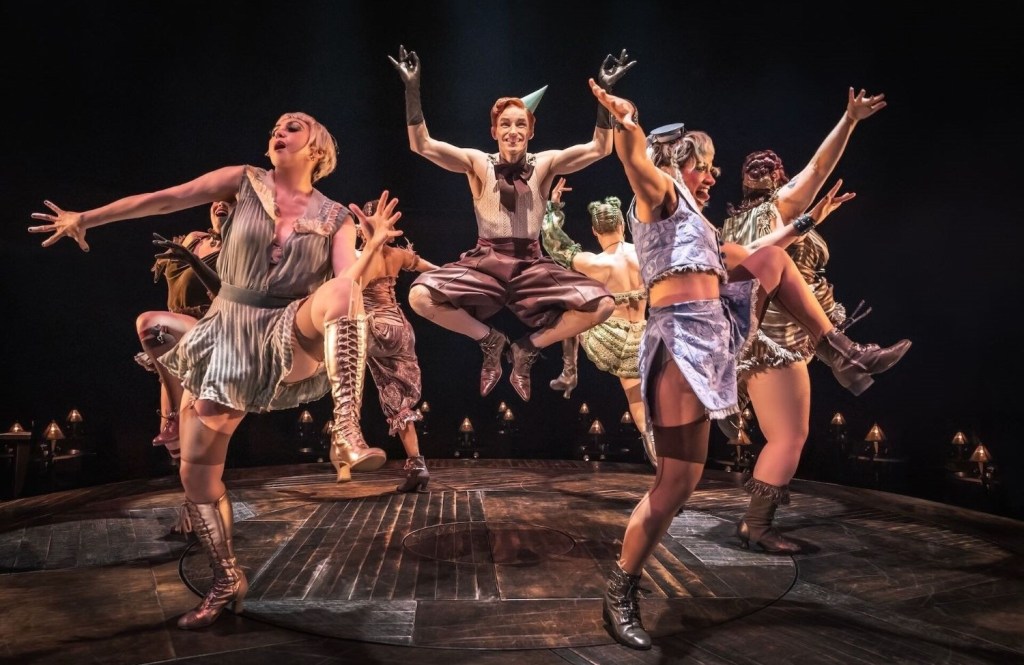
Photo of a scene from the 2024 revival of Cabaret by Marc Brenner.












 The Musical Theatre Report
Leave a comment