A journal for industry and audiences covering the past, present, and future of the musical stage.
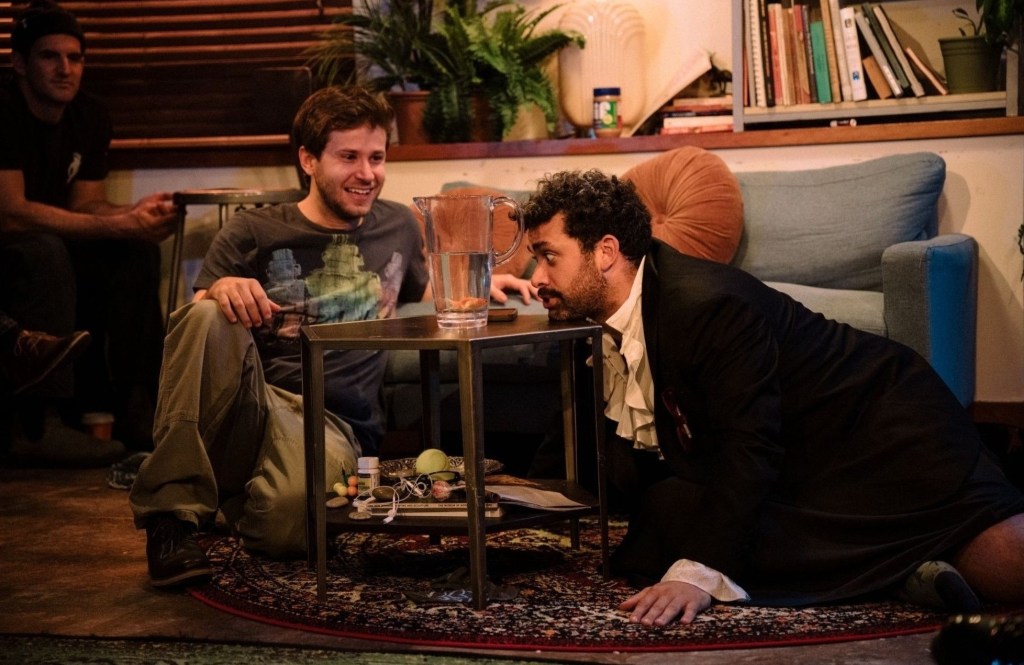
Soon, a new musical by Nick Blaemire, is currently playing a two-week engagement at New York’s East Village Basement. It is an incredibly strong piece of theatre, with some terrific, idiosyncratic writing and glorious wafts of humanity, but the production, directed by Will Blum, is unsatisfactory.
The musical, which runs roughly 90 minutes, centers around a young woman, Charlie, who refuses to leave her Lower East Side apartment due to the imminent end of the world, incessantly watching the news and occasionally talking to her goldfish, Herschel. Steven is her gay best friend and roommate: over-the-top and supportive. Adrienne is her lush of a mother who lives in Connecticut. And Jonah is Charlie’s new boyfriend. Charlie and Jonah meet, toward the top of the show, when Jonah delivers Steven’s groceries, and the two court, over the course of several months, strictly within the confines of Charlie and Steven’s apartment. Steven bonds with Jonah. Charlie speaks on the phone with Adrienne. Adrienne visits Charlie. Charlie recalls speaking on the phone with her doctor. And an eleventh-hour revelation alters the circumstances of the story – which has little to do with apocalyptic climate change.
Though the intimate affair has only four characters and a thin shred of plot, it is emotionally, intellectually, and dramatically expansive, and it bubbles with theatricality. Blaemire is a great writer, with a respect for the musical stage and a modestly individual voice, and he seems to have a special knack for crafting enlivening, offbeat stage stories driven by an exploration of character, relationships, mortality, and human connection. He seems to have a special knack, as well, for crafting juicy, playful dialogue, rooted in story and character, and attention-grabbing entrance lines that launch or lift the respective scene and support the narrative composition.
And Soon has an exciting, minorly complex narrative composition involving full scenes, interwoven news footage, a fantastical episode, an exterior interlude, a telephone monologue, and a pair of split-stage scenes. But the composition has a deficiency of crispness, which is exacerbated in the current production by the manner in which the material is being executed, and the news footage has not been fully or effectively woven into the proceedings, with its use during the first 15 minutes of the show proving particularly choppy. (The monotonous voiceovers recorded by Scott Stangland, as Wolf Blitzer, do not help.)
The structure of the story is quite sound, and Blaemire has chosen, happily, to forego the use of song for Charlie and Jonah’s meet-cute, which has a great false exit, and to deploy Adrienne thrice, with her third appearance shrewdly echoing her first. The characters are complicated, flesh-and-blood human beings, with a certain emotional fragility underpinning their comic quirks. (Charlie is perhaps the least finely etched of the four.) Most of the scenes, including those with song, unfold organically and propulsively, with a quiet dramatic tension sustained almost throughout the show. Most of the scenes crackle, with several generating fireworks in their kinetic combination of personalities ricocheting off one another in a seemingly spontaneous manner, in a moderately individual playground. And the movement between dialogue and song is mostly seamless.
Blaemire has penned, for the musical, a strong theatrical score, similarly rooted in story and character, that is composed of an array of musical styles and active, revealing lyrics, sometimes forced, which steadily develop and provide much to play. But false rhymes creep in from time to time and call unwanted attention to themselves, and Blaemire seems to have a relative weakness in the way of mechanics – which can be similarly felt in the narrative composition.
“Bohemia Paradiso,” for instance, is a flavorful, fabulously seductive solo, with a pointed purpose, in which Adrienne recalls her younger days living in New York City. But Blaemire has failed to give the song a definitive ending, and he has provided no dramatic reason for Steven and Charlie to join in the chorus. (Adrienne has also been given an exhilarating jazz waltz, ironically titled “How Are You?”) “Avoid the Apocalypse,” meanwhile, is a nearly fine number in which Steven attempts to get Charlie to go with him to the Hamptons. But Blaemire has provided no dramatic reason for Charlie to join in the chorus. Plus, the ramp-up into song is labored, and the brief bit of dialogue that follows the number should have been inserted into the end of the number, as interstitial dialogue, because it is currently causing a double beat and leaving the scene with a limp finish.
“Waiting” is a well-routined indie-guitar solo, for Jonah, with a restlessness and a neat melodic motif on the title line. But, like other items, it lacks a definitive ending. “Bar Mitzvah for the First Jewish Fish” is a frustratingly extraneous novelty number, serving no dramatic purpose and briefly stalling the story. It commences with Steven alone onstage, crying over a fish tank, and one wonders if the moment might not have been better served by an introspective soliloquy that allows the brassy best friend to reveal a different color. “Sweet and Golden Brown” is a duet for Charlie and Jonah that loses its way. And “Peanut Butter” is an academic item with a manufactured ending, and it is likely not the most effective way of launching Charlie’s journey. But the song contains a thrilling interlude – sweet, delicate, ruminative, bluesy – that recurs throughout the show, gaining new meaning along the way: “What do you do when you know that you just have a few months to live?”
Charlie’s perception of the world might be more consistently kept in play, and her struggle to leave the apartment might be more evident. The jump in time for the second courting scene is a nice touch. One might be left to wonder what Jonah is getting from Charlie in their relationship. The musical’s early scenes seem to hold up well under scrutiny, following the eleventh-hour revelation, and at least one early line gains a deeper meaning. And the material detail is sometimes lacking, and the internal continuity is sometimes askew. Muffins, for instance, materialize out of nowhere during the opening scene, before quickly being forgotten.
Soon is being suffocated by its current staging, and not just because the story takes place in multiple locations. The East Village Basement is essentially a tiny subterranean living room, with a couch on one end, a chair on the other, two rows of audience seating along each of the other sides, and a smattering of atmospheric accessories: books, plants, lamps, etc. Three musicians, led by Wiley DeWeese, are tucked away in the back corner, next to a narrow passageway where actors enter and exit, and the front door of the venue is being used as the front door of Charlie and Steven’s apartment. (Christopher Bowser designed the set and lighting, and Gina Ruiz designed the costumes.)
Blum has done a solid job of delineating the alternate locations, under the site-specific circumstances, but his staging is unremarkable and sometimes unassured, and it tends not to contain, particularly in song, the breadth found in the material. (Look no further than the opening number.) Plus, he must take partial responsibility for the orchestrations, by DeWeese, which are anemic, and do a disservice to the score. But Blum must simultaneously be credited with cultivating a sense of purposeful play among three-quarters of the cast, and the decision, presumably his, to treat Adrienne like a lounge singer in “How Are You?,” with a handheld microphone serving as a telephone, offers a welcome tinge of theatricality.
Ava Delaney, as Charlie, is quite poor, neither commanding the room nor anchoring the musical. She has failed to carve out a distinct personality. Her vocal instrument is weak. And, on the evening of October 31, she killed some of the comedy, like the false exit in the meet-cute. Nicholas Podany, as Jonah, and Mike Millan, as Steven, are incredibly fine, delivering full-bodied performances, with detail and individuality, and chomping on Blaemire’s dialogue with apparent glee. And Mylinda Hull, as Adrienne, is quite strong, landing several real laughs on several choice lines.
Soon is imperfect, but it contains a mass of material meat and a human touch, and one hopes it might still receive small refinements, at least in terms of composition and mechanics. Nonetheless, the musical demands a wider life, on a proper theatrical stage, with a proper theatrical staging.
Note: A reappraisal of the piece was published the following week under the title Soon is Equally Savory the Second Time.
Photo of Nicholas Podany and Mike Millan in Soon by Andy Henderson.


















Leave a comment