A journal for industry and audiences covering the past, present, and future of the musical stage.
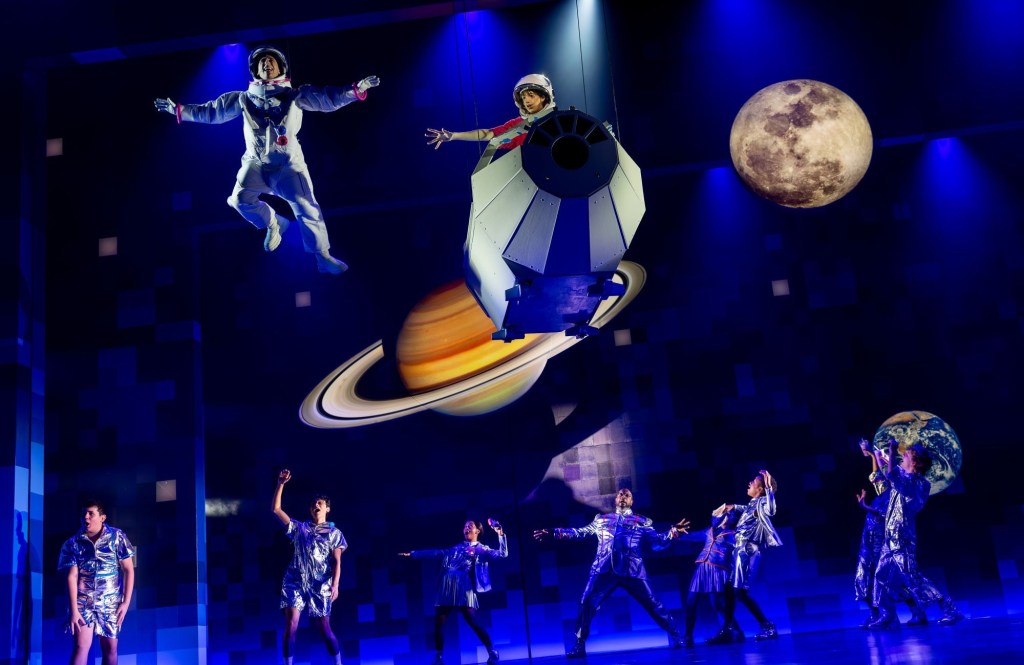
Wonder, a new musical based on the R.J. Palacio novel and the Lionsgate and Mandeville film, is currently playing a world premiere engagement at American Repertory Theater in Cambridge, Massachusetts. It has a book by Sarah Ruhl, lyrics and music by Ian Axel and Chad King, of A Great Big World, and direction by Taibi Magar, and it is, at present, a disastrous affair, prematurely staged.
The musical is set in the present day, and it centers around a seventh-grade boy, Auggie, who likes science and outer space, and who is embarking upon his first year at Beecher Prep after previously having been homeschooled, due to a facial difference. Isabel is his mother and a former illustrator of children’s books. Nate is his father. Via is his protective older sister who feels unseen by their parents. Miranda is Via’s best friend. Jack is a seventh-grade boy who befriends Auggie. Julian is a seventh-grade boy who bullies Auggie. Justin is a high-school theatre nerd. And the remainder of the cast includes teachers, students, an arrogant parent, a genial principal, and a man dressed in a space suit and identified in the program as Moon Boy.
The story upon which the musical has been founded is fairly strong, despite being of the familiar feel-good sort, but the musical is ablaze in problems, large and small, and the fairly strong story has not been effectively told or fully exploited, dramatically or theatrically. To begin with, the central figure is absent, inactive, or buried for most of the show, and his sister currently has the most pronounced, clearly defined character arc and the most dramatically active narrative thread: she gets rejected by Miranda, meets Justin, auditions for the school play because of Justin, becomes the understudy for the role played by Miranda, starts dating Justin, hides her extracurricular activities from her parents, argues with her parents, argue with Auggie, reconnects with Miranda, and, when Miranda feigns illness on opening night, finally gets her moment to shine.
In fact, the current iteration of the musical essentially ends two-thirds of the way through the second act, when Via’s arc resolves, courtesy of an emotionally high-pitched solo entitled “Moment to Shine,” and a familial interlude that immediately follows. By this point, the bullying of Auggie and the corresponding school “war” have both been resolved, with Julian, of his own volition, deciding, unlike his mother, to ‘change the way he sees,’ after a combative conference in the principal’s office. And, by this point, Jack has won back Auggie as his best friend. (Jack is, at present, the only other strong narrative presence in the show, for he must wrestle with peer pressure after he first links up with Auggie, and, during a Halloween dance at the end of the first act, he succumbs to said pressure, making a cruel comment about Auggie that Auggie overhears, unbeknownst to Jack.) Indeed, by this point, nothing of the established story is outstanding, nothing is at stake.
Still, the musical drones on, with the authors introducing, in the final 15 minutes, an entirely new strand of story, sans setup or support, and suddenly, finally activating Auggie – who must decide whether or not to part with his emotionally comforting astronaut helmet (though he already parted with his emotionally comforting astronaut helmet earlier in the show); who must decide whether or not to go on a major school trip (though the presentation of his science-class project was already endowed with the weight of a culminating event); and who, on said trip, must find his voice and stand up for himself (though he has not previously struggled to do either). The musical’s artificial ending involves the genial principal bestowing upon Auggie an award – for no particular reason.
Wonder is greatly in need of, among other things, a structural realignment and a repatterning of plot, if the piece is to have any sense of continuity, momentum, or sustained dramatic interest, and, relatedly, its three authors will need to make three critical decisions on three critical facets of the storytelling – which should have been decided upon before the musical went into production.
First, what is the function of Moon Boy: is he Auggie’s imaginary friend, is he Auggie’s voice, or is he Auggie? The authors currently have Moon Boy serving as all three, with lines and lyrics that oscillate between being spoken to and spoken as Auggie, and with staging that oscillates between autonomy and reflection. The result is a mystifying heap of nothingness.
Moon Boy might be a stunning and highly theatrical narrative device, whichever way the authors choose to take him, but the authors must make a deliberate choice, and they must give him detail and definition and dramatic purpose. And they must deploy him in a way that enriches the character of Auggie, rather than upstaging or obscuring the same – as is currently the case. Especially if Moon Boy is going to continue owning all of the song-spots that would otherwise have belonged to the central figure. (Auggie’s lack of song currently gives the impression of being an actor accommodation, not a deliberate choice, despite Auggie delivering a single solo lyric in the penultimate number, and the lack of song is currently having a negative impact on the storytelling.)
Moon Boy even leads the opening number, an earthbound space fantasy, while Auggie sits on his bed: inactive, immobile, and lyric-less. And, by the way, the authors do not even bother to identify Moon Boy until after the number, when Auggie steps downstage right, and, out of nowhere, casually delivers a few lines of direct address, introducing himself, his imaginary friend, and his family, who appear in a kitchen center stage. It is sloppy and pedestrian and bizarre, and here is the kicker: Auggie will never talk to the audience again!
Second, what is the language of the storytelling? Nothing about the way in which the musical currently operates is distinct, and none of the material feels definitely or definitively fashioned for the stage. The direct address, in particular, is nondescript, erratic, and ineffectual, and it is neither confined to a single character, nor inclusive of them all. But it, too, might be a stunning and highly theatrical narrative device, and one wonders if the authors have not inadvertently endowed the piece with a dynamic personality, employing audience as present third-party: patron, friend, and confidant. Some of the production numbers, for instance, already have a presentational bent (which is awkward and purposeless at present), and the second act opens, in one, with a seventh-grade girl’s gossipy soliloquy (which is extraneous as presently written). Perhaps the answer is to amplify and fully integrate the use of direct address, even perhaps to grow more playful with it, and to lean into the musical’s presentational nature, giving such moments definition and making them purposeful. The realization of such a world with such a language will require meticulous calibration and pinpoint precision, but such a world and such a language might go a long way toward individualizing and distinguishing the musical.
Third, how do the songs function in the story; what dramatic purpose are they serving? Indeed, the score is, at present, a largely untheatrical mess, comprised primarily of static statements, montages, and action sequences, in which the characters are essentially singing their own background songs, because the hyperactive and often unfocused activity in which the characters are engaged during the number is not aligned with or supportive of the lyric. And the lyric, in most cases, fails to deepen or propel the narrative. “Moment to Shine,” for instance, finds Via performing, alongside random actors, her entire high-school production of Our Town, while simultaneously singing about her turn in the spotlight, and “Best Friends” finds Jack going through a regiment of activities with his new pal, while simultaneously singing about his new pal. (Is Wonder a music video or a piece of theatre?)
“You Are Beautiful” is a pop ballad sung by Isabel to Auggie at the end of his first day of school, but for what reason exactly? Plus, its introduction of the show’s title feels accidental, generating no impact. “Ordinary” seems to want to propel Auggie toward his decision to attend Beecher Prep, but the lyric does nothing of the sort, and the song includes a brief parental duet in an entirely different locale. “Shoes” seems to want to find Jack wrestling with why his best friend might suddenly be ignoring him and how his best friend might be feeling, but the lyric is a meditation on footwear, and Jack discovers why Auggie is suddenly ignoring him when a classmate flat-out tells him at the end of the song. And why does “Choose Kind,” currently situated toward the top of act two, not close the show? The production number, built with bouncy music and key changes, is a natural finale. Plus, the show must earn its message moment in telling the tale, not come out preaching, in spite of the tale, throughout the entirety of act two.
Axel and King are surely not untalented songwriters, and they have written, for the musical, several appealing, if increasingly similar, passages of music, even to be found in the ineffective act-one finale, “Black Hole,” but Axel and King are surely unfamiliar with the musical stage, and their unfamiliarity is surely wreaking havoc on the score – and, consequently, the storytelling. “Moon Boy,” for instance, is a song, not a sung extension of a conversation between father and son. Axel and King would be well advised to work on their ability to write for situation and character, and in the service of a continuous narrative.
And Ruhl has her own homework to do, acquiring a feeling for this singular medium, because her excruciatingly inexpert book, including structure, plot, and character, is responsible for some of the failures of the score. (“This is War” is pitiful; “If It Makes You Feel Better” is an abomination of a memory sequence; and you cannot effectively have Miranda jump into a flashback that she is narrating when you have preceding dialogue that directly addresses a recent change to her appearance, specifically purple hair.) Even Ruhl’s dialogue leaves much to be desired, and one late-show scene, concerning the school trip, turns around on itself.
Plus, if all of the material were more focused and more efficient, Isabel might have a moment that explores her sacrifices, her sense of self, and her return to illustrating. (She has, right now, only one line, in passing.) Nate might have a moment to himself. (He has, right now, only “Moon Boy.”) Isabel and Nate might have a moment together. Miranda might be more than a convenience. Justin might not drop out of the narrative. The seventh-grade crush might actually be addressed. The conference in the principal’s office might develop into a fiery dramatic scene, sans song, with Julian’s mother storming the stage and making a showstopping impression, and perhaps making her first and only appearance. And so on and so forth.
Several buttons are weak, several songs end abruptly, and music supervisor and arranger Nadia DiGiallonardo must take part of the blame here. (The audience, on the evening of December 28, was unsure, on multiple occasions, whether or not to applaud at the conclusion of the number.) Not a single student has any kind of reaction to Auggie’s face upon his arrival at Beecher Prep, and I am unclear on how the absence of reactions, especially from Julian, is serving the story. (One could even make the reaction a direct address.) Via suddenly peeking into Auggie’s bedroom prior to the button of “You Are Beautiful” is mind-boggling. Isabel’s interjection in the opening number should be eliminated if it is not going to spark any sense of urgency. (The lack of drive is an issue throughout the show.) And is ‘look at me and stare,’ repeated ad infinitum, really the most exciting, impactful, articulate, triumphant way for Auggie to (finally) stand up for himself?
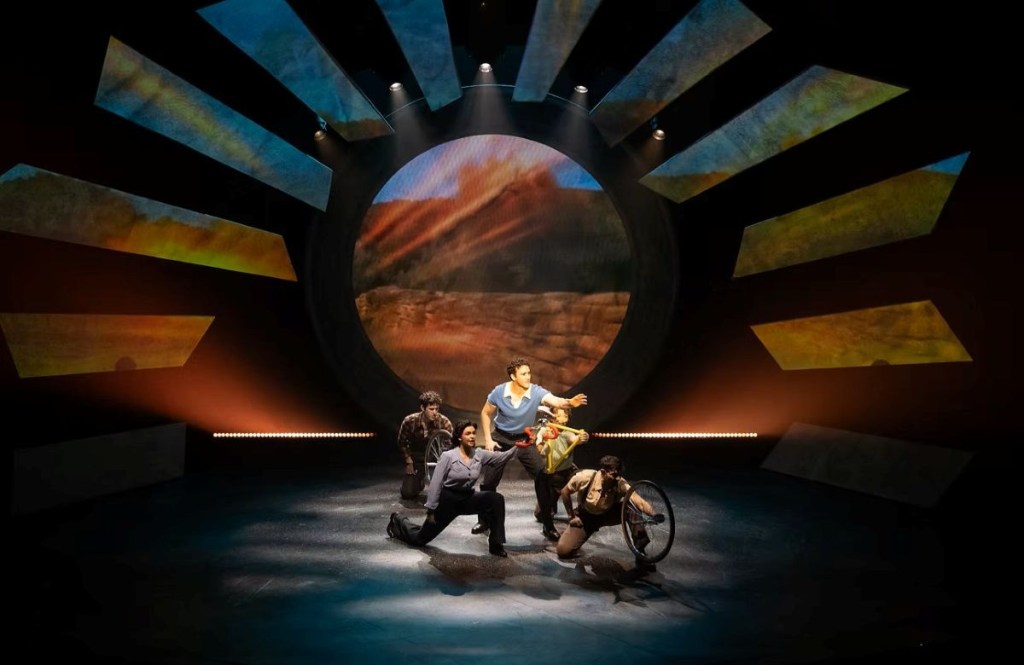
Magar is a skilled director, from a standpoint of staging, but her work here is atrocious. The turntables spin and spin, without generating any interest or excitement; the actors constantly walk in place; the blue walls, with a block theme echoing Tetris or Minecraft, shift back and forth relentlessly, and they occasionally land slightly off-center such that actors can enter and exit through the resulting – and unbelievably tacky – side-stage opening; some of the transitions take what feels like days; huge cables attached to Auggie’s spaceship bed telegraph the bed’s impending takeoff in the opening number; “Choose Kind” devolves into an embarrassingly anemic and disorganized spectacle; a first kiss is not treated as such; Auggie, early in the show, takes off his helmet while simultaneously refusing to take off his helmet; Moon Boy has a pitiful final exit (which is partially a matter of material); and nearly every scene with furniture is staged dead-front. In fact, the science teacher does not even face her students while teaching.
The choreography, by Katie Spelman, is baffling. “Precepts,” for instance, is one of the show’s unsurprisingly ineffective montages, depicting the entire first day of school, without even focusing on or ending with Auggie, and Spelman has the kids, while sitting in English class, begin bopping in unison as soon as their English teacher begins singing at the top of the song. Why? Would not a more natural place to introduce physicality be immediately following the kids’ call-and-response with their teacher, thus motivating the kids’ movement, and revealing a dramatic progression to the number? “Our Town,” meanwhile, is so incredibly overdone that it fails to serve its purpose, of bringing Justin and Via together. And, for the record, the physical design team is led by Linda Cho, Bradley King, and Matt Saunders, all of whom should be sent back to the drawing board.
Garrett McNally, as Auggie, is turning in a very poor performance. Javier Muñoz, as Nate, is strong. Donovan Louis Bazemore, as Jake, is especially strong. Raymond J. Lee and Pearl Sun appear to be having much fun in their underdone roles as teachers. Reese Levin, as Julian, and Nathan Salstone, as Moon Boy, have a certain appeal. And Kaylin Hedges, as Via, does a solid job of delivering “Around the Sun” and “Moment to Shine.” But everyone onstage is suffering, to some degree, from the show’s titanic deficiencies, in material and production.
Wonder is being produced commercially by Jill Furman, and, even though the development price-tag is already a reported $4 million, Furman, Ruhl, Axel, King, Magar, and DiGiallonardo might consider, as an exercise, setting aside the current iteration of the piece, at least for the moment, and mapping out the musical from scratch, remembering that it is being built for the theatrical stage.
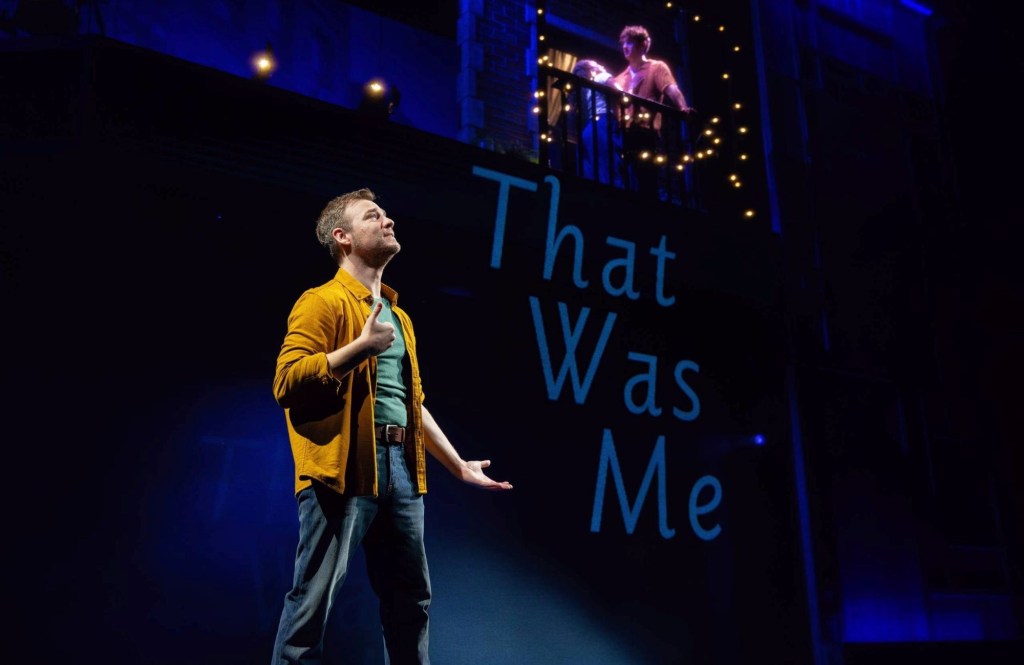
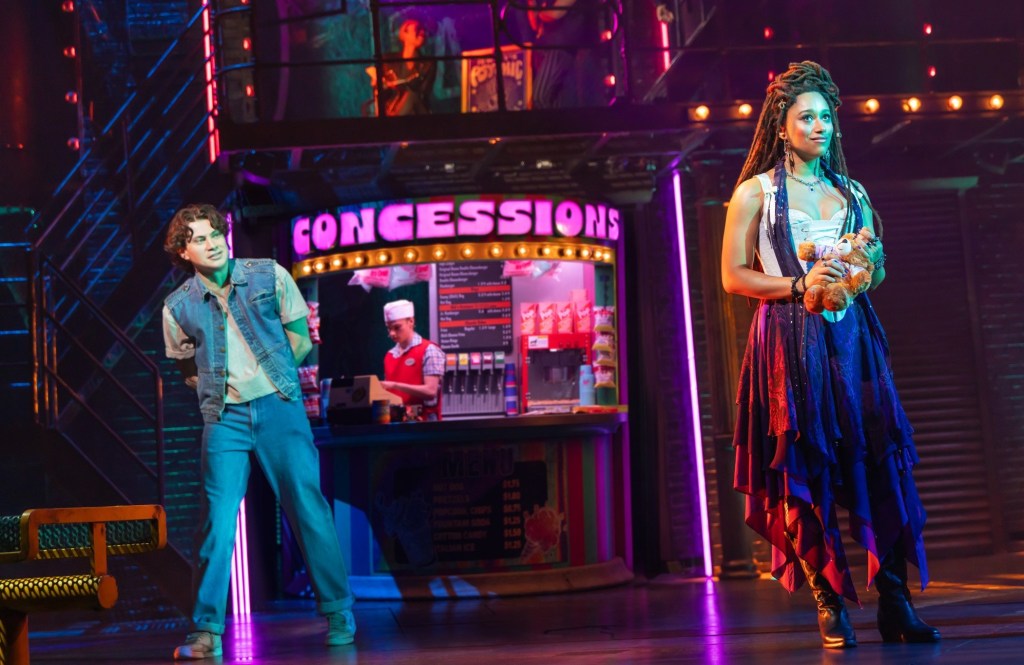
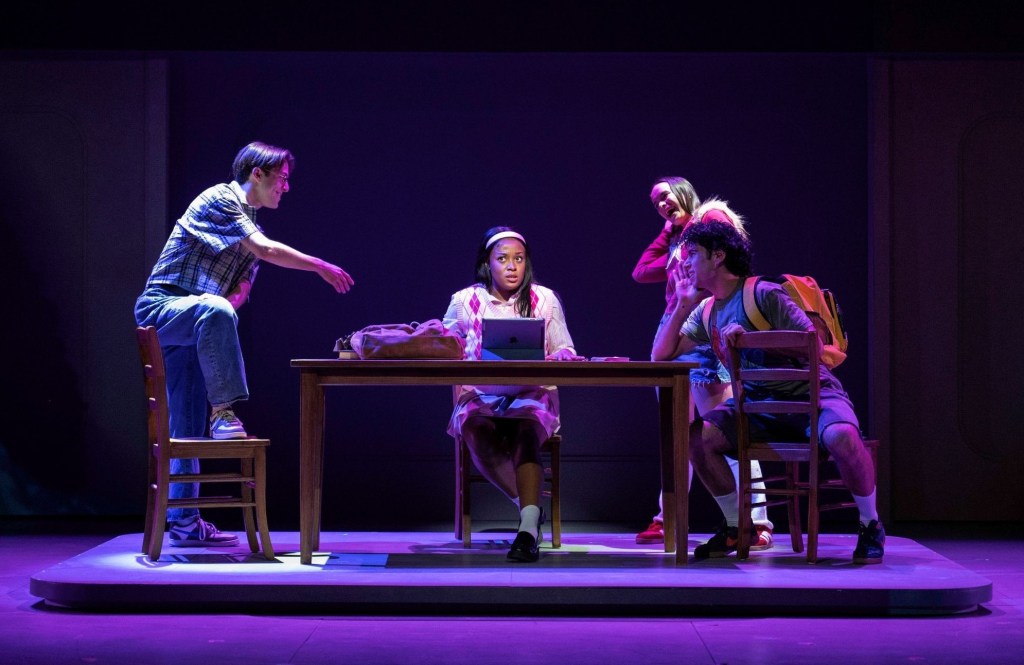
Photo of a scene from Wonder by Hawver and Hall.













Leave a comment