A journal for industry and audiences covering the past, present, and future of the musical stage.
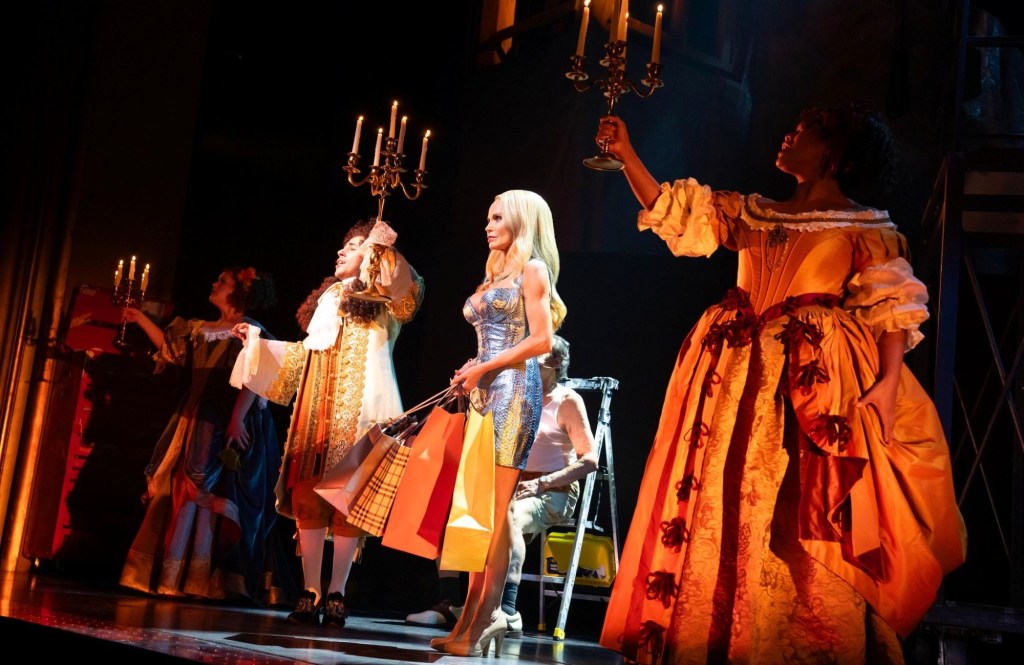
The Queen of Versailles, a new musical based on the documentary about Orlando billionaire Jackie Siegel, opened on Broadway on November 9 at the St. James Theatre. It is closing on January 4. The musical has a book by Lindsey Ferrentino, lyrics and music by Stephen Schwartz, and direction by Michael Arden, and it might have been a thrilling theatrical affair – a searing indictment of the American dream encased within a satirical, psychological portrait of one lucky dreamer from upstate New York.
Jackie Siegel is an exquisitely complicated character, exploding with dramatic possibilities. Her story includes a modest upbringing, a series of odd jobs in her teens and twenties, a physically abusive first husband, a verbally abusive second husband to whom she remains married, a local beauty pageant, an addiction to shopping, an addiction to plastic surgery, an obsession with fast food and diet coke, a tendency to stuff and display dead pets, a stint in reality television, a niece whom she adopts, six children from her second marriage, and an eldest child, from her first marriage, who struggles with her weight and becomes the victim of drug addiction, bullying, and teen suicide. Jackie’s story includes, as well, a certain feeling of emptiness, loneliness, and isolation – a void her social media followers cannot fill – and, of course, the ongoing construction of Versailles, a new Siegel family home to which she desperately clings. (Her second husband, David, is the billionaire founder of Westgate Resorts, and he hatches the idea for the couple’s mega-mansion while on their honeymoon in France.)
The musical unfolds in two acts. The first is built – profitably, in principal – around the making of the documentary. It involves filmed testimonials and flashbacks; it sees the arrival, in real time, of Jackie’s niece, Jonquil; and it culminates with the 2008 stock-market crash and the corresponding halt in construction. And filming. The second act involves the release of the documentary and the restart of construction; it sees the suicide of Jackie’s eldest child, Victoria; and it culminates with the completion of the grand ballroom – which serves as the imposing scenic backdrop for the entire show, with drop cloths, scaffolds, and the like slowly disappearing over the course of the same. (A marvelous touch.) Plus, the musical is splashed with historical interludes that find French royalty, associated with Versailles, commenting on the state of American affairs.
This is the stuff of dramatic fireworks. But Ferrentino and Schwartz have, to their grave disadvantage, chosen not to explore almost any aspect of Jackie’s story – or her psyche – and they have simultaneously failed to endow her – and, in turn, the musical – with a central purpose, an internal drive, a superseding design continuously powering her journey, given the fact that her one professed dream, of being wealthy, has, by the time that the action of the musical begins, already come true, courtesy of her second husband. And the palace, you will recall, is David’s idea.
The Queen of Versailles culminates with a scene in which Jackie is deserted by every member of her family, after taking a celebratory picture, in the grand ballroom, for social media. Thereafter, she finds herself in the dark, with the lights of the palace having been turned out under the assumption that no one is home. And, finally, uncomfortable in her solitude, she desperately tries to get the last remaining member of the construction crew to stay past his shift, offering him champagne and suggesting they make plans to remodel the finished ballroom. The young man declines, and Jackie muses, in song, about Jonquil returning home, her parents finally moving into Versailles, and David finally retiring such that the two might spend time together – none of which will ever happen. Jackie’s eleventh-hour breakdown, laced with delusions, psychosis, and a fresh coat of American-made veneer, is telling, but it is telling too little, too late, and the payoff is nil, for Ferrentino and Schwartz have failed to lay the groundwork for such a moment. And they have failed to skillfully craft it.
Indeed, the material for the musical is remarkably untrained. The dialogue is inefficient and stocky; the jokes are planted and predictable; the lyrics, despite being active, consist primarily of clunky phrases, ham-fisted rhymes, rambling thoughts, and awkward scans; the social comment is neither sharp nor biting; and the generally melodic music is mostly indistinct, little helped by John Clancy’s mushy orchestrations, for sixteen musicians, including two guitars and electric bass. (Mary-Mitchell Campbell is music supervisor.) Plus, the entertainment metaphors, like Americans getting a “second act,” and the recurring motifs, like “when is it enough,” “hustling,” and “this time next year,” tend to register as mechanical, carrying little dramatic weight, and the structure and routine are out of whack.
“This is Not the Way” and “This Time Next Year,” for instance, close the first and second acts respectively, and they are, in terms of the sentiment of the lyric, nearly identical. “Because We Can” and “Caviar Dreams,” meanwhile, occur back-to-back toward the top of the show, and they are, in terms of the style and temperature of the music, nearly identical. All four numbers are sung by Jackie, and in neither instance is the semi-sameness of the two respective items deliberate. Or productive.
The use of flashbacks to reveal Jackie’s early years is unimaginative and impractical. (A mature actor simultaneously portraying, in earnest, a mature character and a seventeen-year-old version of that character?) David is an afterthought who comes and goes whenever convenient. Jackie’s parents have no song and no roles. The dog is a complete waste. The coming together of Victoria and Jonquil occurs before it actually occurs, and its belated occurrence, courtesy of “Pavane for a Dead Lizard,” is utterly bizarre. Some musical numbers, like “The Ballad of the Timeshare King,” lose shape and focus, and others, like “Grow the Light,” wither away. The juxtaposition of the family and the help is unsteady. A quartet involving Jackie, Victoria, Jonquil, and the family’s housekeeper, Sofia, is similarly unsteady. And the abrupt snap from a celebratory number to a somber interlude is a fine idea, but, like so much of the material, it is poorly executed.
Ferrentino and Schwartz have, furthermore, failed to realize a clearly defined narrative composition, and a distinct narrative language, especially failing to fully capitalize on the inherent presence, in the story, of media, and to fully integrate the use of the same. And the situation is made worse by the severe disconnect between the material and the staging, suggesting the authors and their director were on different pages. Or a vigorous lack of know-how.
A musical is necessarily comprised of multiple elements, and each element, when in play, must be precisely synchronized – a focused fusion in the service of the storytelling – their union meticulously calibrated, moment-to-moment, if the musical is to be complete, dramatically effective, propulsive, impactful, involving. The Queen of Versailles is a masterclass in creative discord, revealing little sense of cleanliness or cohesion.
The show begins, for instance, with a 17th century prologue that finds Louis XIV posing for a portrait, and the subsequent transition to the 21st century might have been exhilarating. (Members of the construction crew walk through the scene and collect various objects, including the portrait of Louis XIV, for use in Versailles.) But the intersplicing of the two worlds is imprecise and unsupported by the written material, and it results in a muddy reveal for the leading lady. Similarly muddy is the reveal of the grand ballroom – which occurs in silence, with a couple of 18th century figures, from the prior scene, still crawling offstage.
A sight gag, involving clips on the back of a dress, is suffocated. A series of Louis XIV poses is unaccented. The initial entrance of David and the initial entrance of the dog are buried in a busy number. The use of live video is clever, erratic, inexact, and overdone, nearly killing the button of the first-act finale. The testimonials directed into a camera are completely undefined, with actors looking every which way and sometimes playing to the audience. (This lack of detail and rigor inevitably results in a lack of dynamism, tension, excitement, momentum.) And the projections, identifying the time and setting of the respective scene, have been imposed upon the proceedings, with Arden asking audiences to focus their attention in two places at once.
Arden, a talented visual director, has a history of disregarding text, and The Queen of Versailles finds him disregarding text in the extreme. His staging of “Caviar Dreams,” for instance, finds Jackie dropping a lobster into a pot and assisting in a morgue, even though neither of those activities has anything to do with the lyric Jackie is singing. (The authors must take part of the blame, because they have specifically designed the continuous solo to operate in a dramatically disadvantageous or dangerous manner, with the physical action running parallel to the lyric and covering a large swath of time.) During a holiday sale at the top of the second act, Arden has Jackie singing, “You’ve got to show ’em you’re the queen,” directly to a male shopper. During a flashback in the first act, Arden has Jackie begin singing a song to her newborn child, before a fellow actor has actually delivered the child to her arms. And during Victoria’s solo in the second act, Arden strikes the bedroom set, and moves the young lady down-center – where she is left to sing about “these pages” of “this book,” despite Victoria and her diary now being in different locations. This move, by the way, is done purely to effect an artificially posed, visually striking button – at the expense of the storytelling.
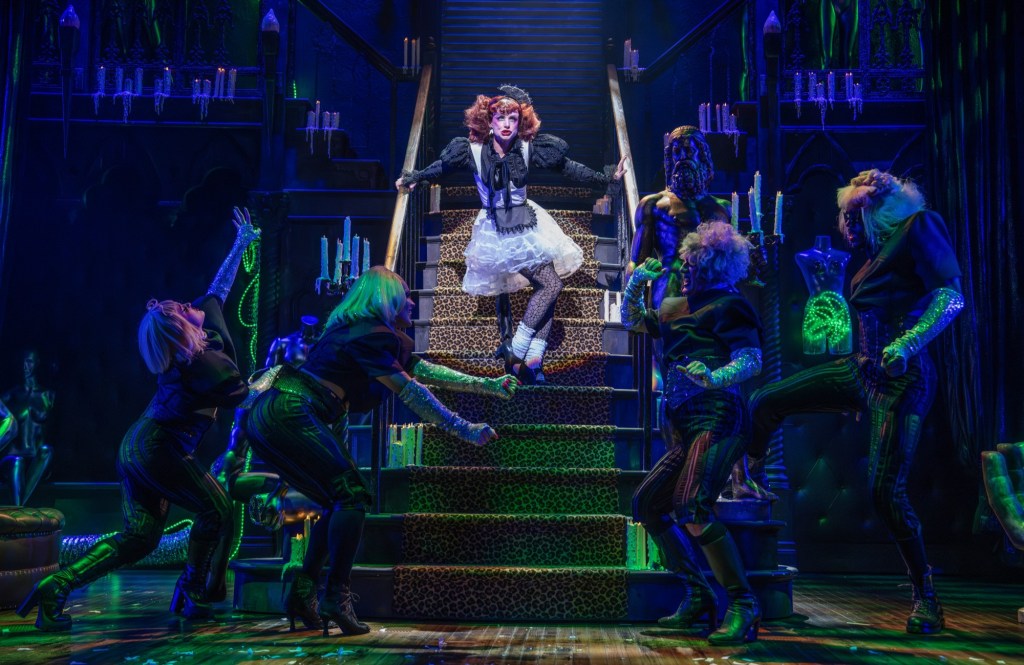
The attractive and decidedly lavish scenic design, by Dane Laffrey, is neither gratuitous nor excessive, simply poorly exploited, with its many mobile elements almost constantly in motion, courtesy of a hardworking ensemble. Arden even stages scene shifts during a quiet monologue about Victoria’s death. And Jackie finds herself stuck on the stairs of the grand ballroom for her eleven o’clock, especially failing to reach the top, in an unintentionally deflating moment. (An impulse is actioned but not followed through.)
The lighting, by Natasha Katz, is solid enough. The costumes, by Christian Cowan and Ryan Park, are solid enough. The sound, by Peter Hylenski, is solid enough, excepting the use of headgear, in which the leading lady’s hair gets tangled. And the choreography, by Lauren Yalango-Grant and Christopher Cree Grant, is the pits, with a senseless construction-site kick line and a premeditated chair-stepping routine.
Kristin Chenoweth, as Jackie, is professional, and, being a radiant Broadway star, she inevitably casts a spell. But the spell wears off after ten minutes, and the show goes on for another 150. And though Chenoweth dutifully moves the show along, she occasionally blasts through beats, and might have delivered a meatier performance. F. Murray Abraham, as David, is similarly professional. Melody Butiu, as Sofia, is quite strong. And the remainder of the cast is passable, no doubt hampered, to some extent, by the unsatisfactory material and staging of what might nonetheless have been a thrilling theatrical affair.
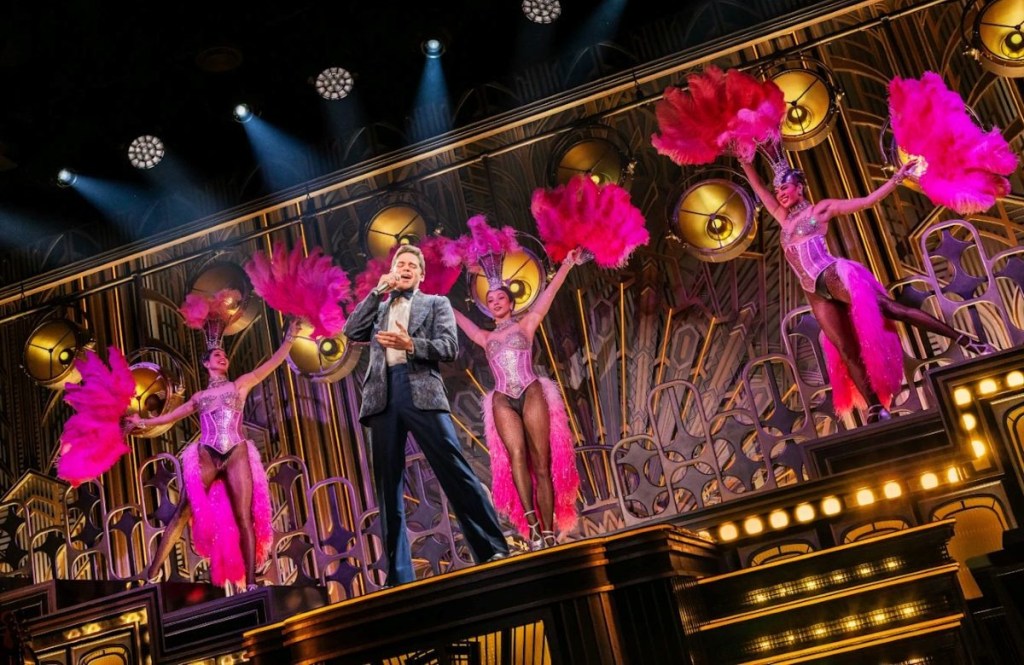
Photo of a scene from The Queen of Versailles by Julieta Cervantes.








 The Musical Theatre Report
Leave a comment