A journal for industry and audiences covering the past, present, and future of the musical stage.
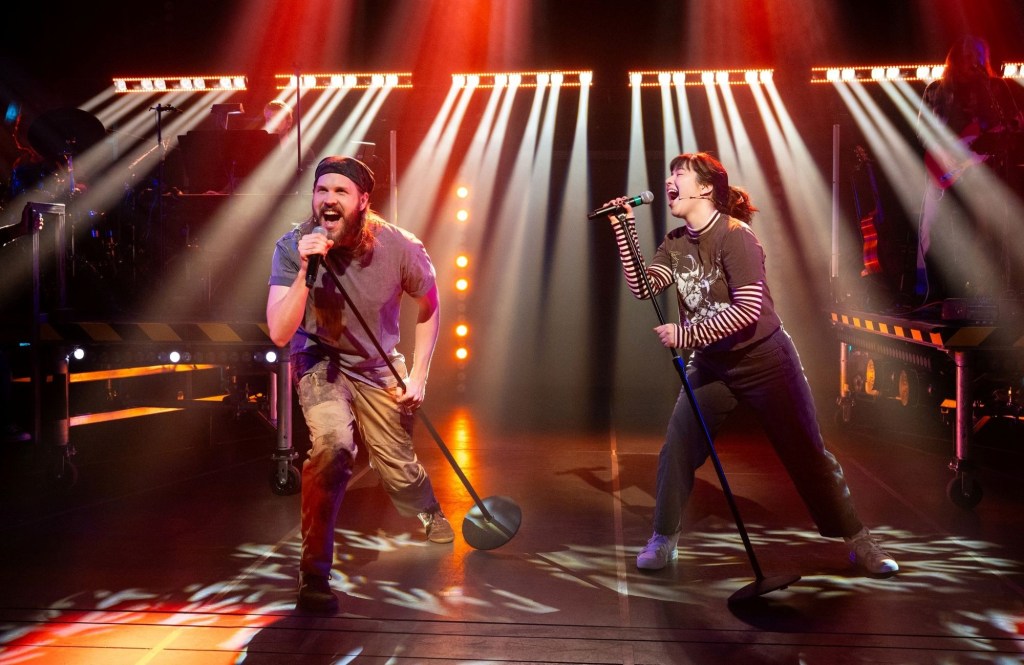
Safety Not Guaranteed, a new musical based on the 2012 film, is currently playing an engagement at Signature Theatre in Arlington, Virginia, after previously having been seen, in an entirely different production, as part of the Next Wave series at the Brooklyn Academy of Music in 2024. It has a book by Nick Blaemire and lyrics and music by Ryan Miller, and it has, over the last year, blossomed into a distinctive, gloriously theatrical affair, currently shopping for a home in the top drawer.
The musical follows three Seattle reporters investigating a man who has just placed a wanted ad looking for a companion for his trip back in time, and, despite harboring hints of science fiction, it is ultimately a story of love, loss, longing, and regret, of humanity and human connection. Its nonetheless nut-adjacent plot involves, among other things, a heist, a romance, a hookup, a car crash, a couple of twists and turns, and a splash of chocolate milk.
Blaemire is a skilled musical theatre writer, with a modestly individual voice, a respect for craft, an intellectual bent, and a tendency toward honest eccentricity, and he has (now) fashioned Safety Not Guaranteed emphatically for the stage, employing an intricately blended array of crossovers, cutaways, stage splits, overlays, reveals, interludes, interstitials, full scenes, full songs, sequences, recurring song fragments, recurring bars of theme music, and so forth, specifically in the service of the story and the involving multistrand plot. The composition is appropriately dynamic and complex, with a sharply fluid disposition, and it would be exhilarating, if most of the transitions were not limp, causing deadly drops in the narrative energy, and briefly extinguishing the musical’s dramatic charge. Blaemire must ensure that the shift or dramatic progression from moment to moment is airtight and propulsive, crafted with some sort of exclamation point, synchronizing light, sound, material, and, if applicable, movement.
Most of the dialogue is clever, punchy, and wonderfully playful, wonderfully personal. The comedy is rooted in situation and character. The characters are idiosyncratic flesh-and-blood human beings. And the scene work, on the whole, bristles with a kinetic energy, continuously kindling the high-stakes drama. Plus, Blaemire has done, in this latest draft of the script, an incredibly fine job of leading into song, and of purposing and spotting song, and the songs, in this latest draft of the script, are incredibly strong, incredibly effective, practically astounding, making significant contributions to story and character, and propelling the narrative, from beginning to end.
Indeed, the score is (now) theatrical. The lyrics are (now) active, playful, and revealing, though the false rhymes have not been eradicated. The music explodes with vitality, leveraging melody and repetition and ascension and range, and even, in several instances, amplifying the lyric. And the style and temperament of each song, while neatly woven into the musical’s distinct, cohesive sonic tapestry, is beautifully tailored to the specific moment in which the song resides, individualizing the moment, and enhancing the storytelling. Special mention must be made of the stellar arrangements and orchestrations by Bill Sherman, who has, shrewdly, endowed the numbers with a dramaturgical development, instrumentally. (Jeff Tanski leads the five-piece band.) But nearly every button needs work, and the buttons will be crucial to the completeness of the composition.
Blaemire & Co. have (nearly) realized a singular, electric narrative world, with a hint of freshness and a deliciously offbeat personality, and the singular, electric onstage world carries an intrinsic connection to the same. The happy marriage of material and physical production gives the impression that Blaemire has (re)patterned the piece with the playing space in mind – even though the playing space has not been definitively or assuredly exploited in the staging, specifically the staging of actors. (Oliver Butler is credited as director and Lisa Fagan is credited as choreographer, but Butler and Fagan parted ways with the production during rehearsals, and Signature Theatre artistic director Matthew Gardiner is understood to have guided the musical through tech and previews.)
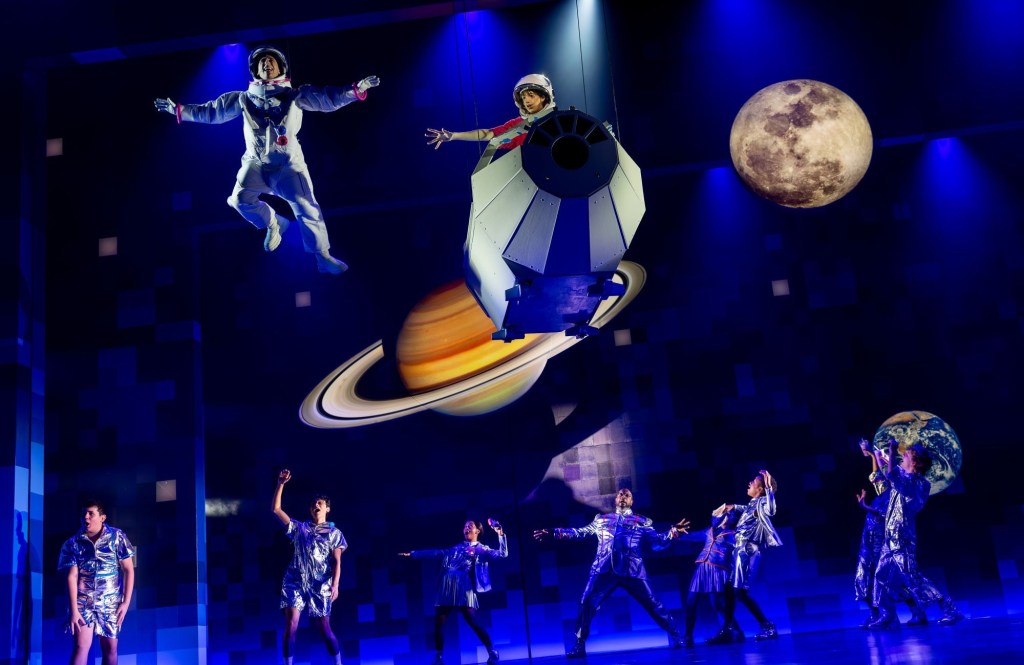
The excellent unit set, by Arnulfo Maldonado, consists of two neighboring band platforms that split center and slide in and out, four vertical panels that slide in and out, a pair of upstage doors that slide open and closed, a pair of small ventilation fans burrowed into the upper regions of the back wall, and an elevated bridge that runs along the center of the back wall, with two ladders reaching down to the deck. Black-and-yellow safety strips and other-worldly lighting equipment adorn the tastefully appointed laboratory, which carries suggestions of a time machine. The lighting, by Jason Lyons, is incredibly elaborate, but it is neither ostentatious nor excessive. It is specific and purposeful and steeped in story, and it is, as such, truly remarkable, superb. The costumes, by Shahrzad Mazaheri, are acceptable. And the sound design, by Eric Norris, is especially fine, disregarding the use of concert-mic headgear. The balance between actors and musicians is on point, with audible lyrics, and the volume level is not deafening. Plus, the atmospheric effects, like the clanking of silverware in a diner, are a nice touch.
Each of the four principals is delivering an incredibly poor performance, and all four must be replaced, for not one has excavated or individualized their character; not one has sunk their teeth into the playful dialogue; and not one seems to know how to charge a scene, or how to deliver a laugh line. Mia Pak, in particular, plays the central figure, an intern named Darius, and she is not physically engaged. She is not in her body. She – the actor – invariably sinks downward and backward, causing, to an extent, the show to do the same. She is not even able to slam a microphone stand to the ground; the stand is, instead, timidly tipped. This is not the commanding performance needed to anchor the musical (which is designed to soar on the clashing and coming together of colorful, complicated human beings). And neither is the performance of her co-star, Gunnar Manchester, who plays the subject of the investigation, Kenneth. Preston Truman Boyd, for the record, plays the lead journalist, Jeff, and Tyler Dobies plays a second intern, Arnau. The two other actors in the cast of six play a handful of roles, including Jeff’s former high-school flame, Liz, and Arnau’s new love interest, Tristan, and the two actors need to be replaced alongside their colleagues. Sadly, one must look beyond the current cast to see the potency and the promise of the material and the physical production.
Safety Not Guaranteed, which runs roughly 100 minutes, is a compact entertainment, with explosive tendencies. It has commercial prospects and commercial producers, and it is, with the necessary refinements, almost certain to find a home in the top drawer. Here, to that end, is a punch list that the creative team might consider moving forward.
• The opening number has a refreshingly unaggressive musical temperament, despite an evident drive and an emotional expanse, and it is near to being sensational, efficiently and effectively introducing, in a dramatically active fashion, the world of the show, the language of the storytelling, the circumstances of the story, and the central figure – whose journey is shrewdly, skillfully launched with a vocal overlay that finds Darius singing the text of Kenneth’s advertisement, which Jeff has just begun reading aloud in the middle of a staff meeting. The calculated interruption is instrumental in activating Darius and in propelling and keeping fresh the storytelling. It is a dramatic trigger, and the dichotomy of text and voice is thrilling. The launch is buttressed moments later by a brief interlude in which Darius sings of ‘flashing back to a girl,’ laying the groundwork for her motivating backstory. And the use of interstitial dialogue is similarly shrewd and skillful, revealing Blaemire’s known affinity for crafting attention-grabbing opening lines that ignite the respective scene. (“Clicks!”) But the second patch of interstitial dialogue needs a musical tune-up, because the weak underscoring causes the bottom to drop out of the number. And one is unclear why Darius, after enthusiastically volunteering to join Jeff in his investigation, suddenly and immediately reconsiders. The turnabout is unsupported and dramatically unproductive, and if Blaemire’s intention is to establish Jeff as an obnoxious and or unlikable personality, he can surely find an organic way of doing so that does not simultaneously sacrifice the launch of the central figure. And the show. Plus, the opening needs a cleaner and sharper ending – a definitive finish that successfully sails the reporters – and the show – into the next scene, with style and interest.
• Blaemire & Co. are currently employing a handheld microphone conceit that would seem to be extremely valuable, but it has not been effectively introduced, and it has not been effectively deployed. (A matter of material, not merely staging.) Darius, for instance, grabs a handheld microphone in the opening number, which is a smart way, in principle, to establish the conceit, but the moment, like others of the sort, is physically unclean and lyrically and dramatically unspecific. Every instance of a handheld microphone being used must be fully considered and meticulously executed, deliberately woven into the dramaturgy of the musical, in the service of the storytelling, aiding the theatricality. When the conceit is consistently executed in such a manner, it will be tremendously impactful, and it will contribute to the crispness, definition, and dynamism of the composition. A couple of instances already are and do.
• The new eleven o’clock number is dynamite: a feverish reckoning, for the central figure, that consumes the theatre, and continuously builds toward an earned volcanic eruption. (Blaemire has improved Darius’ arc significantly, and some of his choices are striking and inspired.) But the team might consider penning a new lyric for the top of the final chorus, rather than falling back on a lyric from an earlier chorus. The repetition does not currently register as deliberate or productive. And, as a matter of concept and staging, the other characters have, at present, no reason to wander through the number. Let Darius punish herself in private, or deploy the company in a manner that is definitive, a manner that makes them essential. Separately, Blaemire & Co. must be commended for crafting a moment in the eleven o’clock number that mirrors a moment in the opening number. Both moments find Darius nonliterally activating the laboratory, extending her arms on a specific lyric of “Architects and Engineers,” thereby causing the band platforms slide out-stage. The mirrored moment even contains a dramatic progression, with the platforms, on the second time around, sliding further out-stage: stunning! (Notwithstanding Pak’s lack of presence and arm strength.)
• “Chocolate Milk” is an electronic-flavored interlude for the central figure, and it is devastatingly fine. Note, in particular, the delayed back-beat, and the use of the ‘flashing back to a girl’ interlude from the opening: an emotional and dramatic timebomb. But the company is nonessential, and their presence is deflating, and similarly nonessential are the police lights that accent a certain lyric. Plus, the physical transition into the number would benefit from sharpening – which might require material support. Nonetheless, “Chocolate Milk” is one of the inspired moves that went into the sharpening of Darius’ arc. And the storytelling.
• The scene between Kenneth and Darius that immediately follows the heist has a false beginning, failing to account for the heist! The thieves simply sit down and relate, beautifully, but the beautiful relating is not preceded by any transitional beats, like hydrating, eating a protein bar, reminiscing, releasing adrenaline, Darius asking about the object in the case, Kenneth checking his blood pressure, etc. Some motivated exchange of the sort would strengthen the launch of the scene and pave the way for the natural boiling down of the temperature. And some associated bit of physical activity, baked into the text, would give the actors something with which to play.
• “What’s Your Mission?” has been profitably overhauled, and the new “Safety Not Guaranteed” overlay is phenomenal. But one wonders if Arnau really needs to be part of the number, especially since he has no musical identifier as yet, and, regardless, the ending needs to be cleaner. Separately, from a standpoint of staging, the two inflatable figures are, at present, neither here nor there, but they might prove advantageous in future.
• “Are You Good?” is a strong double duet for the musical’s two couples: Jeff and Liz, and Arnau and Tristan. But it needs a stronger button, and one is unclear what dramatic purpose is being served by having Kenneth and Darius briefly join the number while walking across the bridge. They should likely be eliminated.
• Early in the show, Jeff drags Arnau offstage to do karaoke. But the pair pop up moments later, the same day, not having done karaoke, and then exiting, again, to do karaoke. The karaoke component of these scenes, especially the first scene, needs to be addressed.
• Some of the bridge work would benefit from a combination of embellishment, crispness, and definition. The crossover made by Jeff and Liz, for instance, is incredibly valuable, and it might earn a bigger narrative payoff with a couple more lines of dialogue, such that the moment is fully established, while remaining a crossover. And a split-stage scene involving Arnau and Jeff on the bridge and Kenneth and Darius on the deck needs sharper snaps, especially the short snap back to the deck – which might similarly benefit from an additional line or two of dialogue.
• Kenneth does not have a definitive narrative presence, or perhaps a fully fleshed out arc, in part because most of his scenes are with and about Darius, and, to that end, he would seem to be missing a private, revealing moment, late in the show, after having developed a bond with Darius, and with his mission set to commence in a matter of hours. And Blaemire has already set-up such a moment, courtesy of a split-stage scene that finds the reporters, stage left, talking to the FBI, and Kenneth, stage right, working in his hideout. A solo for the leading man at the end of this scene would almost certainly serve the story, the character, and the transition, which is currently terrible. (Blaemire & Co. will, of course, need to ensure that the nature of any new number complements the neighboring items in the routine.) The FBI scene is nonetheless begun in a fine, escalatory fashion, with successive scares – even though the staging is imprecise.
• The earlier iteration of Safety Not Guaranteed was exciting and enlivening and filled with potential, but it had real deficiencies, especially in terms of the score, and the musical completely fell apart in the final 20 or so minutes. Blaemire has done a fantastic job of refining the ending and the corresponding ramp-up, simplifying a couple of plot points along the way. Indeed, he and his colleagues have even generated a sense of acceleration. But a couple of minor refinements might still be made, especially to the confrontation scene between Kenneth and Darius, where the matter of a dead girlfriend dematerializes, with no discussion. Kenneth simply abandons his mission and tells Darius that they will instead travel to her desired moment in the past. The implications of the girlfriend matter similarly go unaddressed, and if Blaemire wants to leave Kenneth’s motives undisclosed, he should do so in a deliberate fashion. The “trust” exchange between Kenneth and Darius is nonetheless valuable.
• The team has offered no justification for the company suddenly appearing during the strobe section of Kenneth and Darius’ training session. And Pak sabotages, among many other things, the beautiful decision-making moment that Blaemire has created mid-song.
• The lack of detail in three moments is inexcusable, despite the production’s absence of an official director. First, Pak plainly fails to write her full phone number on a can of soup. Second, Kenneth, in an early solo, carefully unfolds a carefully folded map, only to carelessly ram the map back into his bag at the end of the song. And the moment in which the reporters are told to “scatter” is an egg-on-face flop (because of the staging).
• “Jankholes,” in which Kenneth unfolds his map, has a wonderfully exciting musical texture, but one is unclear what the character is doing, physically. Perhaps part of the physical activity should simply be Kenneth preparing for his job, thus setting up the ensuing scene. This might even aid the transition.
• The transitions, as a whole, have been discussed, but the transition out of the heist must be singled out for its ungodly length. And while the subsequent reveal, of Jeff and Liz, is terrific, simulated sex onstage looks ridiculously fake, every time, any way you slice it. Simply give us a few groans during the transition, and bring up the lights immediately after the climax, with their clothes being restored. Separately, a transition from night to day is rough, but it is a fine idea that simply needs to be properly executed. Indeed, once Blaemire & Co. attack the seams, the composition will be deliriously crackly, and the instances of back-to-back scenes, sans song, will really click.
• The microphone conceit has similarly been discussed, but a moment between Kenneth and Darius in front of the vertical panels must be singled out for its clumsiness. The start is intriguing, but Blaemire & Co. seem entirely unsure where to go and how to end it.
• One wonders if Arnau and Tristan are not missing an exchange about the distance between their respective homes, given Arnau is currently on a road trip.
• Jeff, at one point, asks Darius why she is doing his job for him, but Blaemire has Jeff, in an earlier scene, specifically tell Darius to do his job (i.e. engage with Kenneth).
• The theme music disappears during the middle portion of the show. This is not necessarily a problem or a detractor, but one is uncertain whether or not its temporary disappearance is a deliberate choice on the part of the creators.
• The beginning of the scene in a hair salon finds Liz conveniently ignoring the customer whose hair she has just finished styling.
• “I Wanna Go Back” is an incredibly strong number that serves as something of a breakdown for Jeff. It has been outfitted with a new bridge, and it has been shifted later in the lineup, such that it now registers as a fabulous dramatic foil to the deliberately superficial number Jeff sings earlier in the show. And “I Wanna Go Back” has done wonders for Jeff’s arc. But one cannot help feeling that the lyric might still benefit from a turn at the end, and, though the resolution of Jeff’s arc is beginning to come into focus, Blaemire might be encouraged to further solidify said resolution. And the transition into the number nonetheless needs to be much smoother.
• “What Am I Doing, Why Am I Doing This” has a great beginning, built upon a rhythmic rap, but the body of the lyric might be more specific, more personal. And the heist, which the song supports, has the potential to be quite fine – including the birthday moment and the slow motion finish. But the staging will require cleanliness, precision, and calibration.
• “One Man Wrecking Machine” has, happily, been repositioned as an addendum – an earned addendum. It should, as such, almost certainly be done as a straight sing, sans the pretentious character business. And it should almost certainly be given an immediate button, sans the preceding flourish. (Unless the bows are woven into the number.)
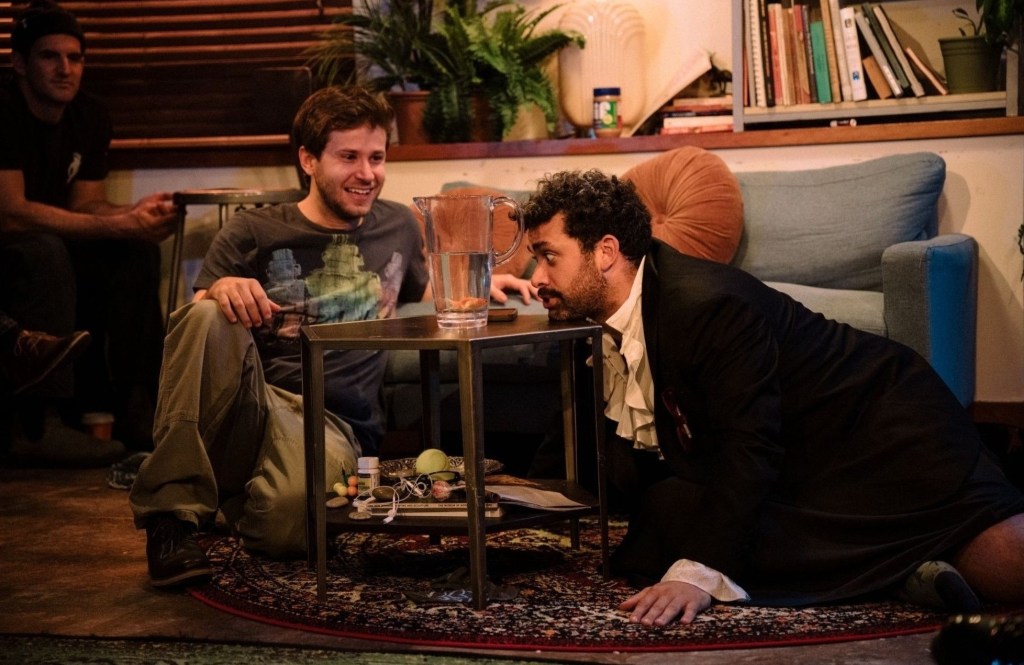
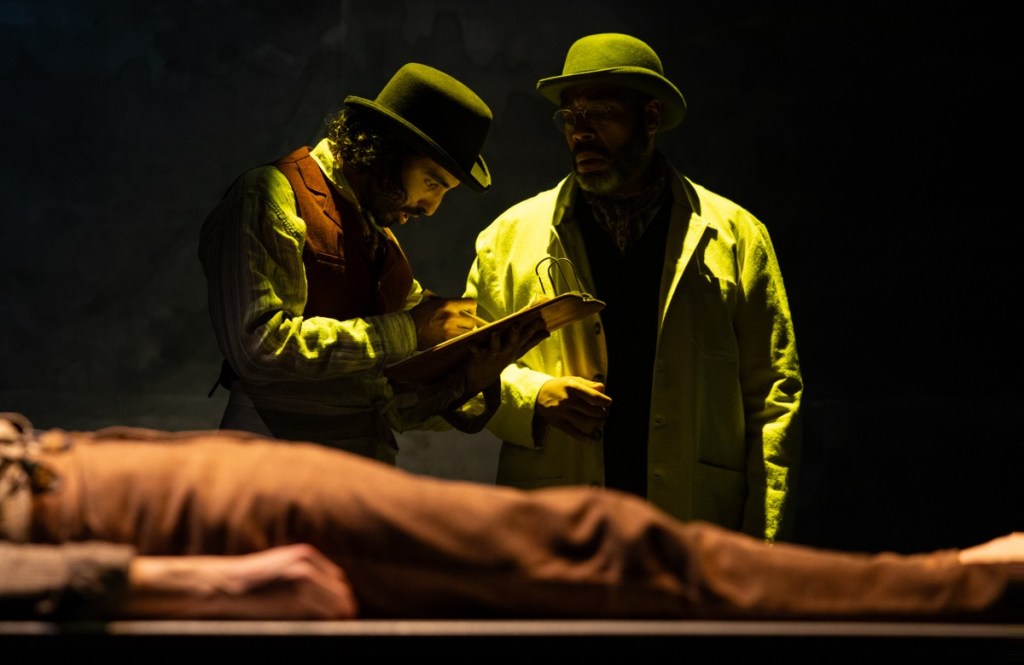
Photo of a scene from Safety Not Guaranteed by Daniel Rader.












 The Musical Theatre Report
Leave a comment