A journal for industry and audiences covering the past, present, and future of the musical stage.
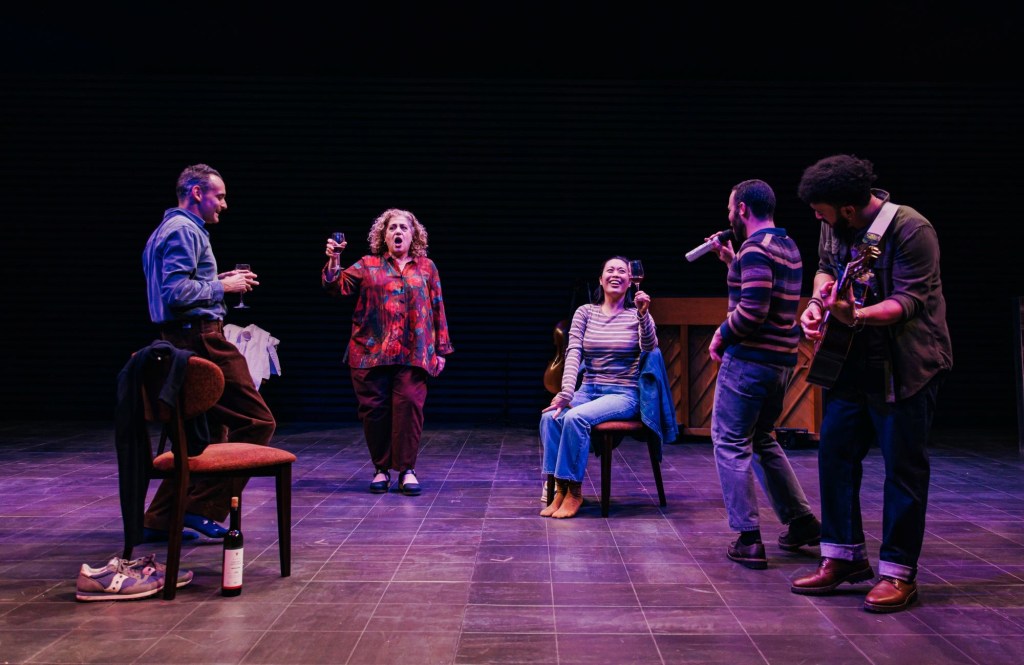
Night Side Songs, a new musical with communal singing, opened an Off-Broadway engagement earlier this month at Lincoln Center Theater’s Claire Tow. It has been written by Daniel and Patrick Lazour and directed by Taibi Magar, and it is a middling affair, suffering especially from song, but the seismic positive changes that have been made since the musical’s unsatisfactory world-premiere engagements last year are astounding. And commendable. And heartening. They are the sort of meaningful artistic improvements that give one hope for the future of the art form. Even though more improvements were needed.
Night Side Songs is an intimate exercise in story theatre, with five actors serving as narrators and playing multiple roles. (One actor also plays a couple of instruments.) The musical runs roughly 100 minutes, and it centers around a 41-year-old woman, Yasmine, who battles cancer, intermingling chronological incidents, like her diagnosis, her treatment, her wedding, and her relapse, with momentary flashbacks and historical interludes. The stylish construct involves an intricate and generally well executed blending of narration, dialogue, side comments, quick verbal baton tosses, and song, and the actors occasionally speak about their character (i.e. themselves) in the third person. Audience members are invited to lend their voices to certain sections of certain songs, and a hymnal is distributed prior to the performance for that purpose.
When seen last year, first at Lincoln Center’s Clark Studio Theater as part of Under the Radar, and then at Philadelphia Theatre Company, Night Side Songs was largely devoid of drama – an impersonal synopsis of one woman’s harrowing ordeal. But it is an impersonal synopsis no more, and three adjustments, in particular, have been instrumental in cultivating a stronger sense of story and character, and an uptick in dramatic action.
First, the musical’s three “visions” have gained motivation, and they have lost their erroneous label. Indeed, the “visions” are and always have been merely interludes, being neither initiated by nor fantastical extensions of any one character, and, in the original iteration of the show, they occurred separate and apart from the action of the story, to the extent that the action of the story occurred on stage. The first “vision” ventured into the past to find a loose woman, Prudence, giving shelter to and sleeping with a Pilgrim – who later becomes a Bishop and tells the woman that she has gotten sick as punishment for her wicked ways. The second ventured into the past to find four doctors, in white lab coats, debating the use of a dangerous new drug. (This was perhaps, at one time, the most dramatically charged scene in the show, despite ultimately deflating.) And the third told of a musician who does not die with his boots on because he never wore shoes – in Santa Cruz.
These three interludes, with one caveat to come, are now woven into the action, effectively furthering it, as opposed to interrupting it, and they are no longer identified, in the narration, by any particular name, “visions” or otherwise. The interlude with the four doctors, for instance, is now ignited by a new scene in which Yasmine’s mother scrolls through her Facebook page – a new scene that has the added benefit of allowing the audience to spend more time with Yasmine’s mother, further establishing her character. And this new integrated approach to what were previously pegged as “visions” and previously rendered in structural isolation simultaneously serves to enhance the dynamism and the fluidity of the composition.
Second, and here is the caveat, the first “vision” has been eliminated altogether. In addition to interrupting the narrative, this interlude with Prudence and the Pilgrim carried little interest and caused a double beat – or an overlong beat – with the ensuing song, “The Reason.” And “The Reason” happens to be one of the strongest songs in the show. Furthermore, as a result of the elimination of Prudence and the Pilgrim, the dramatically charged doctor scene has – naturally, inherently – shifted earlier in the evening, and it happens to be buttoned, after still deflating, by another one of the strongest songs in the show, “Miracle Song.” And though “Miracle Song” is not dramatically effective, it has a thrilling new(ish) arrangement, accented with cello and pitched-breath background vocals. (Alex Bechtel, on piano, is music director and the sole musician.) These combined changes have significantly bolstered the first 30 or so minutes of the musical.
Third, Yasmine is now seen receiving her diagnosis, and she is now seen in the moments immediately after receiving her diagnosis, erupting at strangers in a park and in a coffee shop. The original iteration of the show simply cut away, as the original iteration was wont to do, after a few lines of friendly dialogue between Yasmine and her doctor, reverting to narration, and, even then, relating only that the doctor had delivered this diagnosis to numerous patients. The new scene has strengthened the launch of Yasmine’s journey, and, as a result of the changes made here and elsewhere, Yasmine has blossomed into a comparatively richer character with comparatively richer relationships – though the changes, here and elsewhere, sometimes lack refinement, and one wonders if they were made hastily in rehearsal, for remnants of the original iteration can be found in the program.
Sadly, the staging has seen a minor loss of crispness, specificity, and interest. The musical still unfolds in a small playing space, with audience-seating situated on three sides of the space, and actor-seating situated on the fourth, but the small playing space used to have a circular perimeter, clearly demarcated with white chalk, or something similar, and the staging used to involve a number of circular motifs. Actors would step in and out of the circle, or deliver an interjection from the perimeter; they would dart around inside of the circle at different radii; they would dart through it; and they would slowly rotate in place at the center of it, with Magar generating, in her staging, a valuable sense of narrative propulsion.
The circle of white chalk is now gone, leaving the small playing space entirely undefined, amorphous, adorned with the same hospital flooring used throughout the theatre, and the circular motifs have mostly disappeared. The one pronounced circular motif that remains finds a nurse fast-walking laps around the space, continuously, apart from two brief patient visits in the center, as he makes his rounds and recalls his sleepless night; the other actors hand him props and or briefly join him on this circular journey. And his laps are timed to the text. This moment used to be, from a standpoint of technical stagecraft, quite exciting; it is not anymore.
The new environment, by Matt Saunders, is attractive, but it does not serve the original staging, and the original staging has not been wholly reconceived to carry an intrinsic connection to the new environment. Plus, the new wine-bottle halo – independently gorgeous – just hangs over the playing space, doing nothing, not even catching light. Magar is a skilled director, from a standpoint of staging, and I am sorry that Lincoln Center audiences will not get to see her original staging of Night Side Songs. It was not flawless, but it had more to savor than does her current staging – which occasionally breaches the bounds of messiness.
The lighting, by Amith Chandrashaker, is unremarkable, despite a couple of nicely sculpted moments, purposefully shaded with blue. Three members of the cast are strong, even if they are not giving definitive performances. Kris Saint-Louis is underwhelming. And Robin de Jesús is quite poor. His track was originally played by Taylor Trensch, who recently joined the current cast for select performances. (Patrick Lazour has also joined the current cast for select performances.)
A detailed discussion of the score and matters of material immaturity can be found in my review of the Philadelphia Theatre Company production – which will simultaneously reveal the extent to which the musical has been improved, just not enough.
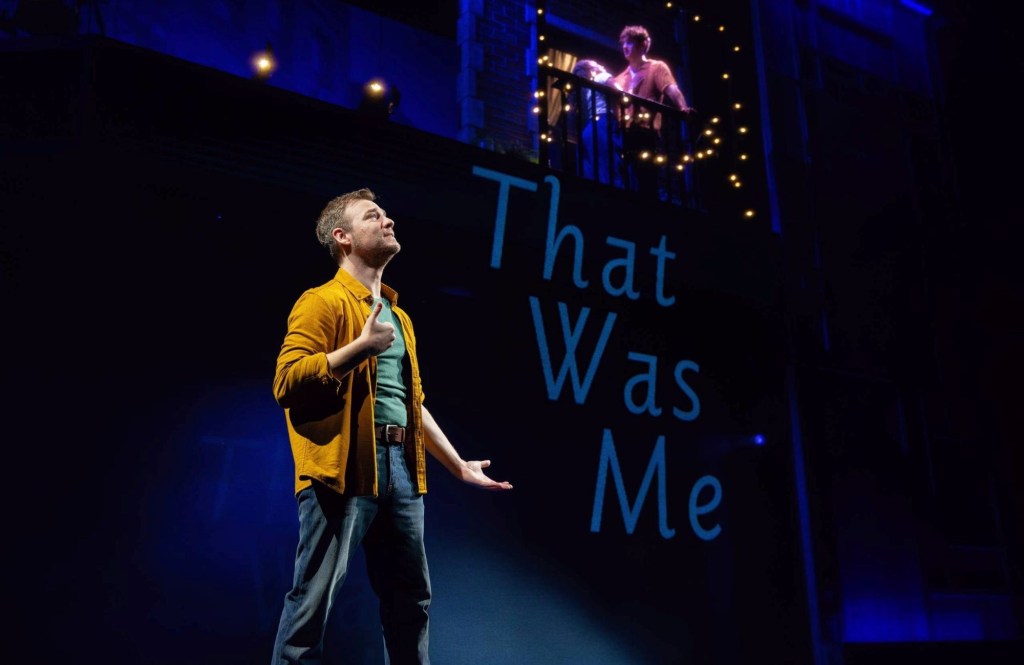
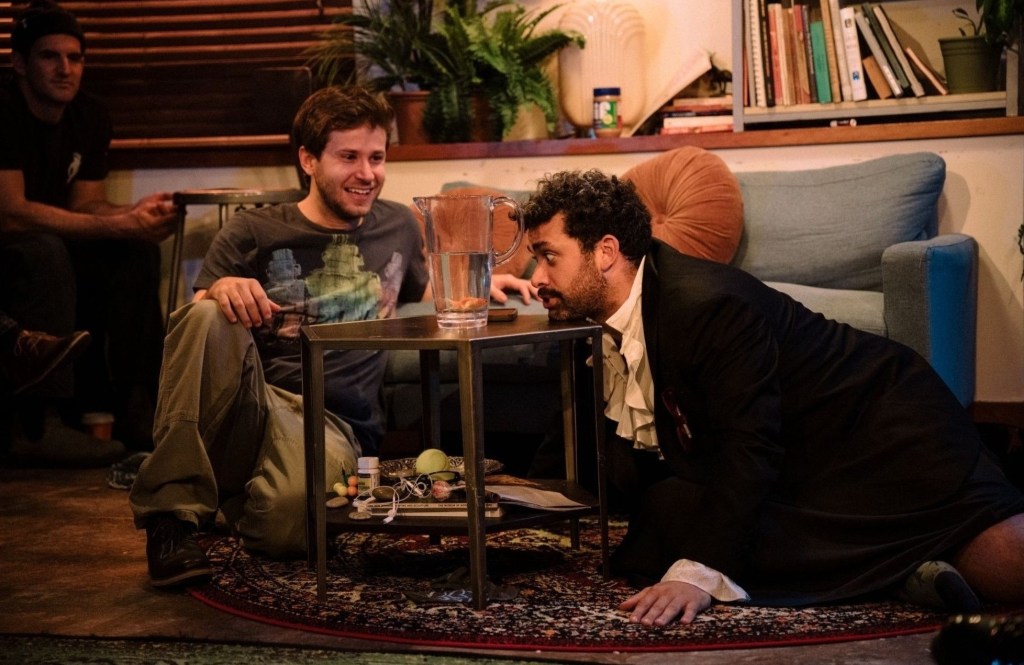
Photo of a scene from Night Side Songs by Marc J. Franklin.


















Leave a comment