A journal for industry and audiences covering the past, present, and future of the musical stage.
No Singing in the Navy, The “Golden Age” of the Musical Theatre, Lunchtime Follies, and More
Today is Sunday, and this week’s Report features a review of No Singing in the Navy, including, for the first time and hopefully the only time, a critique of the production’s curated program material. Plus, a quote of the week; select press announcements from the past week; and a list of the upcoming week’s previews and openings.
QUOTE OF THE WEEK
The first two pages of an essay, by Kurt Weill, discussing his association with Lunchtime Follies, a series of miniature revues designed specifically for war workers during World War II, and sponsored by the American Theatre Wing, formerly the Stage Women’s War Relief:
My life with the Lunchtime Follies started one day in the spring of 1942. I was sitting at lunch with Moss Hart and we were talking about that one problem which was on everybody’s mind during that period: how can I find my place in the nation’s war effort? Somehow we felt that those who were young enough to serve in the armed forces had at least one slight advantage because somebody else decided for them what they could do for the country. We had to go out and find a place where we could be useful.
Moss Hart told me that he, together with Aline MacMahon and George Heller, had been studying for some time the work of ENSA (Entertainment’s National Service Association), the English government’s own impressive entertainment service which provided entertainment not only for the armed forces but also for the workers in defense plants, with a definite increase of production as the result of these factory entertainments. It was quite obvious, in the spring of 1942, that “victory depended as much on the spirit of fighters in overalls as on the spirit of fighters in uniforms.” If we could, through entertainment, better the morale in factories and relieve workers from fatigue and monotony, we might open up a new field of war activity for the entertainment world.
After some weeks of talks and committee meetings, Moss Hart had decided that the only way to test this idea was to put on a show in a defense plant. He had obtained permission from the U.S. Navy to give a show during the lunchtime period at the Wheeler Shipyard in Brooklyn and now, together with Harold Rome and Kermit Bloomgarden, he was busy putting together a little variety show and asked me if I would help. A few days later we arrived at the shipyard with a group of about 10 performers. The workers had built a little outdoor stage in a square overlooking the sound, against the background of a victory ship which was just ready to be launched. It was one of the most exciting moments of my theatrical life when at noon, with the sound of the lunch whistle, some 1400 men rushed into the square and watched the show while they were eating their lunch.
The show consisted of some singing and dancing, with the Kaufman & Hart sketch “The Man Who Came to Russia” as the centerpiece. We felt immediately that the idea was what Broadway would call ‘a natural.’ It had the informality, the genuine popularity, the immediate contact between audience and performers which you find when a wandering circus comes into a small town. Strangely enough, ever since, when I went out with one of our shows, I experienced the same excitement at the sound of the whistle, the same feeling that this was theatre in the oldest and best sense, comparable to the Greek theatre, the Chinese theatre, or the miracle plays of the Middle Ages. But, what was more important for us: the men liked it, they were grateful and happy and they were still humming Harold Rome’s tune “Gee, But It’s Cold in Russia,” they were still laughing at David Burns’ Hitler take-off when they went back to work…
NO SINGING IN THE NAVY AT PLAYWRIGHTS HORIZONS
No Singing in the Navy opened a world premiere engagement this evening at Playwrights Horizons, and it is juvenile and pretentious and sloppy and stale – an abject embarrassment written by Milo Cramer and directed by Aysan Celik.
The musical runs roughly 80 minutes, and it follows three “silly” sailors on 24-hour shore leave, but the piece seems entirely uncertain what it wants to do and what it wants to be, and though Cramer evidently intends for the intimate three actor, one piano affair to address the innocence, the delusional optimism, the absence of detail and depth that Cramer (incorrectly) believes define the “Golden Age” of the American musical, No Singing in the Navy suggests that Cramer is the one who is innocent – ignorant – naïve. Indeed, Cramer and their colleagues have demonstrated, in their work on this piece, little understanding of the musical stage, practically or especially historically, and they have demonstrated, in their discussions of this piece, the same, as well as a socio-political viewpoint that is based on false absolutes and devoid of context and nuance. And Cramer’s colleagues, in this instance, include the artistic leadership of Playwrights Horizons: Adam Greenfield and Natasha Sinha.
To be clear, I do not, as a rule, read program notes, curated interviews, or curated essays, and certainly not before the respective performance, but I was compelled to read the program note, by Cramer, the interview, by Sinha, and the essays, by Greenfield and playwright Alex Lin, associated with No Singing in the Navy, after the performance, and they are just as infuriating, just as embarrassing as the musical itself: unfettered foolishness, of the unfunny and destructive sort. What, for instance, is “the Golden Age style?” And did “glossy polish,” “glitz and glamor,” “flashing lights,” “spectacle,” “orchestra swells,” and “pristine precision” not exist on the musical stage prior to Greenfield’s “Golden Age” start date of 1943? Or, for that matter, after Greenfield’s “Golden Age” end date of 1963? And was the “Golden Age” really the time when the theatre was part of popular culture? Was the theatre not at or near the apex of popular culture in, for instance, the early 20th century, and did it not, at that time, almost directly overlap with the popular song?
The middle of the 20th century, running essentially from the 1930s to the 1960s, is a convenient target for the uninformed likes of Cramer, Celik, Sinha, Greenfield, and Lin, because many of the stage musicals written and produced during that time are remembered and or regularly performed today, whereas nearly all of the stage musicals written and produced in the decades prior are not. The reason for this (understandable) disparity is not the advent of cast recordings, though cast recordings have surely contributed to the longevity of certain properties. The reason is that many of the stage musicals, including original revues, written and produced in the middle of the 20th century are solidly-to-exceptionally well made, i.e. dramatically effective works, with character and distinction, in which the various elements have been seamlessly or almost seamlessly woven into a single theatrical statement, a unified theatrical whole, regardless of one’s feelings about a particular story, whereas nearly all of the stage musicals written and produced in the decades prior are, again, not. Why? Because the musical theatre matured in the middle of the 20th century, principally in America and specifically in New York, through a decades-long movement, begun about the 1910s and brought to a close in the 1960s, to better the art of musical storytelling – a movement, documented in the words and works of numerous artists, that simultaneously established the enduring standards of excellence in musical storytelling – which are not to be confused with the nonexistent rules of musical theatre.
When, in the early 1960s, composer Arthur Schwartz was asked about the requirements for a musical at the time vs a musical at the time he began writing, in the 1920s, Schwartz replied, “They must be better.” Composer Johnny Green, who similarly began writing in the 1920s, replied, “Music and lyrics must not occur as quasi-islands or little olios, but must specifically carry forward the dramatic action and or its intent. No longer can a song or a choreographic segment be considered valid if, should it be dropped, the dramatic values would be complete without it.” Book writer and lyricist Alan Jay Lerner noted, “There has been a far greater emphasis on the quality and credibility of the book.” Sketch writer and lyricist Arnold B. Horwitt added, “The book has to be immensely better.” Lyricist and composer Harold Rome advised, “Skill in where and how to spot the songs and make them carry character and plot interest is necessary.” And lyricist and composer Johnny Mercer concluded, “We have more expert, refined musicals.”
The maturation of the art form is what defines the middle of the 20th century, from a standpoint of the musical stage. Not any one style. Not any one sound. Not any one story. Not any one show. Not any uniform or unique polish or precision. Not any uniform or unique lack of detail and depth. Not any uniform or unique depiction of innocence, optimism, or social customs and social sensibilities, culled from the American consciousness.
The middle of the 20th century is Call Me Mister and Guys and Dolls; Cabaret and Lunchtime Follies; Ballet Ballads and My Fair Lady; Bye Bye Birdie and Lend an Ear; Cabin in the Sky and Little Mary Sunshine; Are You with It? and Lady in the Dark; The King and I and Oh What a Lovely War; Oklahoma! and Pins and Needles; Love Life and Wonderful Town; Damn Yankees and Trumpets of the Lord; Of Thee I Sing and Take Me Along; Anya and Beggar’s Holiday; Make Mine Manhattan and 1776; Anyone Can Whistle and The Apple Tree; A Funny Thing Happened on the Way to the Forum and Street Scene; Little Me and Lost in the Stars; St. Louis Woman and Where’s Charley?; Annie Get Your Gun and One Touch of Venus; The Cradle Will Rock and The Pajama Game; The Gay Life and West Side Story; Candide and Top Banana; Ernest in Love and Stars and Gripes; I Do! I Do! and Knickerbocker Holiday; The Hot Mikado and The Most Happy Fella; High Button Shoes and 3 for Tonight; The Boys from Syracuse and How to Succeed in Business without Really Trying; Allegro and Promises, Promises; Funny Girl and High Spirits; Bells Are Ringing and Show Girl; Star and Garter and Your Own Thing; Finian’s Rainbow and Reuben, Reuben; Barefoot Boy with Cheek and Kiss Me, Kate; Follow the Girls and Two on the Aisle; I Can Get It for You Wholesale and I Had a Ball; Blackouts and Tan Manhattan; Do Re Mi and Hello, Dolly!; The Beast in Me and Stop the World – I Want to Get Off; The Fantasticks and Wish You Were Here; Pretty Penny and Sweet Charity; Kismet and Man of La Mancha; Carmen Jones and Count Me In; South Pacific and You’re a Good Man, Charlie Brown; The Music Man and La Plume de Ma Tante; Golden Boy and Regina; No for an Answer and The Shoestring Revue; Flahooley and Phoenix ’55; Gentlemen Prefer Blondes and Wait a Minim!; One for the Money and Two for the Show and Three to Make Ready; etc.
No Singing in the Navy is an amorphous blob of half-baked, though not necessarily unprofitable, ideas involving familiar devices that Cramer & Co. somehow seem to think are fresh, automatically, despite the familiar devices having been executed here without skill, taste, style, relish, or a particular point of view and toward no clear end. Take, for instance, the onstage pianist who occasionally engages in the action or serves as a hat rack; the slithering atop the piano of a crusty old captain; the homoerotic musing of the crusty old captain while slithering atop the piano; the murdering of a single sailor by the crusty old captain; the screaming death of said sailor atop the piano; the burlesque fighting played against a philosophical ballad; the donning of disguises plucked from a clothing rack stage left; the hourly countdown; the audience sing-a-long; the baby; the audience booing during the show within the show; the tortured asides delivered during an upbeat refrain; the sailor who loves to sing but is ashamed to admit that he loves to sing until he erupts in song; the noting in the captain’s log of day nine billion, followed by the noting in the captain’s log of day nine billion and one; or the burlesque dialogue involving one or two words repeated ad infinitum: “war war war war war war war.”
Nothing congeals, nothing fully develops, and nothing matters in this faux-trenchant affair, because Cramer has made no effort to define or detail the world or the narrative composition, let alone the narrative. Inconsistencies and dramaturgical inanities abound, unproductively and nondeliberately. The stakes are nonexistent. Tension and propulsion and escalation are nonexistent. The action haphazardly meanders, from a crab bucket to a casino and so forth. The lines and lyrics are mostly dull and muted, failing to provide a springboard for excitement and fun and purposeful play. (Though an up-down motif within the casino number holds considerable interest, and the use of interrogatives in the crusty old captain’s homoerotic musings is valuable.) And the piano accompaniment is awful, tending to alternate between a series of sustained chords and a series of spacious pulses, without the combination developing into a definitive musical aesthetic, and, in both instances, sans embellishment or fill, leaving the songs bottomless and unsupported and earthbound and sounding repetitive. And the banging chords in the emotionally vacant, dramatically artificial finale carry practically no impact, because banging chords have been heard practically all night – and not in such a thoughtful, calculated fashion as to build-up to this particular moment. (Kyle Adam Blair is music director and pianist.) But who cares, and what are we doing here in the first place?
No Singing in the Navy does not effectively register as a satire of the “Golden Age,” regardless of one’s (mis)perception of the period. Nor does it effectively register as a comment on the same. Nor does it effectively register as a satire of – or comment on – perceived American innocence. (America was never innocent, though each new generation may be, initially.) Could the musical, then, be nothing more than the author’s take on familiar wartime tales believed by the author to have previously been told incorrectly, evidently marred by, among other things, patriotism, impossibly genuine? (Surely Kurt Weill, in 1942, did not really want to contribute to the war effort out of a sense of patriotism and duty, intent on lifting the morale of his fellow countrymen in these United States, and surely neither did Rachel Crothers, in 1917, really want to contribute to the war effort when she founded the Stage Women’s War Relief, while these United States were submerged in lynchings, censorship, anti-immigration crusades, prohibition laws, and women’s suffrage.) Or could the musical be the author’s comment on his own take? Or, since Greenfield, in his essay, references the 1945 film Anchors Aweigh as a “Golden Age” musical, could Cramer have actually meant to tackle movie-musicals – an entirely different medium? Perhaps, perhaps, perhaps, perhaps, perhaps, perhaps, perhaps. If only Cramer had revealed a distinct, individual voice and an appreciation for craft, and if only he had crafted his piece with cleverness and ingenuity and specificity and conviction and…
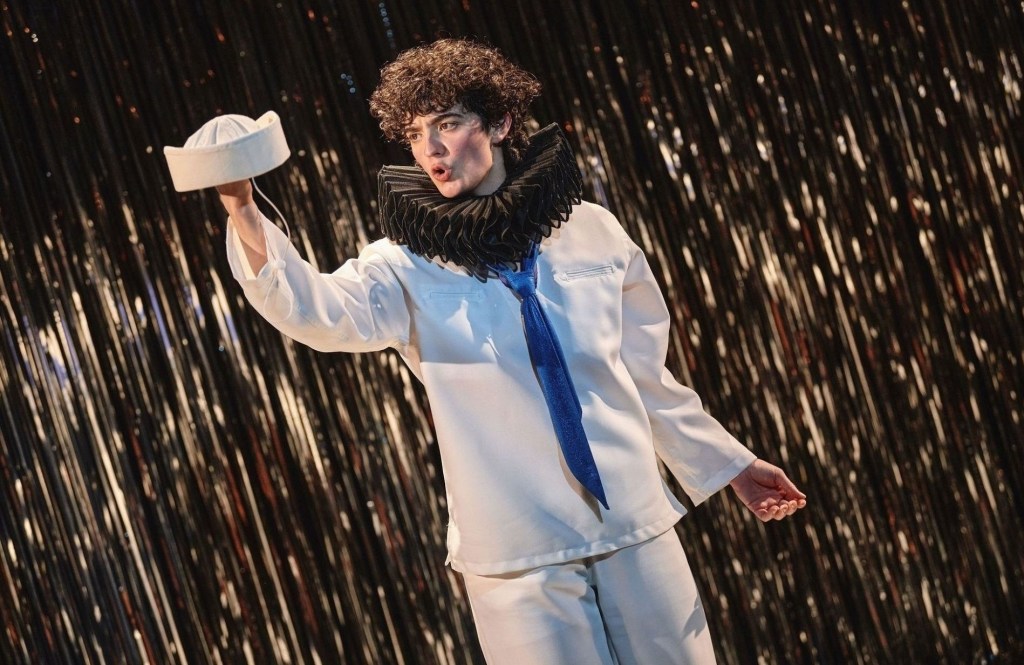
The staging is in the dumps with the material, and two of the three actors, Bailey Lee and Elliot Sagay, are unhelpful. But Ellen Nikbakht has a real presence and real ability, and she almost makes the crusty old captain’s homoerotic musings engaging. One hopes Nikbakht will be seen to better advantage in the near future. One hopes, as well, that Cramer will soon return to the musical stage with a vengeance. And know-how. And deliver something as genuine and fresh and at least as good as, say, On the Town.
PRESS ANNOUNCEMENTS
Here is a list of select press announcements from the past week. Each headline is clickable for more information.
• Pre-Broadway Stage Mother and Unlock’d and More Set for Phoenix Theatre Company 107th Season
• New York Theatre Workshop Sets In Honor of Jean-Michel Basquiat and Wild Rose for 2026/27 Season
• Broadway-Aimed Loch Ness Will Make World Premiere at Two River Theater in 2027
• Creative Team Revealed for New Dave Malloy-Jen Silverman Musical Black Swan
• Freak The Mighty Musical Will Make World Premiere at Seattle Rep
• Joanna ‘JoJo’ Levesque Will Join Chess as Florence Vassy
• Gloria and Emily Estefan Musical Basura Finds Full Casting for World Premiere
• See Who’s Joining Jennifer Nettles in Her World Premiere Musical Giulia
• Ragtime Extends for a Second Time on Broadway
• Falling Out: A New Musical Extends Run at Chelsea Table + Stage in May
• New York Theatre Workshop Extends My Joy is Heavy Off-Broadway
• Trainspotting Musical Sets London World Premiere
• Menopause The Musical Will Embark on 25th Anniversary Tour This Summer
PREVIEWS AND OPENINGS
Here is a list of the new musicals and revivals either opening or beginning previews during the upcoming week, specifically on Broadway and Off-Broadway. It contains, as well, select new musicals beginning performances regionally, and select new musicals and revivals beginning performances in New York City. Each title is clickable for more information.
Monday, March 30
• Concert: Songs for a New World
Tuesday, March 31
• Opening: Gotta Dance!
Wednesday, April 1
Thursday, April 2
Friday, April 3
Saturday, April 4
• Previews: Schmigadoon!
Sunday, April 5
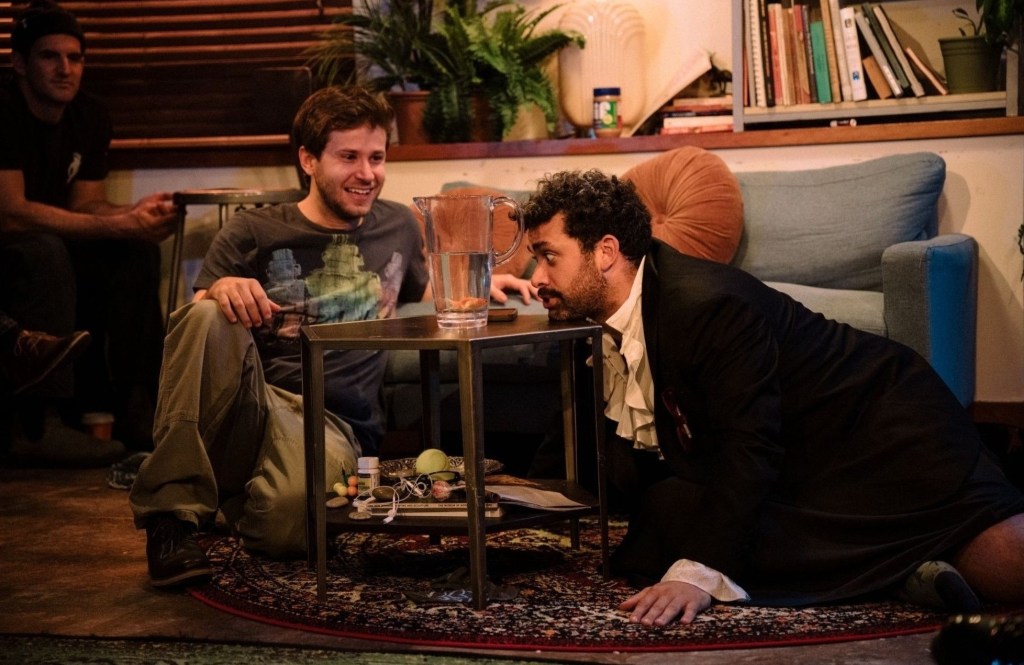
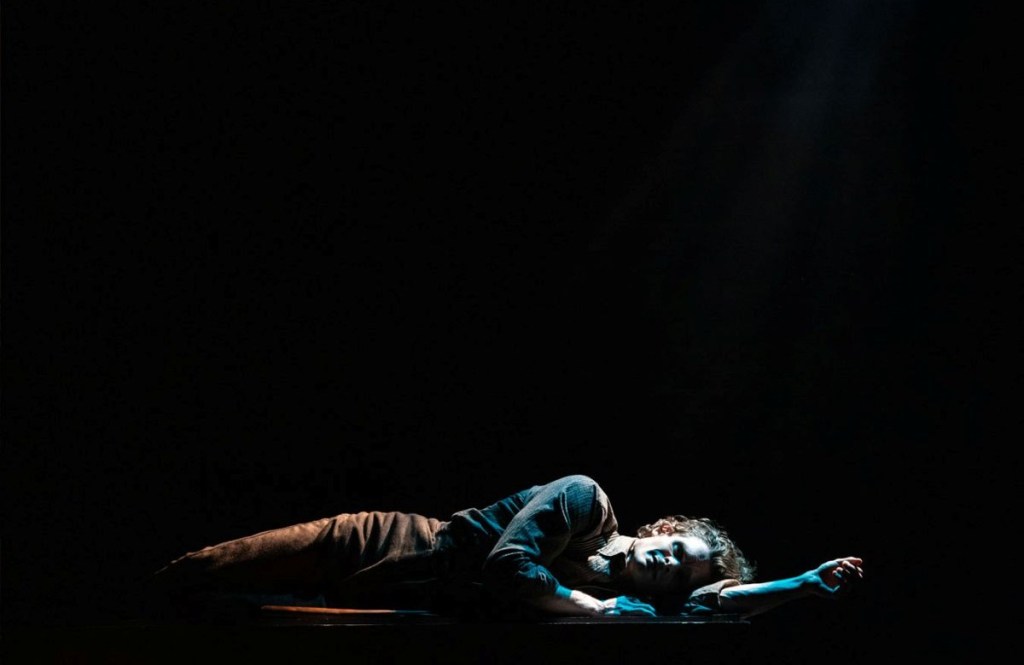
Photo of Ellen Nikbakht in No Singing in the Navy by Valerie Terranova.













 The Musical Theatre Report
Leave a comment