A journal for industry and audiences covering the past, present, and future of the musical stage.
Today is Sunday, and this week’s Report features a review of Gotta Dance!; a reappraisal of Two Strangers (Carry a Cake Across New York); and “No Stage Musical is (Daringly) Unstructured!” Plus, a quote of the week; select press announcements from the past week; and a list of the upcoming week’s previews and openings.
QUOTE OF THE WEEK
A note from Henry Creamer to the Registrar of Copyrights, dated December 17, 1926, and attached to the script and score of Chicago Loop, “a musical comedy in two acts,” with a book and lyrics by Creamer and Ted Wing and music by Jimmy Johnson.
Dear Sir:
The absence of dialogue in numerous places in this play with music, Chicago Loop, is intentional. The general character of the dialogue is given only. The actors are expected to originate, each for himself, dialogue suitable for the occasion, and this will necessarily change with each actor and probably with each presentation of the play or “revue.”
Henry Creamer
GOTTA DANCE! AT STAGE 42
Gotta Dance! opened an Off-Broadway engagement on Tuesday at Stage 42, after previously having been seen, not by me, at Theatre at St. Jean’s under the auspices of The York Theatre. It is conceived by Nikki Feirt Atkins and directed by Atkins and Randy Skinner, and it is a random assortment of first- and second-rate dance numbers from first-, second-, and third-rate musicals, presented in a straightforward – and borderline tacky – concert fashion.
Robert Alton, George Balanchine, Gower Champion, Agnes de Mille, Michael Kidd, and a handful of other choreographers who might be considered “major” figures in the musical theatre are not represented in the musical’s curious routine, while Ron Lewis, Joey McKneely, Randy Skinner, Lynne Taylor-Corbett, and Billy Wilson are – which is not, in and of itself, a misstep or a minus, but the selected routines of these five individuals are generally unremarkable, even perhaps insignificant, and, in at least two cases, not particularly theatrical. (An argument might be made for a third.) Lewis’ “City Lights,” a Las Vegas showpiece from the 1977 musical The Act, nonetheless has something to appreciate – and perhaps even something instructive – in its relentless show-business bent, complete with sharp, in principle, kicks, flicks, and punches, unison work, ripple work, and hat work, and forceful straight-line strides onstage and off. And the number is at least minimally escalatory, even if not skillfully or methodically so. But what is the number really serving? And what is the choreography serving? And how?
Plus, Gotta Dance!, despite occupying a mere 85 minutes of stage time separated by an unearned intermission, contains two numbers from Singin’ in the Rain, credited to Stanley Donen and Gene Kelly. Yes, the popular 1952 film was adapted for the stage in 1985, but does that really warrant its inclusion in a Broadway retrospective? And with two mediocre numbers no less? Numbers which, by the way, are being rendered incompletely and without the camera angles with which they were made.
The opening, choreographed by Skinner, is weak and insubstantial. “Love Potion #9,” choreographed by Skinner, is conveniently attributed to the 1995 musical Smokey Joe’s Café, despite McKneely’s choreography not having been recreated. And while “All I Need is the Girl” from the 1959 musical Gypsy, “Cool” from the 1957 musical West Side Story, “Glory” from the 1972 musical Pippin, “One” from the 1975 musical A Chorus Line, and “Simply Irresistible” from the 1999 musical Contact have, in principle, much to savor in their combination of story, music, movement, and, where applicable, lyric, “Simply Irresistible” is a disadvantageous edit of the original, choreographed by Susan Stroman, and the dancing almost throughout the show is marked by stiff limbs, imprecision, and a lack of synchronicity, detail, finish, and attack. And a lack of character – which is not merely a result of separating the segments from their surroundings.
Indeed, the cast of Gotta Dance! is of the junior-varsity sort, with Jessica Lee Goldyn being a clear standout. But Goldyn has little in the way of vocal chops or, when she is not strictly dancing, acting chops, and she fails, as such, to play the long, long listicle lyric, by Fred Ebb, for “City Lights,” and the scene, by Nicholas Dante and James Kirkwood, and the lyric, by Edward Kleban, for “The Music and the Mirror,” from A Chorus Line. Other solo voices in the cast tend to be strong, but similarly deficient in the delivery of lyric.
Gotta Dance! is produced by Riki Kane Larimer, whose name is invoked during the pre-show announcement, and bigger than all of the other names on the title page of the program. (Two historically ominous signs.) The idea upon which the dance revue has been built is potentially profitable, but Larimer & Co. have not built the potentially profitable idea into a distinctive theatrical entertainment, with a cohesive, carefully curated collection of dances, and a specific compositional language, a specific manner, a specific world, an expert routine. Not to mention a meritorious cast.
A REAPPRAISAL OF TWO STRANGERS (CARRY A CAKE ACROSS NEW YORK)
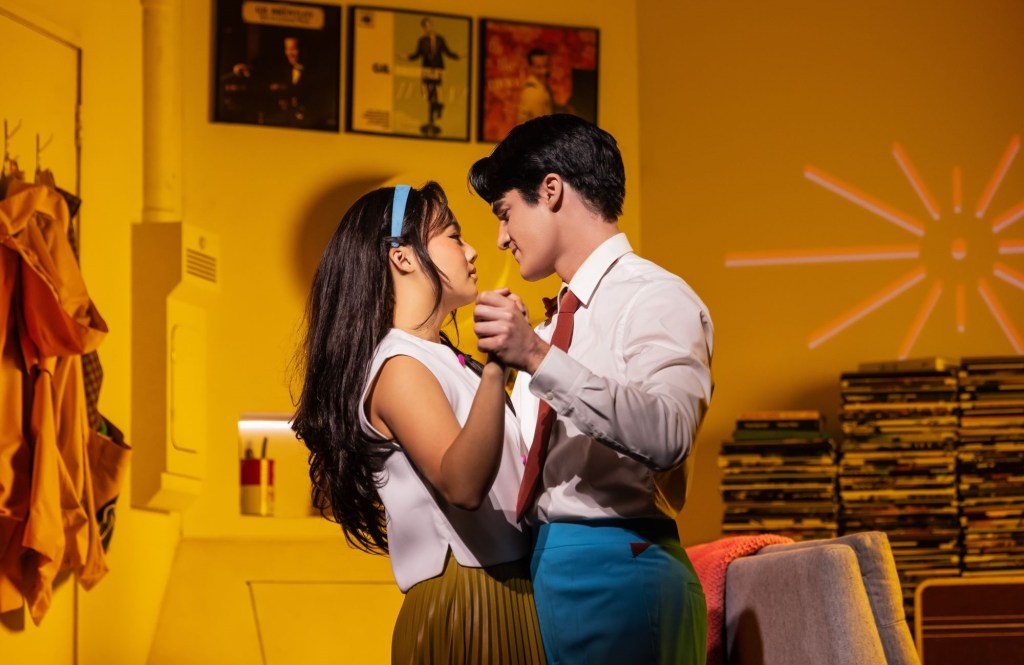
Two Strangers (Carry a Cake Across New York), a new musical made in Britain, is currently running on Broadway at the Longacre Theatre, after previously having been seen at American Repertory Theater in Cambridge, Massachusetts. The piece, a romantic comedy of sorts, is written by Jim Barne and Kit Buchan and directed by Tim Jackson, and, in my review of the pre-Broadway run, I called it a syrupy, mostly superficial affair, marked by convenience and intermittently fine material motifs. Sadly, nothing, in essence, has changed: the musical and the production remain terribly faulty. Let us forego a rehash of the story and plot and jump right in.
Why, for instance, does Robin meet Dougal at the airport in the first place, when all she does is escort him, via public transportation, to the Chinatown hotel that he had to secure for himself, and when Melissa, in a subsequent phone call with Robin, does not ask Robin for any information about Dougal or even recognize his name? And why does Melissa not ask any information about Dougal or even recognize his name, when Melissa is the one intent on Dougal coming to the wedding, sending him an invitation, without Mark’s knowledge, because she does not want Dougal to be her new husband’s “little secret?” Why does Melissa not meet Dougal at the airport herself? Why does she not send him a car? Why does she not arrange a hotel for him? Why does Dougal even need an escort? How did Melissa even find out about Dougal, given, as we are told by Robin, Mark has ‘never spoken a word’ about his son, nor does he have any interest to see his son? And why, if Melissa is so upset with Robin, does she let Robin in on the secret?
One could certainly try to explain away Robin’s airport run as one of the many errands with which Melissa is punishing her (for having had an affair with Mark) and tasking her (such that she might earn an invitation to the wedding), but one would be quite unsuccessful in offering an explanation of the sort, given the conflicting information that the authors have gleefully strewn about, loose ends flailing. Plus, that subsequent phone call between Robin and Melissa occurs the morning after the evening run. Would Robin not have told Melissa she collected Dougal immediately after doing so?
Why, furthermore, has Melissa ordered an individually boxed, assemble-it-yourself wedding cake, given the wealth of the groom and the lavishness of the wedding? And why must the individually boxed, assemble-it-yourself wedding cake be picked up and transported by a member of the wedding party? And why the day before the wedding? And why to Melissa’s apartment rather than to the venue? (Melissa must have a very large refrigerator.)
Why did Melissa drop off Mark’s credit card such that Robin can pay for the cake, rather than Melissa simply paying for the cake herself over the phone? And when did Melissa drop off Mark’s credit card? And if Melissa is punishing Robin with errands, why did Melissa drop off Mark’s credit card rather than making Robin retrieve it?
Why are the four cake boxes not even taped together? Why does Dougal not ask a thing after Robin delivers three-quarters of the cake? Why does a note from Mark not say a thing about the missing layer? Why does Melissa suddenly agree to Robin attending the wedding? And why does grandma’s voicemail not account for the wedding? The incidents and revelations of Two Strangers are factory-made for the moment, doused with preciousness and hammered together by external forces, without regard for coherence, continuity, or completeness.
Dougal has been handed, by the authors, a fairly strong launch with a clear trajectory, due in large part to two back-to-back solos that have solid-enough stage lyrics, and that exist, happily, in a single time and place, even though the first, “New York,” technically finds Dougal in transit. Robin, however, has been handed a weak, sputtery launch with a fuzzy trajectory, due in large part to a dramatically ineffective coffee-shop solo, “What’ll It Be,” outfitted with a nonspecific, wandering lyric; burdened with the parallel passage of time and unassociated physical activity; and slotted third in the questionable routine, after Dougal has taken flight with his two solos. Robin’s second solo, “Be Happy,” suffers from similar lyrical deficiencies, and nearly occupies the same narrative lane. And do all four of the first-act duets not serve, more or less, the same dramatic purpose, sans any real stakes? (A matter for which the book must be at least partially blamed.) Plus, “On the App” and “Under the Mistletoe” are largely labored, and “This is the Place” is the only one of the four to reveal anything personal about the characters – and the personal revelations are minimal at that.
The use of dual modes for “The Hangover Duet” is a terrific idea, inexpertly executed, with an unfunny, artificial lyric, especially for Robin, and an abrupt conclusion, sans climax or counterpoint. “What Did You Say?” is terribly forced. The lyric for “This Year” is another knotty, impersonal radio edit for the leading lady, failing to individualize or interrogate character. And a few of the song entrances are nondeliberate, with the band stepping on dialogue. But the authors must be credited for their handling of the song endings – which feature either a definite button or a deliberate return to dialogue. If only the songs themselves had been more skillfully crafted, specifically serving story and character – even though they, collectively, harbor several valuable dramatic devices, like the well-positioned key changes in “New York.” (Lux Pyramid created the orchestrations, and Nick Finlow is music supervisor.)
Some of the dialogue is strong, snappy, even smart, particularly the exchanges that find Dougal referring to Robin as his aunt, and the laughs, in such moments, are earned, rooted in situation and character. Likewise, if one disregards the musical’s half-formed premise, an instance of physical comedy that finds Dougal throwing the freshly dropped cake-box back onto the floor. But most of the dialogue and most of the scenework is immature.
The coffee-shop scene, in particular, is an absolute joke, with Robin setting up her station, talking and not talking to customers, shouting and not shouting orders, informing customers of completed orders that she has not been seen taking, and so forth. And the Chinese restaurant scene is similarly laughable, culminating with a check that never arrives and a bill that never gets paid. (The unique narrative challenges of a musical with two characters might be effectively addressed with imagination and rigor, but Barne and Buchan have, with Two Strangers, revealed themselves to be careless and lazy writers, if not without talent or comic instincts.)
A lengthy subway ride is, miraculously, devoid of intermediate stops. A couple of scenes in the first act fail to effectively build into song. The top of the show is not especially propellant. And though much might have been had in the way of drama and dynamism and theatricality with Dougal and Robin constantly throwing themselves into different physical circumstances – an AirTrain, a subway car, an uber, a nightclub, a skating rink, a fitting room, a hotel room, a street, an apartment, a different street, etc. – the (careless and lazy) authors and especially their (careless and lazy) director have made zero effort – or chosen not to – detail and define each circumstance. The onstage activity is, as such, a blur, not productively, theatrically, sharply fluid.
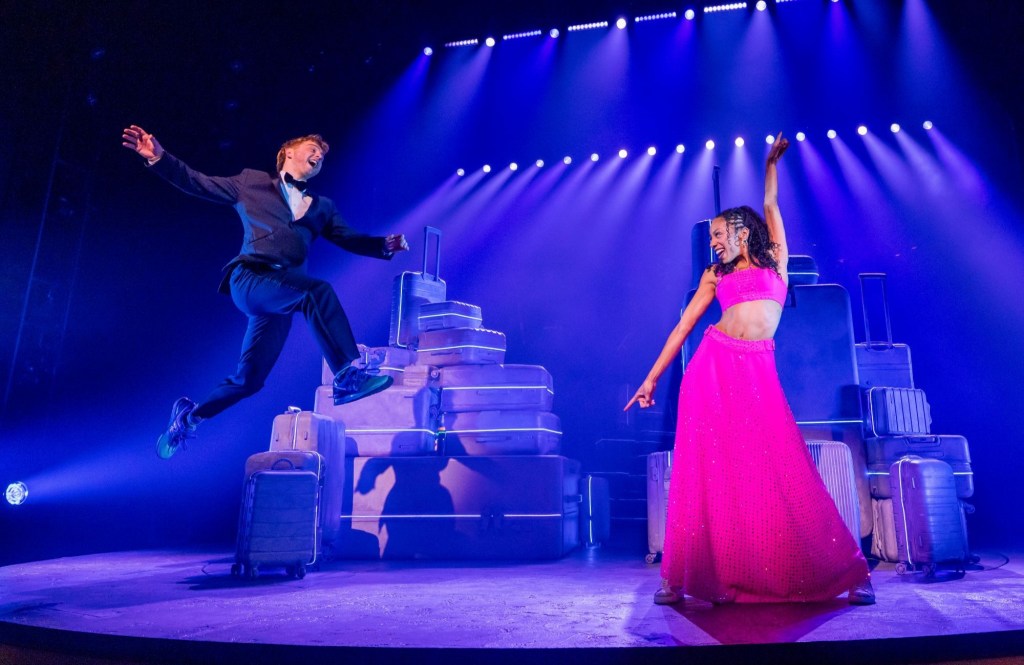
Relatedly, the scenic design, by Soutra Gilmour, is clever and functional, but the numerous compartments hidden inside the two towers of oversized luggage have not been effectively exploited. They include a bar, a minibar, a table, a trash can, a mirror, a closet, and the like. Unfortunately, the opening and or closing of each compartment goes entirely unacknowledged, entirely unaccented in the material and the staging, save the slamming shut of the bar, in the first-act finale, which is synchronized with the start of thumping house music. The compartments are otherwise treated as perfunctory, throwaway gestures, robbed of a moment, generating no tangible payoff, and contributing to the onstage blur.
The turntables are not effectively exploited either, and the choice to have Robin walk the outer revolve for the better part of her eleven o’clock is utterly bizarre. She and Dougal have, by that point, been walking the outer revolve on and off for roughly two hours, so what is new?
Happily, Christiani Pitts has gained a personality since the Cambridge run. Though she has precious little with which to work in the way of material, she is (now) alive and present in a most welcome way. Sam Tutty continues to give a strong performance. But his strong performance seems to be inching toward looseness. Plus, on the evening of April 2, the actor appeared to check-in with the audience at two different points during the show. Tutty has real talent. One hopes he does not start squandering it.
Two Strangers (Carry a Cake Across New York) might have been a nifty musical comedy. It is not. And my husband, for the record, was not particularly fond of the piece, telling me he would give it “only a five or six out of ten,” and hammering the score.
NO STAGE MUSICAL IS (DARINGLY) UNSTRUCTURED!
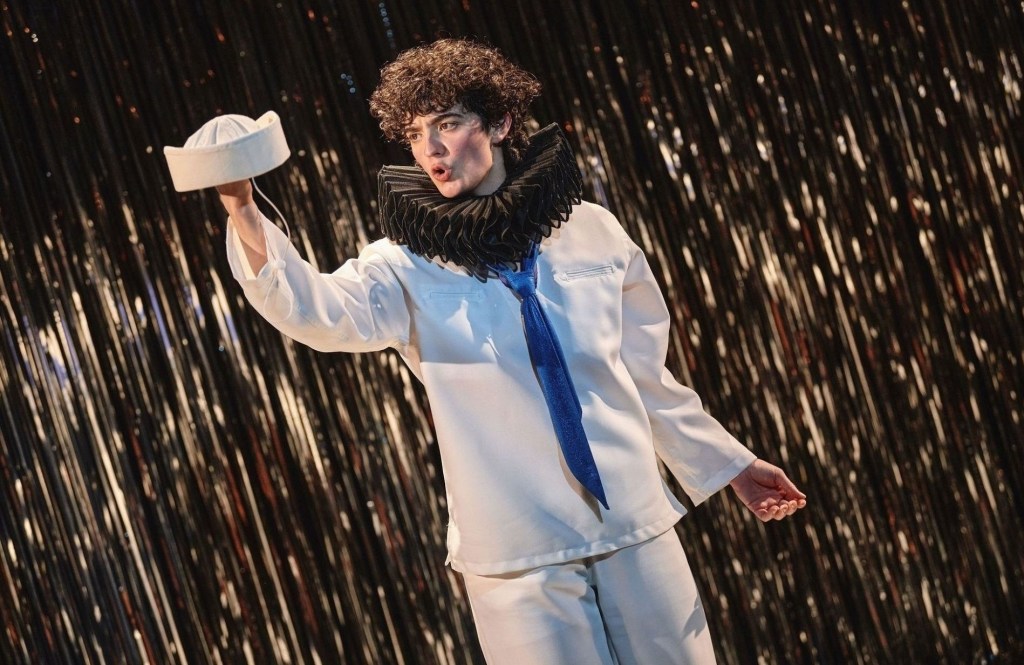
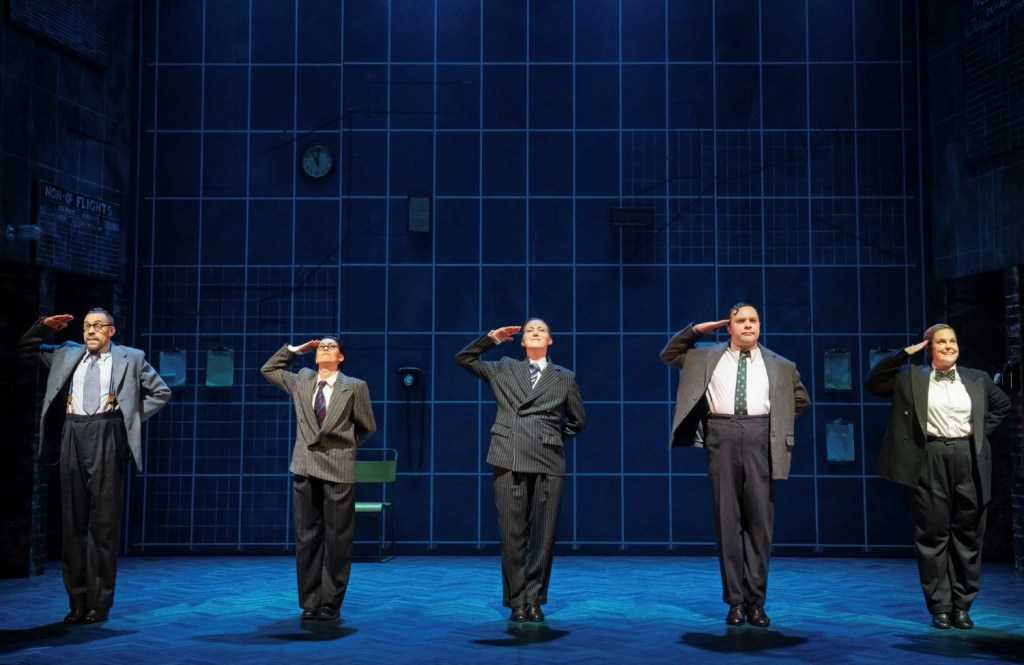
No Singing in the Navy opened last Sunday at Playwrights Horizons, and one review described the piece as “daringly unstructured” – which is, as a matter of fact, impossible. A musical might, for instance, be carelessly structured, or loosely structured, or haphazardly structured, or inexpertly structured, lacking or even absent detail and definition and direction and shape, resulting in an incoherent, scattershot, and or rudderless narrative, an amorphous blob, but no scripted stage musical – story-driven or revue – is unstructured, daringly or otherwise.
Even certain early 20th century offerings that casually intermingle musical comedy, vaudeville, and revue are structured. Look at Chicago Loop. It contains scenes, songs, dances, specialties, monologues, interludes, a prize fight, a Russian Charleston, a three-part sequence framed by a duet, a five-part sequence concerning an “Arabian Story,” and a six-part sequence staged entirely in pink and buttoned with a set of stairs catching fire. Not to mention loads of improvised dialogue. And every item occupies a specific place in the architecture of the entertainment – which begins with an address from the Governor of Illinois and the subsequent arrival of actors.
Structure has been something of a dirty word for the last several decades, no doubt because many or most members of the industry and its pipelines are under the (false) impression that there exists some singular “musical theatre” structure, evidently realized in the “Golden Age,” and evidently mandatory for all musicals. But there is no one way to make – or structure – a musical. No formula. No fixed pattern. No definitive book of rules. Even as there remains an art to musical storytelling and standards of excellence in musical storytelling, simultaneously established in the middle of the 20th century. Every musical is inherently different and necessarily has its own needs.
Rather than turning up one’s nose at structure, or revolting against – or slavishly adhering to – some singular structure that does not exist, authors, directors, and producers might devote their time and energy to developing and refining the structure best-suited to telling their chosen tale, based on their individual approach and their specific point of view, and they might similarly devote their time and energy to developing and refining the narrative composition best-suited to doing the same.
PRESS ANNOUNCEMENTS
Here is a list of select press announcements from the past week. Each headline is clickable for more information.
• Alliance Theatre Reveals 2026/27 Season – Alice in Neverland World Premiere and More
• Center Theatre Group Reveals 2026/27 Season – The Turning World Premiere and More
• Melanie Moore, Jada Simone Clark and More to Star in Black Swan at A.R.T.
• King Princess Joins the Cast of Girl, Interrupted at The Public Theater
• Pittsburgh Playhouse Will Develop Girls Just Want to Have Fun The Musical for Premiere in November
• Adam Pascal to Direct Toronto-Bound Our Little Secret Musical
• Michael Arden and Douglas Lyons to Develop Happy Feet Stage Musical
• Lana Gordon, Nick Adams, Anneliese van der Pol, More Set for The Music That Makes Me Dance
• Heated Rivalry: The Unauthorized Musical Parody to Open Off-Broadway
• The Danish Girl Will Get Stage Musical Adaptation
• Lin-Manuel Miranda to Direct Film Adaptation of Dave Malloy’s Octet
PREVIEWS AND OPENINGS
Here is a list of the new musicals and revivals either opening or beginning previews during the upcoming week, specifically on Broadway and Off-Broadway. It contains, as well, select new musicals beginning performances regionally, and select new musicals and revivals beginning performances in New York City. Each title is clickable for more information.
Monday, April 6
• Concert: for colored girls…
• Concert: The Last Five Years
Tuesday, April 7
• Opening: Cats: The Jellicle Ball
Wednesday, April 8
Thursday, April 9
• NYC: The Wedding March
Friday, April 10
• Regional: Out Here
Saturday, April 11
Sunday, April 12
• Opening: Titaníque
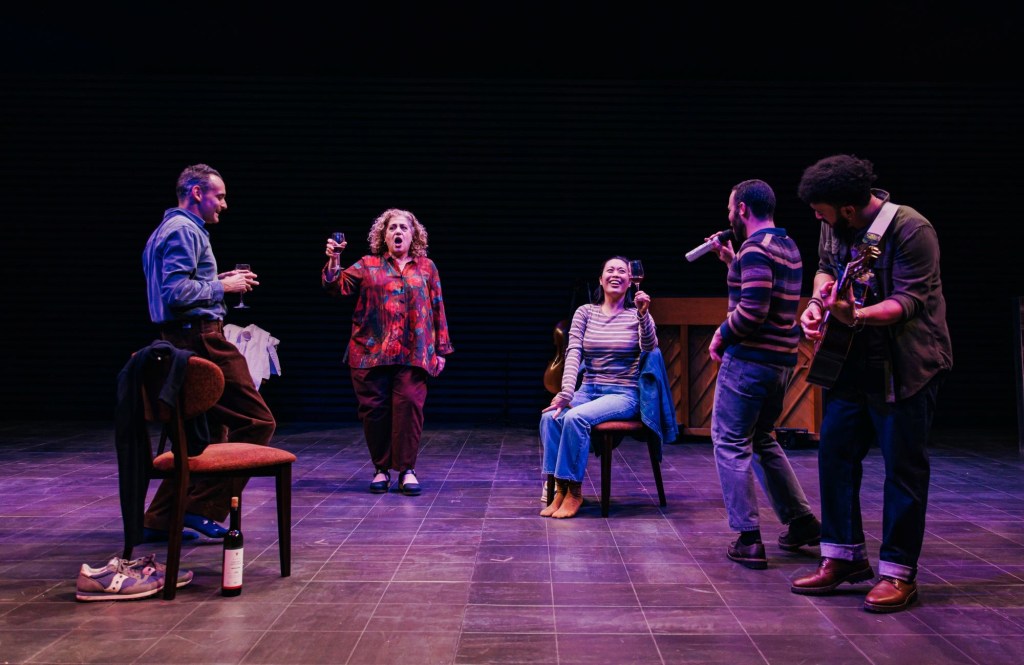
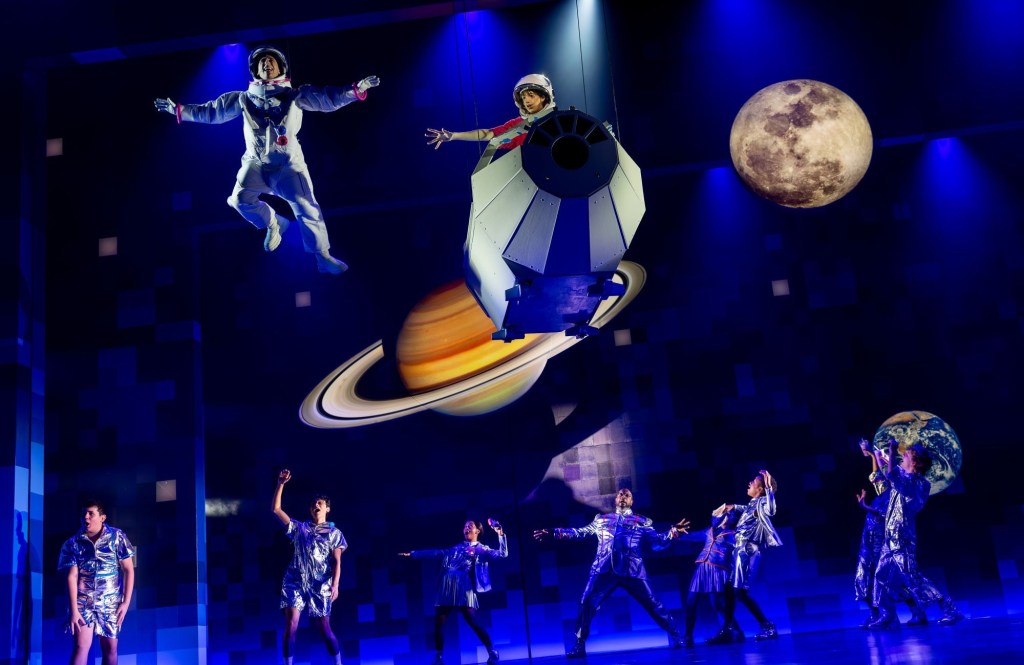
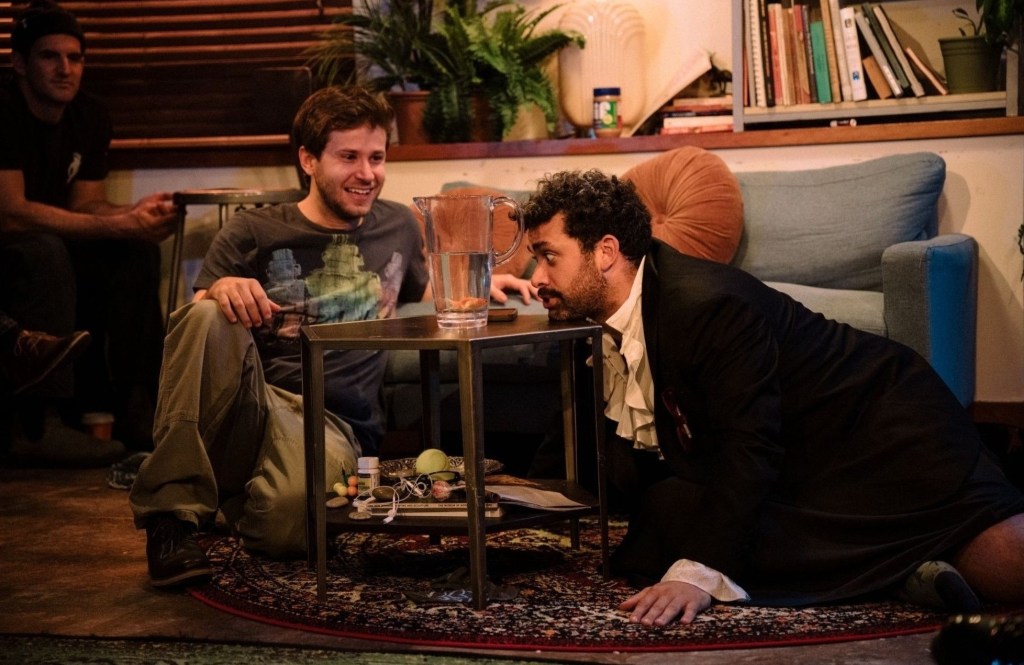
Photo of a scene from Two Strangers (Carry a Cake Across New York) by Matthew Murphy.










 The Musical Theatre Report
Leave a comment