A journal for industry and audiences covering the past, present, and future of the musical stage.
Cats: The Jellicle Ball, Titaníque, A Reappraisal of Safety Not Guaranteed, and More
Today is Sunday, and this week’s Report features reviews of Cats: The Jellicle Ball and Titaníque, and a reappraisal of Safety Not Guaranteed. Plus, a quote of the week; select press announcements from the past week; and a list of the upcoming week’s previews and openings.
QUOTE OF THE WEEK
A note, by Trevor Nunn, from the liner notes for the original Broadway cast recording of Cats:
“Most of the poems comprising Old Possum’s Book of Practical Cats (1939) have been set to music complete and in their originally published form; a few have been subject to a minor revision of tense or pronoun; and eight lines have been added to ‘The Song of the Jellicles.’ However, some of our lyrics, notably ‘The Marching Song of the Pollicle Dogs’ and the story of Grizabella, were discovered among the unpublished writings of Eliot. The prologue is based on ideas and incorporates lines from another unpublished poem, entitled ‘Pollicle Dogs and Jellicle Cats.’ ‘Memory’ includes lines from and is suggested by ‘Rhapsody on a Windy Night’ and other poems of the ‘Prufrock’ period. All other words in the show are taken from the Collected Poems.”
CATS: THE JELLICLE BALL AT THE BROADHURST THEATRE
Cats: The Jellicle Ball, a new production of the 1982 musical, opened on Broadway on Tuesday at the Broadhurst Theatre, after previously having been seen, not by me, downtown at the Perelman Performing Arts Center. The musical is based on T.S. Eliot’s Old Possum’s Book of Practical Cats, with lyrics largely lifted from Eliot’s text, additional lyrics by Trevor Nunn and Richard Stilgoe, and music by Andrew Lloyd Webber. The new production has been conceived and developed by Josephine Kearns, Zhailon Levingston, Bill Rauch, and Omari Wiles, with additional dialogue by Dudney Joseph, Jr. It is directed by Levingston and Rauch, and it is wretched – an aggressively unskilled, abhorrently trashy affair.
The musical, which runs roughly two hours and 40 minutes, is (now) an explosion of queer culture, ostensibly unfolding as a ballroom event, with welcome infusions of cabaret, concert, dance club, and, perhaps most potently and most excitingly, ritual. The concept is promising on paper, but the present execution is the pits, bearing almost no relationship to the preexisting material that the creators have chosen, of their own volition, to exploit – or to the singular medium in which they have chosen, of their volition, to exploit it: the theatrical stage.
To begin with, miniature categorized competitions have been inserted into several musical numbers – which were not written to support, dramatically, said competitions – and, in a deadly misstep, the creators, one of whom is a so-called “dramaturg,” have chosen not to fashion new music arrangements that actively support, dramatically, these competitions, including the judging of these competitions and the presentation of the trophies; arrangements that might simultaneously account for and lend detail and definition to the reconceptualized world. (One particular trophy presentation is pitifully depressed, due to a lack of material support and structural calibration: a dramatic afterthought registering as the antithesis of triumphant.)
Plus, the creators have simultaneously chosen to completely, flagrantly disregard the lyrics of these several musical numbers. (Let us not even discuss the British namechecks, pervasive throughout the score, that the creators have similarly chosen to completely, flagrantly disregard.) The lyrics of Cats, which are surely among the most literate lyrics in the composer’s lyrically deficient catalogue, have everything to do with character and standalone storytelling, and nothing to do with queer ballroom competitions – which would not necessarily be a problem, if the creators had specifically sculpted the songs to account for that fact. But the cats, for these several musical numbers, are essentially being asked, by the creators, to sing live backing tracks, underscoring their own competition. And even then, only the cat(s) about whom the respective lyric is written, not all of the cats in the respective competition – which has resulted in a lopsidedness and or a predictability in the superimposed action.
To make matters worse, the miniature categorized competitions wither away over the course of the show, failing to build to any sort of climactic moment, or even to lead anywhere in particular. The competitions actually wind up detracting from – or conflicting with – the established central thread and the corresponding climactic moment toward which the material has already been designed to build. (This central thread concerns Grizabella, the Glamour Cat, and it works incredibly well, in principle, with the new concept, bolstered by the shrewd amplification of a separate kitten.)
Levingston & Co. have failed to effectively establish, onstage, the parameters of the event and the reconceptualized world of the show, to the extent that they effectively established or fully considered said parameters offstage in the first place, and a handful of the creators’ conceptual motifs are not effectively carried through the show. DJ Griddlebone, for instance, fades into the background after single-handedly igniting the proceedings, in a valuably intriguing fashion: he saunters onstage, sifts through a couple of LPs, blows glitter-dust off the original cast album of Cats, moves to his home in the house-left box during a pre-recorded pre-show announcement, and places said album on his turntable. Meanwhile, the Master of Ceremonies, Munkustrap, disappears in the second act, and the guest judges, a wasted gimmick, disappear in the first, never to return, and without any sort of recognition upon their clumsy departure – which coincides with the clumsy arrival of Old Deuteronomy.
To that end, Levingston & Co. have failed, throughout the show, to build each moment into the next, in a deliberate, propulsive, theatrical fashion. Note, for instance, the clumsiness of the overture, which lacks dramatic development and imagination, and fails to introduce the world. Note the clumsiness of the silent blackout that follows the overture and finds the actors, visibly and audibly, scampering into place. Note the clumsiness of the opening number, which commences with a static isolation sequence and fails to accelerate – emotionally, dramatically – into the runway reveal. And note the clumsiness of the runway reveal, courtesy of the clumsy removal of a velvet rope, causing the unison wedge-work that follows to generate little or no impact, little or no payoff. (The setup of said moment lacks the pressure and focus necessary for the sort of explosive release the creators evidently envision.)
Mungojerrie and Rumpleteazer, who lose their category, spend, at the hands of the creators, roughly one-quarter of their eponymous song offstage, singing while masked by foil curtains, for the express purpose of a costume change – which finds the pair returning to the stage in fashionable green attire, even though one began in green, accented with pink, and the other began in pink, accented with green. (Really?) Unintentionally awkward silence and bizarrely mimed conversations follow the heavy-handed arrest of Old Deuteronomy, even though the creators seem to welcome adlibbing nearly everywhere else in the show. And an elaborate runway sequence first flatlines and then poops out, ending in a nondefinitively, nondeliberately abrupt fashion upon the musically unsupported arrival of a fabulous gold-winged creature.
Playbills are bandied about. The Shubert Organization is invoked. A new “Founding Mothers” slideshow opens the second act. The magical reentrance of Old Deuteronomy is ridiculous. A curtain-tear reveal is shoddily executed. A competitive routine unfolds without either Old Deuteronomy or the guest judges present. The entrances made through the foil curtains are unclean and undefined, though the two executed on a diagonal during “Macavity, The Mystery Cat” might have been fantastic. (They are nonetheless moderately effective at present.) A mass exodus late in the first act is bizarre. (The cat who exited through the house-right aisle on the evening of April 6 said, “It’s time to go home,” which is quite senseless, but my husband followed the cat’s instructions as soon as intermission rolled around.) And the eleven o’clock number, “Memory,” is a near-complete dud, in part because “Tempress” Chasity Moore, as Grizabella, is giving a subpar performance, especially vocally, and in part because her reveal is obscured by the exit of Old Deuteronomy; the steps that she takes during the bridge are predictable and perfunctory; the down-center cross that she makes moving into the final chorus is predictable and perfunctory; and the corresponding gown reveal is predictable and unbelievably sloppy.
But the ritualistic ascent of Grizabella to the Heaviside Layer immediately following “Memory” is nearly thrilling. It finds a sky-high spiral staircase slowly descending to the stage from the grid, backed by the reverent vocal strains of the company – an impossibly theatrical, impossibly glamorous, wonderfully heightened, dramatically expansive, decidedly earned moment that puts a moderately fresh spin on a familiar device. (David Leveaux, for instance, used a spiral staircase in the 2003 production of Nine, and Sean Mathias used a spiral staircase in the 1995 production of Indiscretions.) Sadly, Levingston & Co. have failed to actually sculpt the moment(!), especially Grizabella’s climb, and especially the finish. After Grizabella disappears, Old Deuteronomy simply steps downstage and begins the next item on the bill, during which the spiral staircase lifelessly, self-consciously recedes back into the grid. Here, sabotaged by artistic ineptitude, is an inspired event that might have been epic.
A fine moment in which Old Deuteronomy works the runway is similarly sabotaged. (His routine grows, flatlines, and fizzles.) And “Gus, The Theatre Cat” is sabotaged as well. Junior LaBeija is giving a glorious, captivating performance as Gus – specifically digging into and individualizing the playful lyric – but Levingston & Co. have Gus’ grandchild, at one point, showing off, concurrently with the lyric, a book of playbills entirely unrelated to the lyric! (Why are so many creatives afraid to trust the lyric, afraid to let the lyric stand alone? Why do so many creatives, including writers, misunderstand the functions, for there is not one, of a stage lyric in the first place?) And Gus is literally upstaged by his younger self during the song’s mirror dance. Plus, the two are seriously out of sync. (The placement of Gus in the house-right box during most of the remainder of the show might have been a nice touch, under different circumstances.)
Cats is a strangely cheeky, strangely sturdy – but by no means exceptional or remarkable – property, separate and apart from its original production, and the musical has long felt, to me, like a contemporary take on certain original revues from the first half of the 20th century: Make Mine Manhattan, Music Box Revue, etc. Plus, nothing in the material for Cats necessitates that actors be made up as literal cats. The music, furthermore, is quite strong – the fundamental music, sans the original orchestrations. It has tasty melodies, if one politely disregards the occasionally jagged, unnatural scansion that Lloyd Webber has allowed in setting the text, and it employs an eclectic, cohesive mix of styles, individual to each of the featured felines, firmly supporting the revuesque construct.
Levingston & Co.’s treatment of the music, for Cats: The Jellicle Ball, does not make a significant departure from the treatment of the music, for Cats, and, in fairness, it does not necessarily need to make a significant departure, but one cannot help feeling that an opportunity, to amplify the character and individuality of this particular production, has been missed. One similarly wonders if the routine, which now includes thumping runway interludes, has not lost, ever so slightly, the clear delineation between styles. Quite clear, however, is that Levingston & Co. have failed to effectively or definitively introduce new beats in the overture and or the opening, despite explicitly foreshadowing – and inherently setting up the introduction of – new beats with their use of DJ Griddlebone. (Trevor Holder is beats arranger, Doug Schadt is music producer, Lloyd Webber and David Wilson are orchestrators, and William Waldrop is music supervisor.)
The choreography, by Wiles and Arturo Lyons, consistently lacks a theatrical shape, a definite development, beginning with the withering silhouette work in the overture, and the choreography is, in terms of vocabulary, repetitive, repetitive, repetitive, riddled with dips, inconsistently accented in the music arrangements. (Yes, the piece is set in the world of ballroom, but it purports to be a piece of theatre!)
The scenic design, by Rachel Hauck, is basic and borderline unattractive, excepting the runway, the spiral staircase, and the disco-ball moon, the ritualistic welcoming of which might have been a marvelous moment, again, under different circumstances. The lighting, by Adam Honoré, is similarly basic – which is to say that no moment has been singularly or definitively lit. The costumes, by Qween Jean, are appropriately, enticingly outrageous, if occasionally garish, but the outrageousness of the design does not continuously grow over the course of the show, and a few of the incorporated costume changes are rough. The hair and wig design, by Nikiya Mathis, is appropriately, enticingly outrageous. And the sound design, by Kai Harada, is problematic: the production is, in certain instances, overamplified to the point of removing one from the story, removing one from the show. Look no further than the overture!
Most of the cast is appealing, even though the unproductively, imprecisely, nonspecifically chaotic staging, coinciding with the fumbled execution of the promising-on-paper concept, is preventing some of the personalities from making a complete and permanent impact. (The second act is comparatively settled.) Sydney James Harcourt, Leiomy, and Emma Sofia are among the standouts. And while André De Shields, a venerable Broadway baby, has a commanding presence, his evident frailty occasionally distracts from his performance, given the staging.
Cats: The Jellicle Ball is a ghastly mess. It did not have to be. And therein lies the importance – nay, the essentiality – of showmanship and craft.
TITANÍQUE AT THE ST. JAMES THEATRE
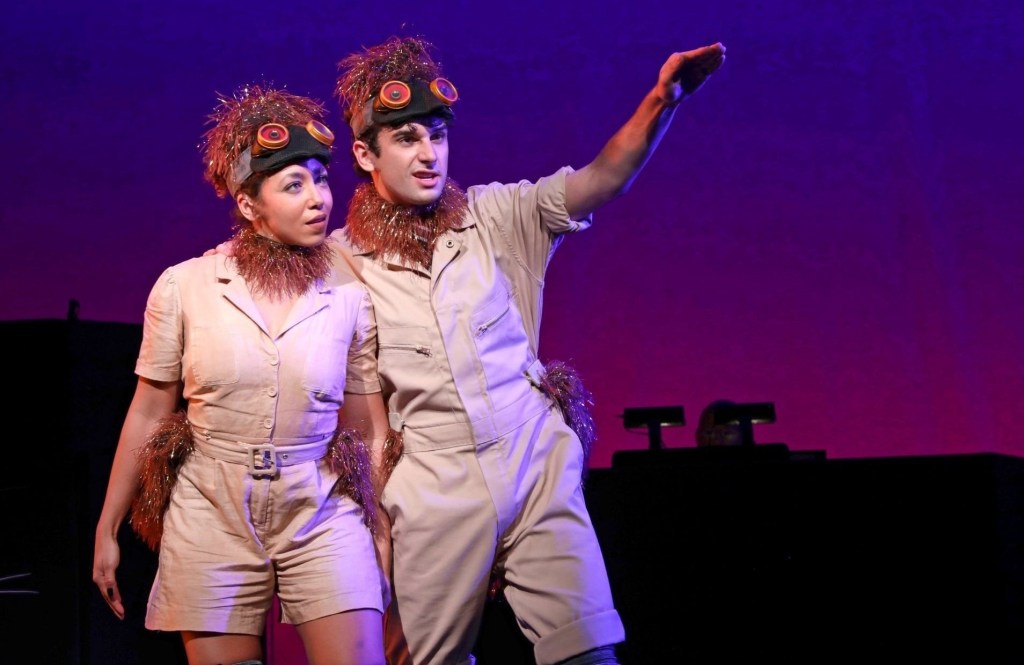
Titaníque opened on Broadway this evening at the St. James Theatre, after previously having been seen, not by me, downtown and overseas. It has a book by Tye Blue, Marla Mindelle, and Constantine Rousouli and direction by Blue, and it is a 100-minute musical riff on the 1997 film Titanic, Céline Dion, and any other topic that the authors feel like addressing: Scream, Chicago, Dreamgirls, Grindr, Tina Turner, Sydney Sweeney, Hugh Jackman, Sutton Foster, “RuPaul’s Drag Race,” “Nobody’s Supposed to Be Here,” the Christian pop of Pasek and Paul, etc. It is cheap, stale, unfunny, and inexpert. It feels, in the worst way, like an expanded version of a childish skit that the creators cooked up to entertain themselves in the final five minutes of a dispiriting dinner party. It is pathetic.
One must nonetheless acknowledge the wonderful crispness of many of the music and sound cues, which help to give the (false) impression that the piece is tight and propellent, and one must be grateful for the (mostly) game cast. But, because of the ham-fisted way in which the show has been written, in which the roles have been tracked, and in which the characters have been exploited, the creators have robbed three of the eight principals of a permanent payoff, and they have handed a diluted payoff to two others. These principals are Melissa Barrera, Frankie Grande, and John Riddle, and Deborah Cox and Jim Parsons respectively. Layton Williams reaps huge rewards. Rousouli, a likeable presence, has given himself much to do in a role that he describes in his program biography as “star-making.” And Mindelle, as Céline Dion, is quite unremarkable. (The pop star’s catalogue provides the soundtrack for this anonymous concert masquerading as parody.)
The preset look for Titaníque involves a gigantic gem suspended, twirling in front of the show-curtain. Evidently neither the creators nor their producer, Eva Price, had the presence of mind to realize that such a look would chop the comic legs out from under the modestly oversized gem used in the production.
A REAPPRAISAL OF SAFETY NOT GUARANTEED
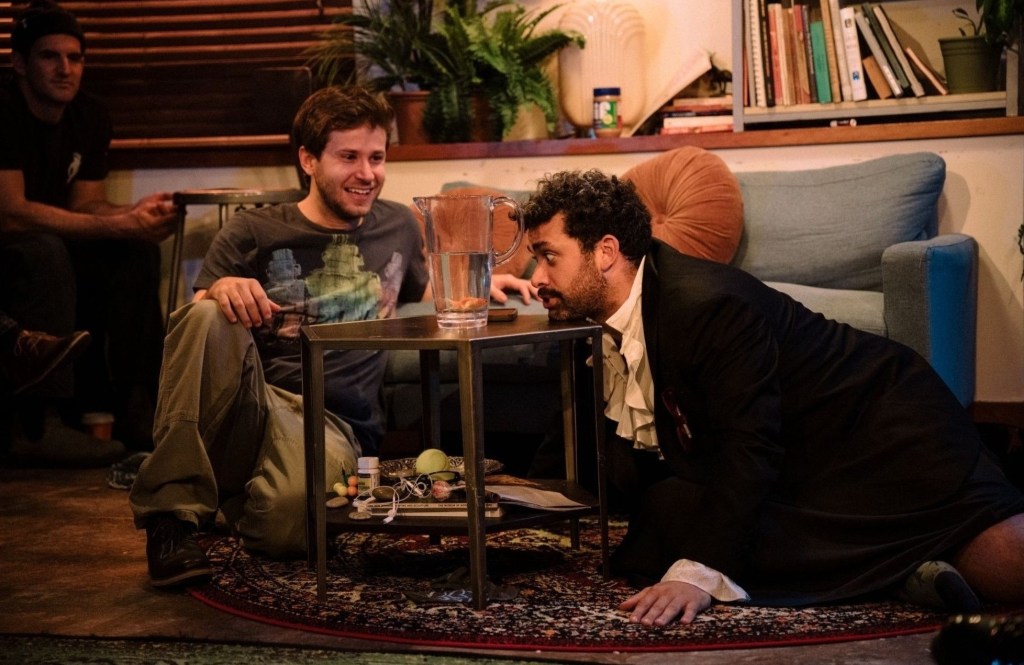
Safety Not Guaranteed, a new musical based on the 2012 film, concluded an out-of-town engagement this evening at Signature Theatre in Arlington, Virginia, after previously having been seen, in an entirely different production, as part of the Next Wave series at the Brooklyn Academy of Music in 2024. It has a book by Nick Blaemire and lyrics and music by Ryan Miller, and, in my initial review, I noted that it has, over the last year, blossomed into a distinctive, gloriously theatrical stage show, almost certain, with the necessary refinements, to find a home in the top drawer. On March 29, I had the opportunity to pay the musical a second visit, and I cannot overemphasize its proximity to greatness.
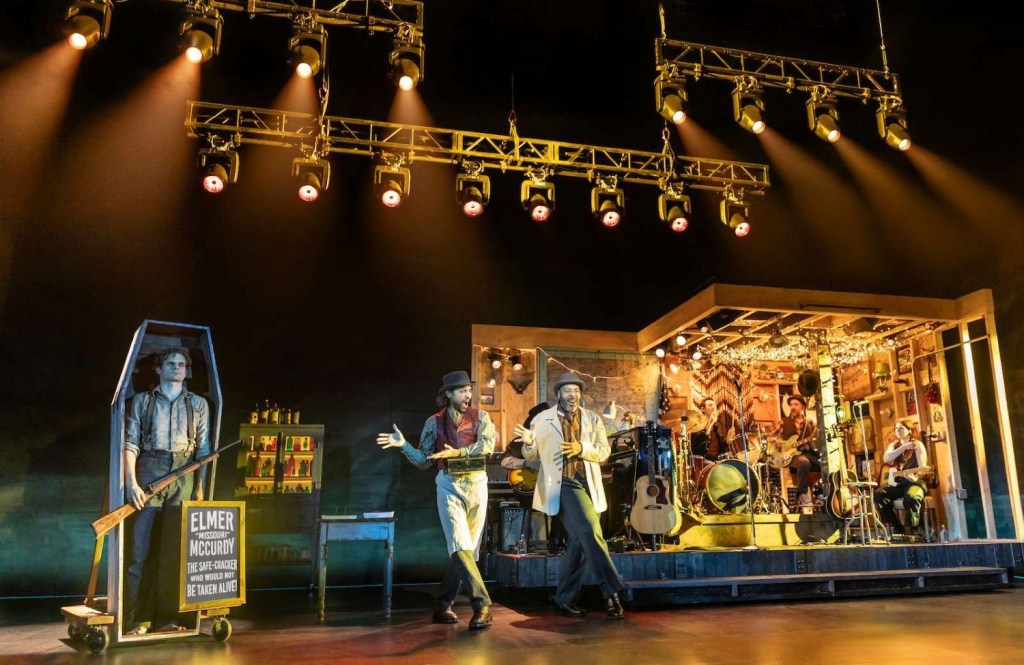
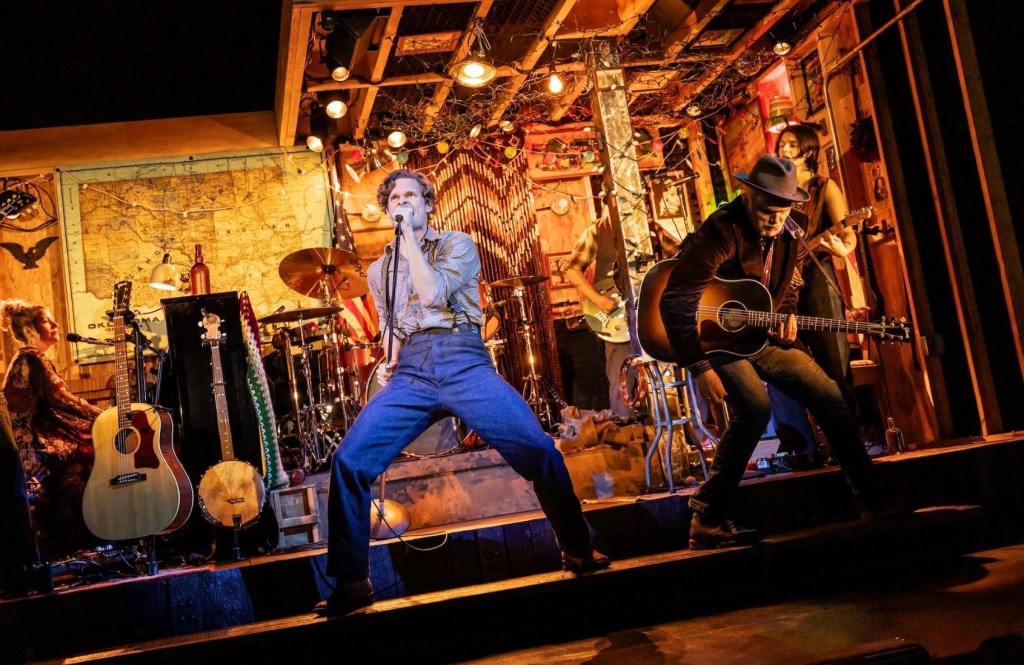
Yes, nearly every song ending needs to be defined and buttoned with emphasis and individuality, and nearly every transition needs to be sharpened. (The problems of transitions and buttons faced by Safety Not Guaranteed remind me of the problems of transitions and buttons faced by Dead Outlaw downtown, skillfully, thrillingly resolved uptown.) A handful of moments, including the final confrontation, need to be embellished. The leading man needs to be punched up such that he has a definitive narrative presence. The microphone conceit needs to be clarified and executed with rigor. The staging needs to be sharpened and consistently charged (by whomever replaces director Oliver Butler and choreographer Lisa Fagan, both of whom parted ways with the production during rehearsals). And all six members of the cast need to be replaced (by individuals with stage presence who understand how to excavate character, charge a scene, and deliver laugh lines rooted in situation and character). But each of these matters is comparatively minor, while simultaneously essential, and the revisions, comparatively major, that have already been made since the musical’s Brooklyn premiere are deft, inspired, skillful, astounding.
Blaemire must be first in line to receive credit, for he is a crafty, intelligent musical theatre writer, with a modestly individual voice, a strong sense of dialogue and character, and a special knack for crafting attention-grabbing entrance lines that launch the respective scene with purpose and punch. Indeed, his scenework for Safety Not Guaranteed has been stimulating from the start. But the work that he has done, over the last year, on the structure and especially the composition is incredible. The musical now has a clear and distinct identity, a clear and dynamic world, a clear and dynamic narrative language; it has been resolutely fashioned for the theatrical stage, and every moment is near to feeling definitive. Plus, the extent to which the happily revised score lands as well as it does is due, in large part, to the work that Blaemire has done on the book – resorting, eliminating, and adding songs, and providing them with purpose, foundation, and springy launching pads – and to the stellar new arrangements and orchestrations by Bill Sherman, whose work has helped to distinguish the world of the show. (This is not to discount Miller’s contributions.)
Safety Not Guaranteed is a prime example of how a malfunctioning musical might be rescued, and one might note that the running time at Signature was essentially the same as the running time at BAM. Will Safety Not Guaranteed return to New York and, with the necessary revisions, become a hit? Only time will tell. But such an outcome, at least commercially, will depend, at least in part, on marketing. And, to date, the institutional and commercial producers have focused the marketing campaign, including the artwork, exclusively on the offbeat, indie-rock, science-fiction aspect of the musical. They might, in future, consider an alternate or a complementary campaign that takes its cue from the sensational title’s second meaning – specifically leaning into the musical’s humanity.
My husband, for the record, liked Safety Not Guaranteed a great deal – almost to the point of loving it – but he was sour on the cast, and he was confused by the action that occurs after the killer eleven o’clock number.
PRESS ANNOUNCEMENTS
Here is a list of select press announcements from the past week. Each headline is clickable for more information.
• Delaware Theatre Company 2026/2027 Season
• Baltimore Center Stage Announces 2026/2027 Season Featuring Ten Productions, Including Three World Premieres
• The Rocky Horror Show Extends on Broadway
• Donna Vivino and Spencer Milford Join Tyne Daly in Pasadena Playhouse’s Brigadoon
• Zachary Noah Piser Will Star in Maybe Happy Ending on Broadway
• No Singing in the Navy Extends at Playwrights Horizons
• Vineyard Theatre Sets Works in Progress 2026 Series with Plays By Ro Reddick, Carly Mensch and More
• See Who’s Starring in World Premiere of Mischief’s Thespians: Greece the Musical
• Lillias White, Darlesia Cearcy, Darius de Haas, More Set for Bubbling Brown Sugar Concert
PREVIEWS AND OPENINGS
Here is a list of the new musicals and revivals either opening or beginning previews during the upcoming week, specifically on Broadway and Off-Broadway. It contains, as well, select new musicals beginning performances regionally, and select new musicals and revivals beginning performances in New York City. Each title is clickable for more information.
Monday, April 13
Tuesday, April 14
Wednesday, April 15
• Regional: The Chequerboard Watch
Thursday, April 16
• NYC: Milk and Honey
Friday, April 17
Saturday, April 18
Sunday, April 19
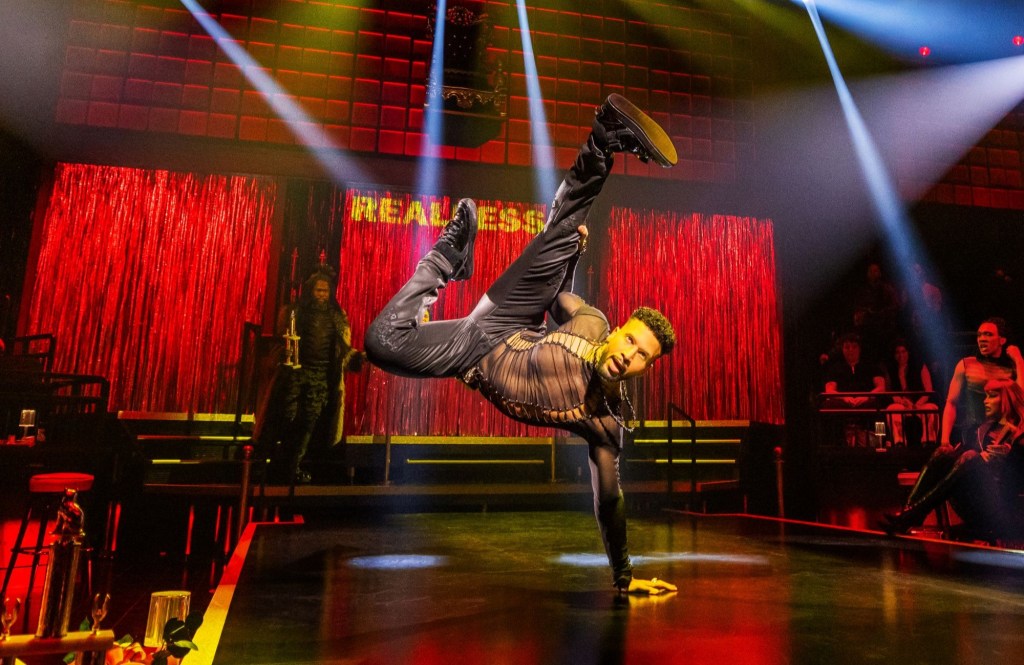
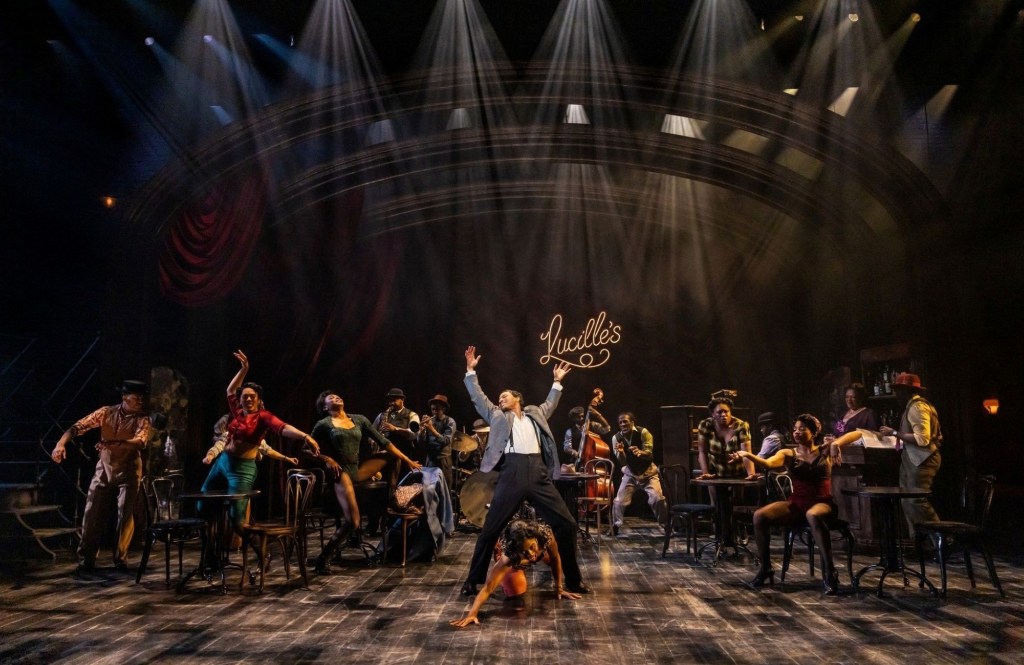
Photo of Sydney James Harcourt in Cats: The Jellicle Ball by Matthew Murphy and Evan Zimmerman.










 The Musical Theatre Report
Leave a comment