A journal for industry and audiences covering the past, present, and future of the musical stage.
Today is Sunday, and this week’s Report features reviews of Beaches, The Rocky Horror Show, and Schmigadoon!, and a preview of my review of The Lost Boys. Plus, a quote of the week; select press announcements from the past week; and a list of the upcoming week’s previews and openings.
QUOTE OF THE WEEK
The lyric, by Harold Rome, for “June, Why Did July to Me?”
Thirty days have September,
April, May, and December.
All the rest have thirty-one,
But February only.
What’s the diff’rence anyway
When ev’ry day is lonely?
Oh, June, why did July to me,
And waste my time away?
Through August and September,
October and November,
You promised to remember
But you left me cold in December!
No June in January.
No June in February.
No June in March, April, or May!
Oh, oh, oh, June, why did July to me,
And waste my whole year away?
SCHMIGADOON! AT THE NEDERLANDER THEATRE
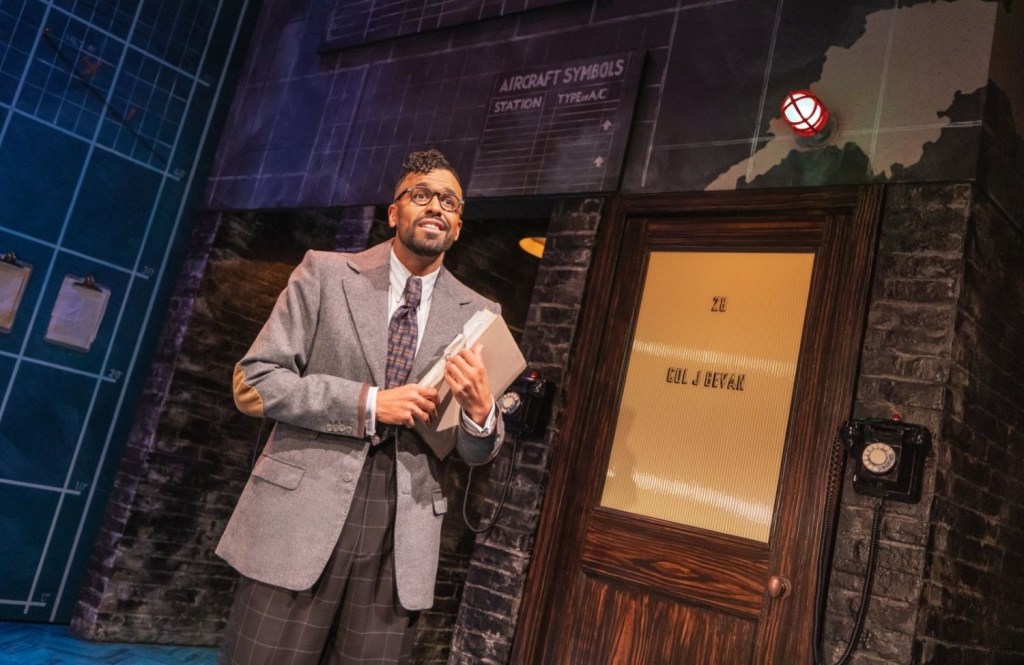
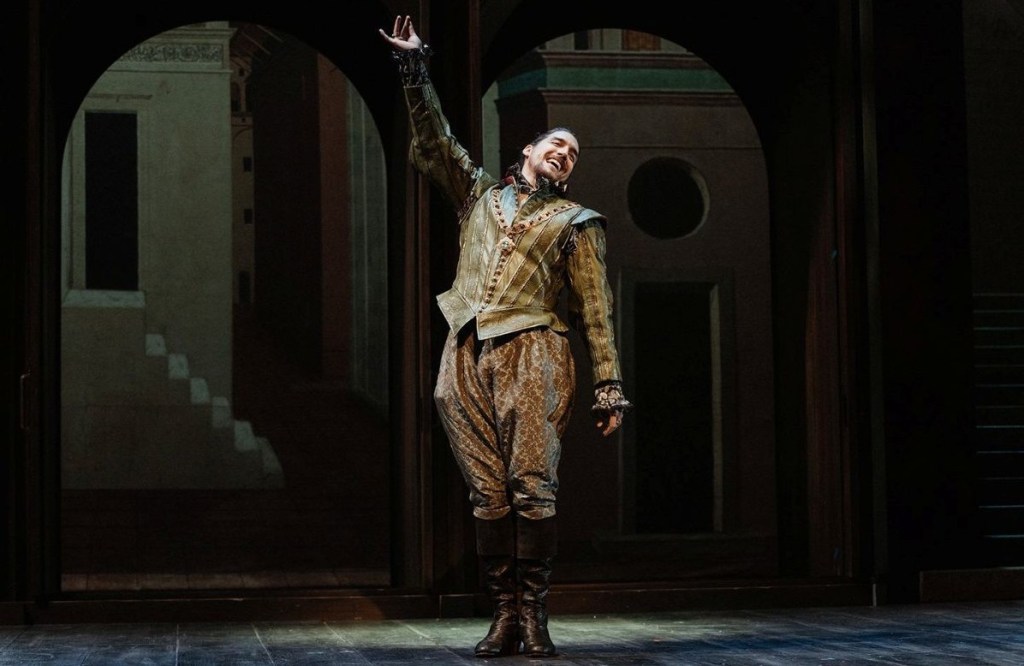
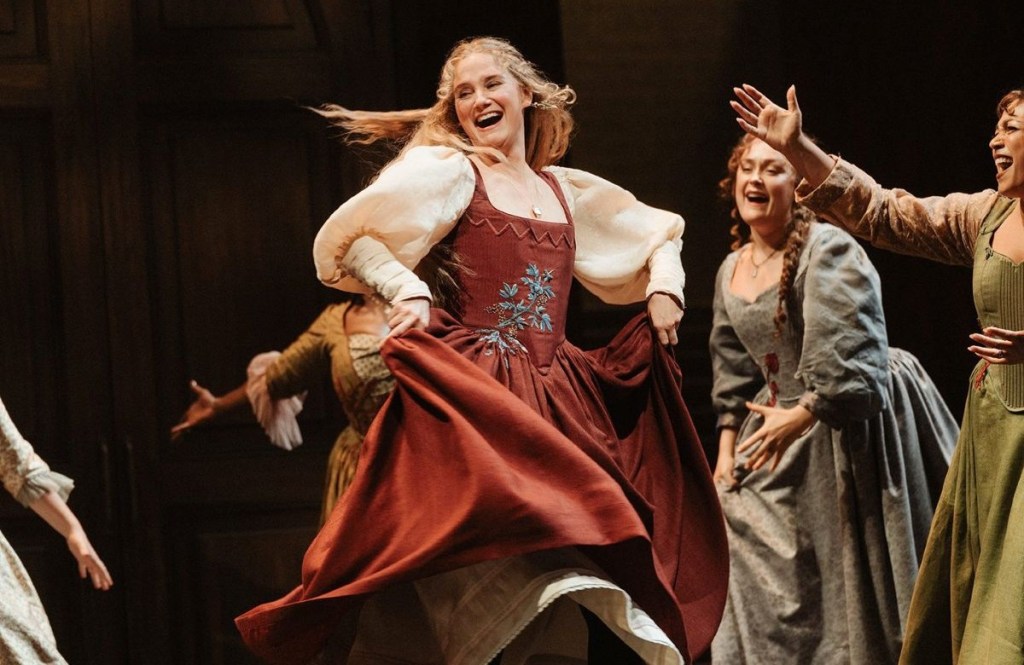
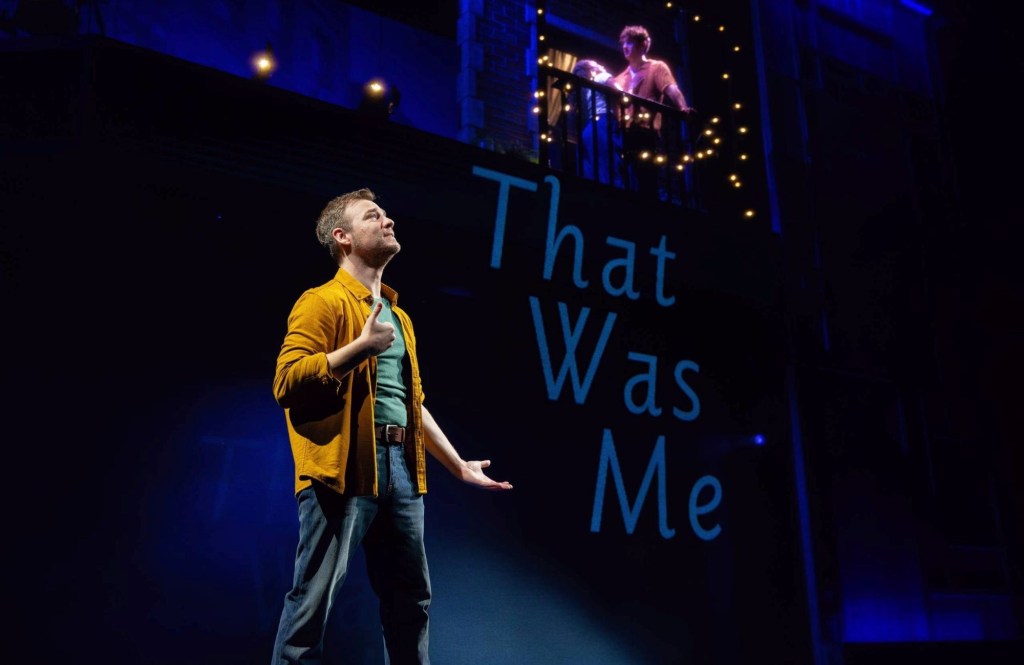
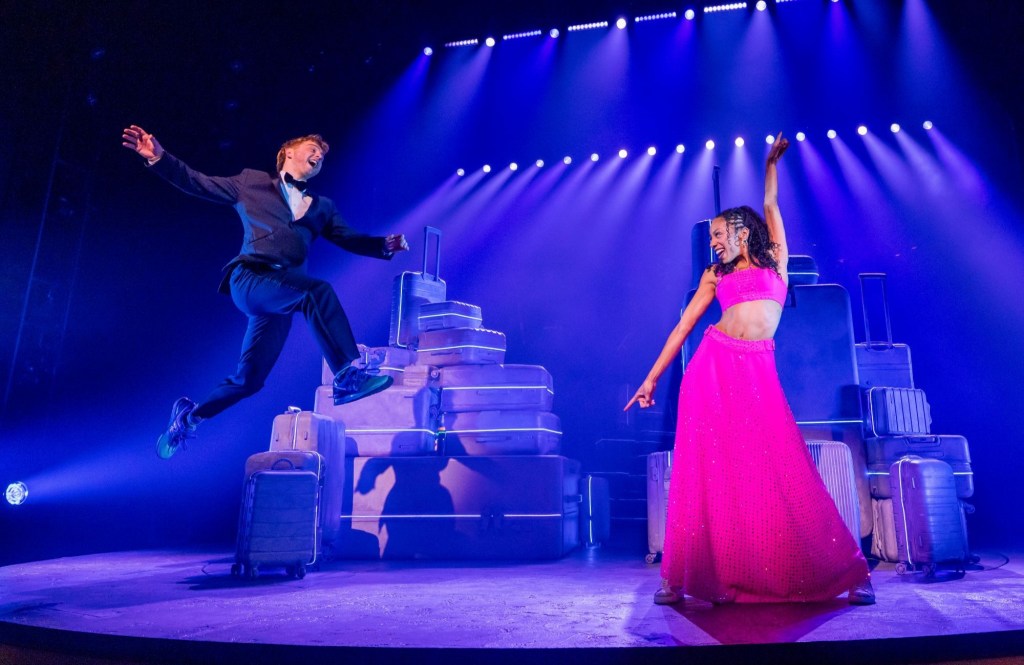
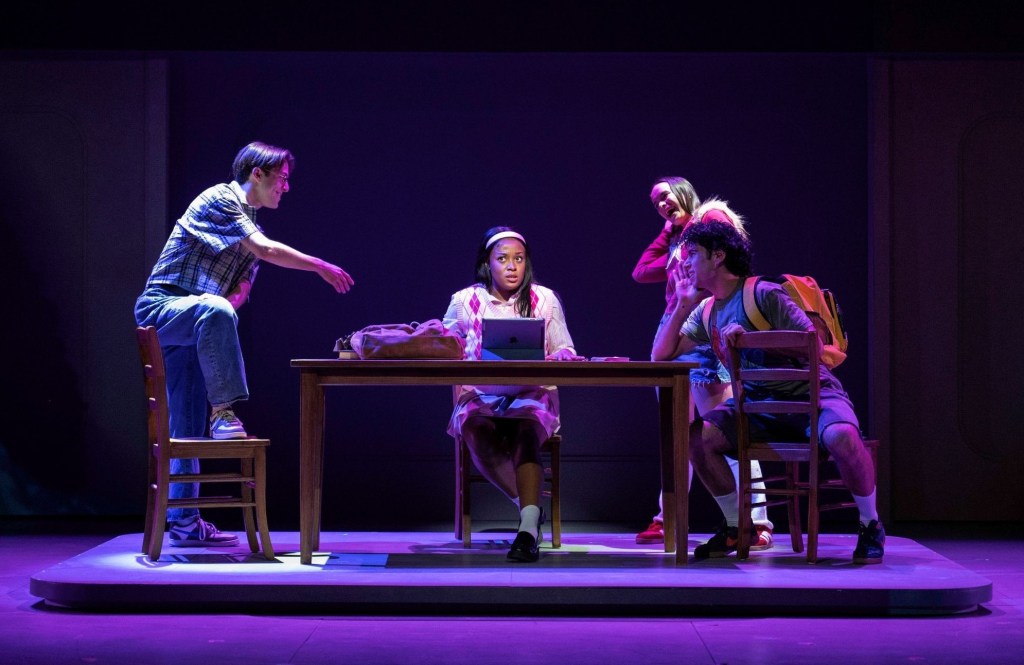
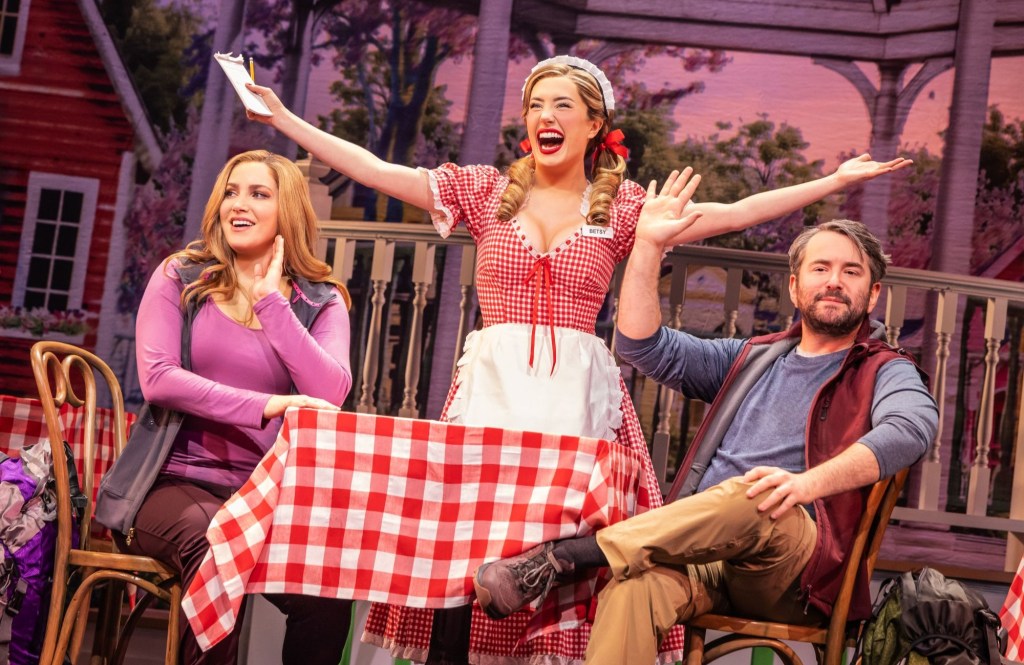
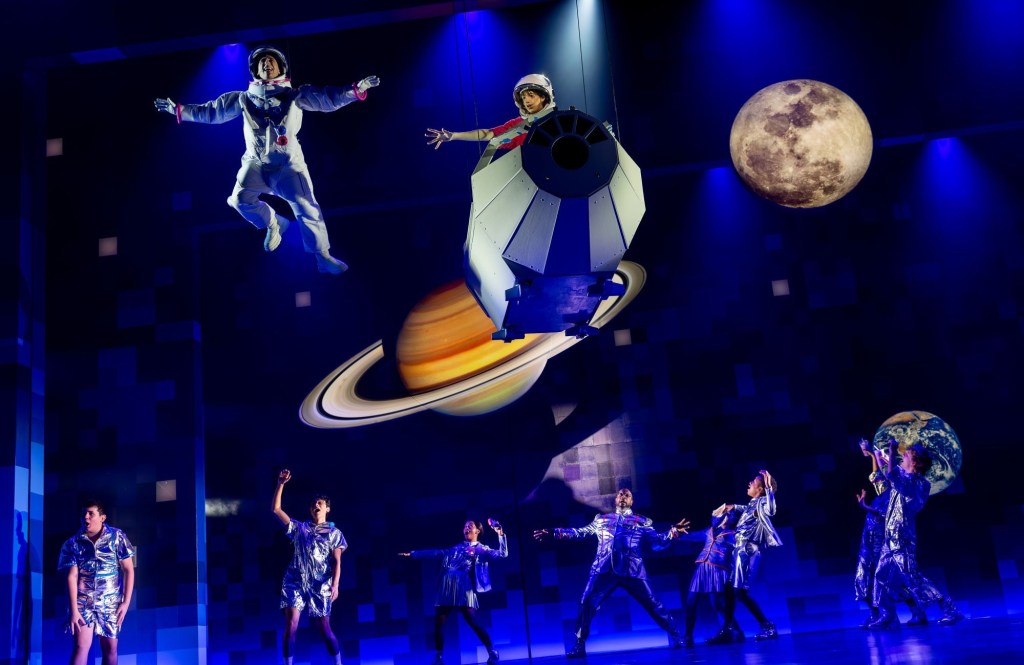
Schmigadoon!, a new musical based on the television series, opened on Broadway last week at the Nederlander Theatre. It has been written by Cinco Paul and directed by Christopher Gattelli, and it is candy-coated dreck.
The musical, like the first season of the series (which I have not seen), follows a bickering couple, Melissa and Josh, who get lost in the woods, traipse across a magical footbridge, and wind up trapped, until they can find true love, in the town of Schmigadoon – where life is a musical. (Let us bypass a formal account of the characters and plot.) The basic premise is not dissimilar to that of the 1973 musical Smith, and it might have proven profitable – if, among other things, Paul and Gattelli had developed said premise with a clear point of view, fleshing out the particulars of their piece, including the world, with coherence, continuity, and specifics, and if, among other things, Paul and Gattelli had an actual understanding of the art form they are purporting to affectionately rib. But they did not and evidently do not.
To wit: the town of Schmigadoon is not merely a musical; it is a “Golden Age” musical – despite the term not being explicitly used in the text – which indicates Paul and Gattelli believe that the “Golden Age,” i.e. the middle of the 20th century, produced a single style of show, apparently set at the turn of the 20th century, seasoned with Americana, and saddled with outdated social customs. This is, of course, false. (See my detailed discussion of the widely misunderstood period.) Plus, in the town of Schmigadoon, dialogue, in many cases, does not effectively build into song, leaving songs, in many cases, to spring forth nearly out of nowhere, sans solid dramatic foundation, sans solid dramatic purpose; and, in the town of Schmigadoon, characters regularly behave in a robotic fashion, bound to a preprogrammed agenda, sometimes refusing to listen to other characters, and occasionally resembling the residents of Stepford. Let us be clear: these are not intrinsic characteristics of a musical! They are (some of the) characteristics of a poorly written musical.
Relatedly and sadly, one is forced to ask: are Paul and Gattelli aware that the absence of real liquid in a teapot, the clutching of a knife in one’s armpit during a death scene, and the use of adult actors as children are matters of production, not intrinsic characteristics of a musical? And are they aware that undepicted childbirth and undepicted intercourse are not intrinsic characteristics of a musical either? And, given their incorporation of these items, in tandem with their handling of the characters, dialogue, and song, one is similarly forced to ask: are Paul and Gattelli, in fact, suggesting that musicals, at least musicals from the middle of the 20th century, are poorly written, with individuals and incidents that are fake, artificial, dishonest, dramatically unsupported, noncredible? (This would necessarily include the likes of Bye Bye Birdie, A Funny Thing Happened on the Way to the Forum, Guys and Dolls, Gypsy, Hello, Dolly!, How to Succeed in Business without Really Trying, The King and I, My Fair Lady, Oklahoma!, She Loves Me, West Side Story, and Wonderful Town, whose director, one might remember, once noted, “If it’s a good show, you get fun by being real.”) The fact of the matter is Schmigadoon! is not a good show. It has been poorly written, and perpetually unclear is of what exactly Paul and Gattelli are intending to make fun, in terms of the musical stage, and if that fun is even really affectionate.
Similarly unclear is the use of music in the prologue, prior to the central couple’s arrival in Schmigadoon, suggesting Melissa and Josh are already in a musical; the sexual fadeout in the prologue, given the sexual fadeout in Schmigadoon; the lack of real liquid in the prologue, given the lack of real liquid in Schmigadoon; the ability of Melissa and Josh to survive in Schmigadoon, given the lack of real liquid; the ability of Melissa to get drunk in Schmigadoon, given the lack of real liquid, and given her awareness of the lack of real liquid; the use of mid-century jazz vernaculars, given the town’s turn-of-the-century setting and the verbal reference to ragtime; the surprise had by one Schmigadoonian when Melissa, at one point, talks of singing, given the complete lack of surprise, the complete lack of response had by other Schmigadoonians when Melissa, at several other points, talks of singing; and the townsfolk’s self-comment: “Somehow we’re okay with it!”
The musical’s structure, furthermore, is incredibly poor, and not merely in terms of patterning of plot and deployment of characters. Examine the musical’s structure specifically in terms of awareness, capitalization, and manipulation of medium: Schmigadoon! has not been built for the stage! Note, for instance, the lumbering series of cutaways that Paul has penned for an egg-on-face funeral scene. In each instance, Reverend Layton voluntarily pauses his eulogy for no dramatic reason; Melissa, Josh, and or Mayor Menlove commence their own side conversation; Reverend Layton and the rest of the attendees stand next to them in silence, inactive, expressionless, tilting their heads slightly downward, unresponsive to the conversation occurring within an earshot; Mildred Layton, out of nowhere, says, “Shhhh!”; and Reverend Layton continues his eulogy, like nothing has happened. And with no underscoring; with no music or sound effect to accent, support, and define the shifts in focus; with no stylized or personalized theatrical approach whatsoever. This sequence, as written, may well work on screen, with the aid of a cinematographer and a film editor; it does not work onstage.
Note, as well, the bumbling time-lapse prologue, with no shape, no texture, no definition, no natural development of character or relationship. Note the artificial bake sale, in which actors, including one of the principals, loiter, facing upstage, while Mayor Menlove and Reverend Layton share a private duet. Note the god-awful split-stage sequence in the second act that finds Josh, while Melissa and Doc are stage left, loitering stage right in a wash, and then pretending, for all of five or so seconds, to fix a seesaw that was operational four minutes earlier. (Actors loitering, by the way, is one of the hallmarks of Schmigadoon!) Note, in that same split-stage sequence, the forced split-stage duet. Note the asinine dream ballet and its asinine nestling, necessitating a mid-stage traveler open and close repeatedly toward the end of the show, revealing, at one point, specifically for said ballet, a sad, sad, unlit vending machine. And note the scene between Melissa and Florence that ends with Josh and a gaggle of girls literally backing into the two women in order to begin an entirely separate scene. (Really?)
Note, in the same vein, the internal structuring of scenes, like the clumsy, completely wasted introduction of the name of the town; the absurd delay in Carson acknowledging the news about his mother; and the obligatory, unmotivated entrance of Mayor Menlove in “Tribulation” such that a lyric might be directed to him, after which he dutifully exits the same wing he entered. (The latter two moments might have, again, worked well on screen, with the aid of a cinematographer and a film editor; they sour onstage.) Finally, consider the many moments and incidents that Paul and Gattelli have chosen not to be a part of the story, at least not the onstage story – especially those moments directly related to Melissa and Josh and their supposed desire to leave Schmigadoon and their supposed growing frustration over their prolonged presence in Schmigadoon. And consider whether or not Paul and Gattelli have, throughout the show, effectively, inventively, shrewdly accounted for Josh’s unwillingness to sing. (“Cross That Bridge,” for instance.)
The individual lines of dialogue are not particularly sharp, funny, or dramatically productive, though a handful of cynical one-liners assigned to Josh have comic value. Notably clumsy, in terms of the scene work, are a down-center addendum led by Mildred, a series of admissions involving much of the town, and a late-show exchange that introduces a Nazi – which is little helped by the staging, especially Doc’s lengthy reentrance with champagne flutes.
The individual lines of lyric are sanitized, flavorless, impersonal, occasionally revealing a sedate cleverness, and some of the linguistic gimmicks are heavy-handed. And the music, despite containing a flurry of admirably painstaking allusions to preexisting songs, has little or no personality of its own, little or no individuality, little or no distinction. It registers as an academic exercise in observation, completed with intelligence and care, and ornamented with fancy orchestrations, by Doug Besterman and Mike Morris. Plus, some of the songs have an unproductive shape, while others are insubstantial, akin to nondefinitive songlets. (David Chase is music supervisor and arranger.)
The use of interstitial dialogue is occasionally awkward and disruptive, unintentionally. The introduction of dance breaks is occasionally uneasy. “What’s the Matter with Men?” falls short of earning its encore (which is lackluster). And the musical’s routine is front-loaded with company numbers, invariably uptempo. (This is largely due to the book, i.e. structure.) For the record, most of the songs in the show have been lifted from the television series, and one of the most effective, active, purposeful, motivated songs in the show is “Tribulation” – which is not an endorsement of its current interpreter.
The matters of material, including the nondescript narrative language and composition, are exacerbated by the staging – inept, ramshackle, aestheticless – which contains, among other things, clumsy sight gags, like a pair of handheld trees, a picnic basket with phallic contents, and the reentrance of Josh in new attire at the conclusion of a company number. (When will Gattelli learn the value, even the necessity, of, among other things, character, crispness, and precision, especially in comedy?) And observe how Josh makes an unmotivated cross away from Melissa on a line about being with Melissa in “You Make Me Wanna Sing.” (The material treatment, by the way, of this climactic moment, when Josh finally sings, is remarkably small, and perhaps better suited to a television screen.)
The choreography, by Gattelli, is athletic, frequently unison, and not entirely without interest. (Here, evidently, he understands the value of precision.) But neither is the choreography entirely effective, or theatrical, often lacking a clear, deliberate dramatic development. And some choreographic flourishes, like the use of trombones and the use of tambourines, are incomplete thoughts, or manufactured, or nondeliberately senseless. (The seemingly inexhaustible ensemble must be commended, under the circumstances, for sustaining their aggressive smileyness.)
The scenic design, by Scott Pask, oscillates between being colorfully, tastefully small-towny, fragrant with nostalgia, and unattractively basic, even dour, especially in terms of the hyper-active mid-stage traveler, made to look like a forest; the piddly footbridge; and the decrepit sign with the name of the town. And the extent to which the scenic design is not functional must be blamed, at least in part, on Gattelli (and perhaps the show’s lead producers). The costumes, by Linda Cho, are similarly colorful. The lighting, by Donald Holder, is unremarkable. And the cast is uneven: Alex Brightman, as Josh, and Sara Chase, as Melissa, are very strong; Ana Gasteyer, as Mildred, is very poor; Max Clayton, as Danny, is a great dancer, but no more; and so forth.
Schmigadoon! is an excruciatingly inexpert, unimaginative charade, and Paul and Gattelli do not get extra points for having, presumably, good intentions.
THE ROCKY HORROR SHOW AT STUDIO 54
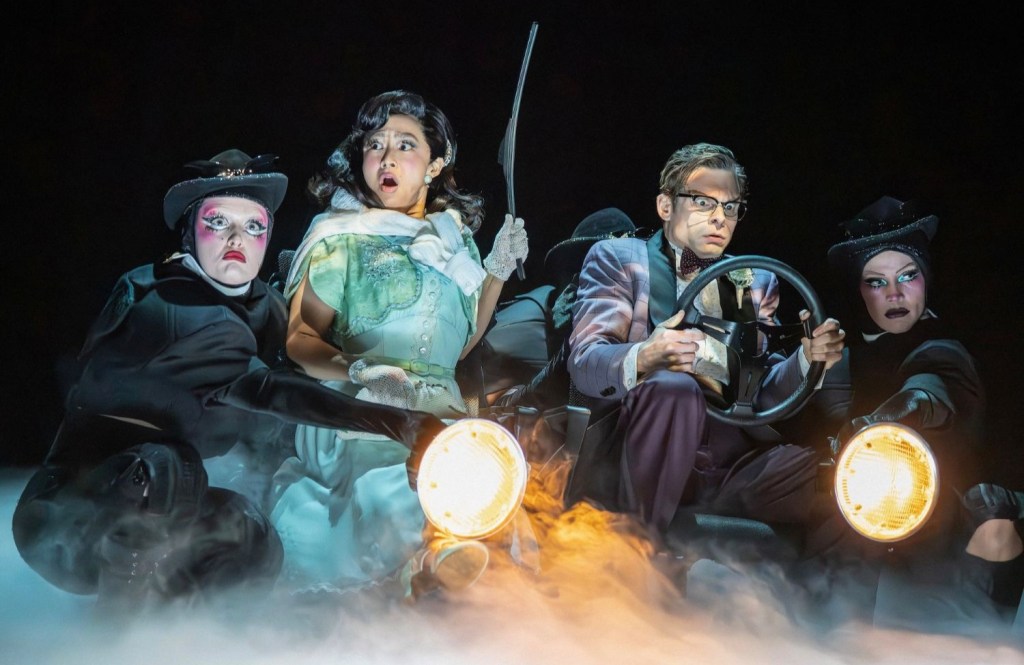
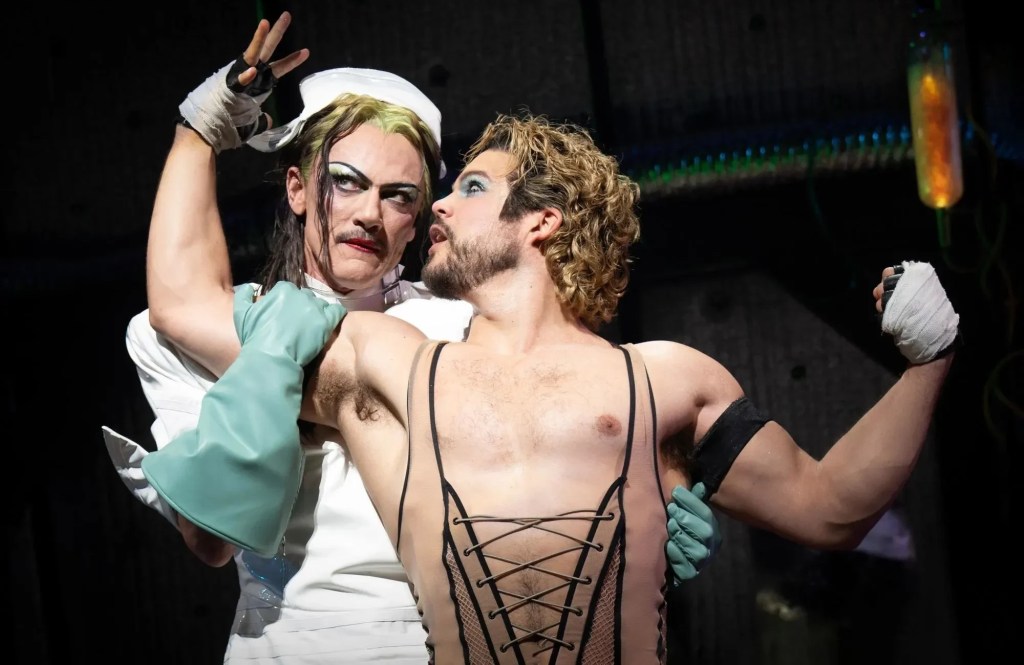
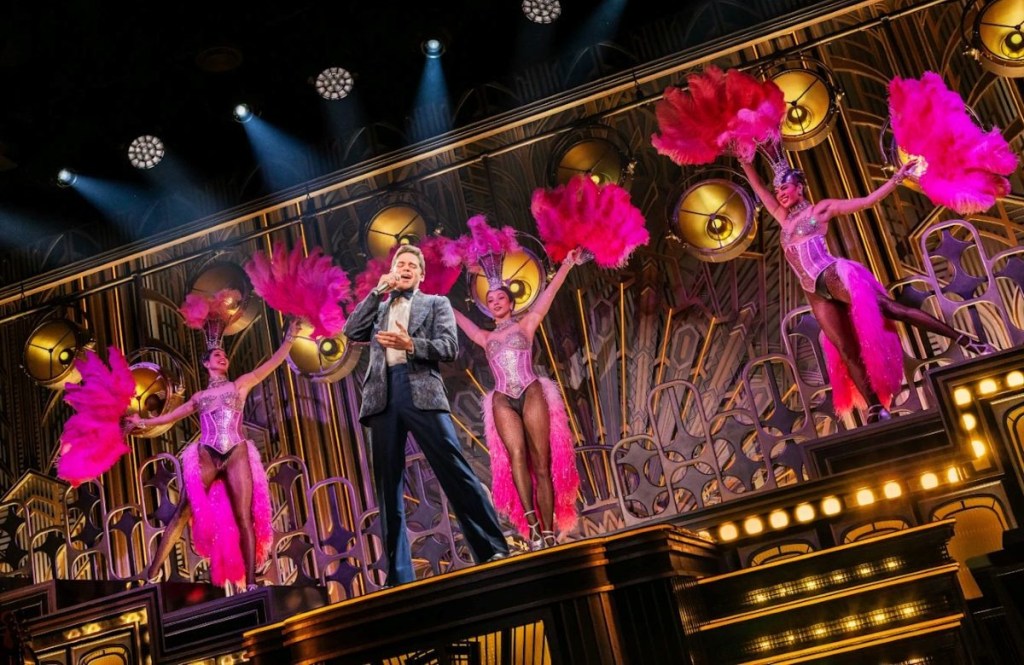
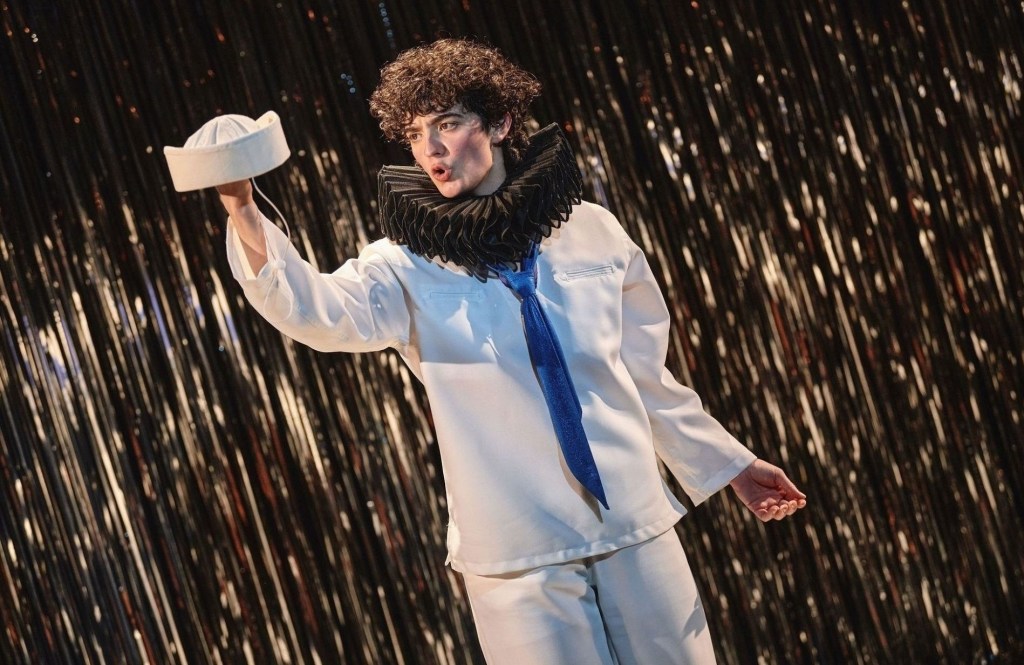
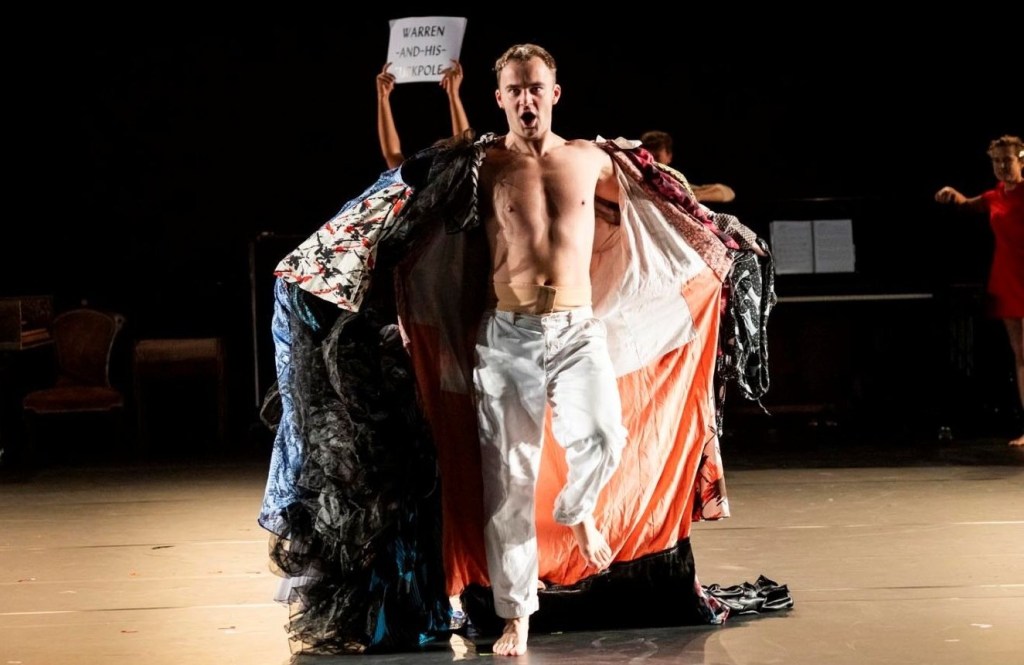
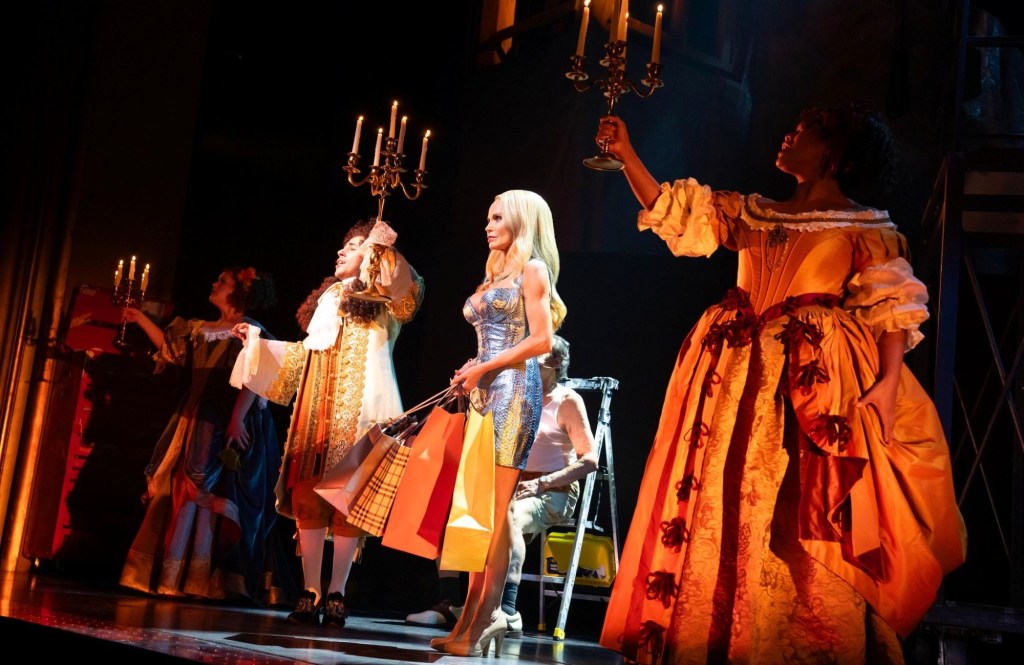
The Rocky Horror Show, a revival of the 1975 musical, opened on Broadway last week at Studio 54 under the auspices of Roundabout Theatre Company. It is written by Richard O’Brien and directed by Sam Pinkleton, and it is a passable production of an utterly ridiculous, outlandish, gleefully queer piece of theatre. Let us bypass the sordid state of the well-known material and get right to the staging.
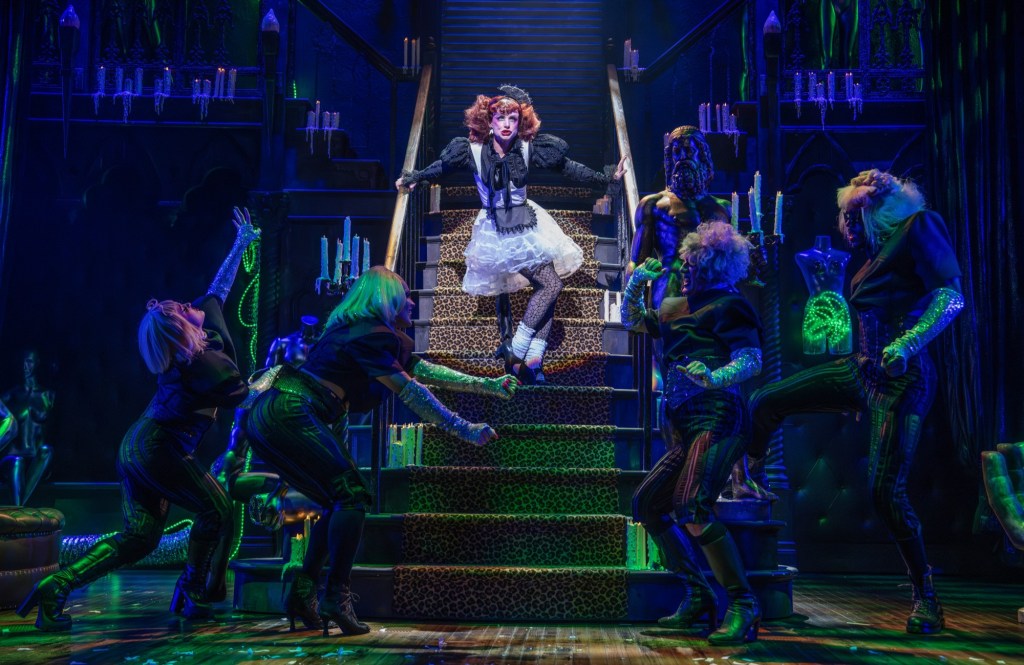
Pinkleton has, in his work to date, revealed little feeling for the musical stage, but his work on The Rocky Horror Show is a happy and heartening surprise. To begin with, he has realized a fine GothGlam world, modestly individual, improbably tasteful, eminently stylish, and notably theatrical, streaked with black, framed with bronze, and accented, delectably, with green, principally of the neon persuasion. He has been aided in his efforts by scenic designer dots, costume designer David I. Reynoso, lighting designer Jane Cox, hair and wig designer Alberto “Albee” Alvarado, and make-up designer Sterling Tull. (Special mention must be made of the shrewd choice of fabric for the drapes, which transform into different looks under different light; and of the atmospheric exhaust fans swirling above the boxes.)
The production essentially alternates between in-one and full-stage setups, and the alternation grows repetitive. But Pinkleton has come close to realizing a sustained tension (which is crucial, especially for such a messy, sophomoric property as this), and he has come close to realizing a crisply fluid manner, with a solid synchronicity of elements. Note, in particular, the stunning snap, in the second act, from Magenta and Riff Raff up-center to the Narrator in her cubbyhole down-right.
Plus, several moments are striking and inspired, and two such moments in the second act are out of this world, notwithstanding the quality, including the dramatic effectiveness, of the material. The first finds the cast standing in fixed positions, precisely placed around the stage, in beautiful balance, singing hypnotically, while white fog billows around them, covering the deck of the stage, and a stage-width sign, with illuminated words in neon-green script, descends – moderately slowly, steadily, deliberately – from the grid to the deck, coming to rest among the cast. If one subsequent dramaturgical beat seems to be missing, it matters little, and Pinkleton happily completes the moment by having the sign fly out – swiftly, purposefully – when the musical mode shifts. The other moment finds Frank-N-Furter delivering “I’m Going Home” down-right against a tableau up-left. And note the shrewdly motivated fashion in which Pinkleton has gotten Frank-N-Furter into position. (One nonetheless wonders why Pinkleton and his music supervisor, Kris Kukul, have not given the song a more complete arrangement.) Here, to savor, are two instances of stagecraft marvelously well done.
“Once in a While,” “Over at the Frankenstein Place,” including the associated car scene, and “Science Fiction Double Feature” might have been similarly marvelous, similarly savory, and the latter, in principle, is a wonderful way to start the show: clean, unfussy, cheeky, chic. (It involves an Usherette in a divine green getup, a choir of mannequins in the house-right box, and a pair of cyclops showgirls.) But all three moments suffer, like most of the moments in the show, from a lack of dramatic development. (When Pinkleton learns how to sculpt scene and song in a precise, theatrical fashion, for the musical stage, he will almost certainly be a force with which to be reckoned.)
All of the choreographed numbers, to that point, flatline and fail to explode across the footlights – including “The Time Warp” – and though Ani Taj is the choreographer of record, Pinkleton must be dinged for permitting to stand such stylistically nondescript, dramatically unproductive displays. In fact, it is the choreography, for the backup singers, that ultimately prevents “Once in a While” from soaring. (The song finds Brad down-center at a vintage mic, backed by a drape adorned with projected stars.)
Frank-N-Furter has been handed two terrific entrances: from behind a roll-up security door, backlit with floodlights; and from above, sitting on the moon. The bits involving the Narrator, and especially the bit that finds her popping up behind some mannequins, tend to lack sharpness and definition. Some of the scene work is sloppy. An entr’acte cross does not have the clever, impactful button Pinkleton seems to envision. The hands gimmick in “Damn It, Janet” might have proven profitable, but it is employed full-tilt at the top of the song, leaving the number nowhere to go. (Development!) The murder of Eddie is nondefinitive. The glitter death of Frank-N-Furter is a great idea, but it causes the subsequent death of Rocky, sans glitter, to be anticlimactic. The five-piece band gives the independently enjoyable music, tinged with sweetness, a strong rendering. And an emphatic word of praise must be said for sound designer Brian Ronan, who has amplified the production with aplomb, despite the presence of rock music. (See, it can be done!) One can almost forgive his use of headgear.
No one in the cast is giving a poor performance, except Rachel Dratch as the Narrator and Juliette Lewis, vocally, as the Usherette. But no one is giving a definitive performance either, or manifesting infectious fun, and one wonders if this is a rare instance of actors taking longer than usual – or longer than expected – to grow into – or settle into – their roles. I will report back at a later date, for I plan to revisit the production, specifically to appreciate Pinkleton’s macro-level work, especially in the second act.
BEACHES AT THE MAJESTIC THEATRE
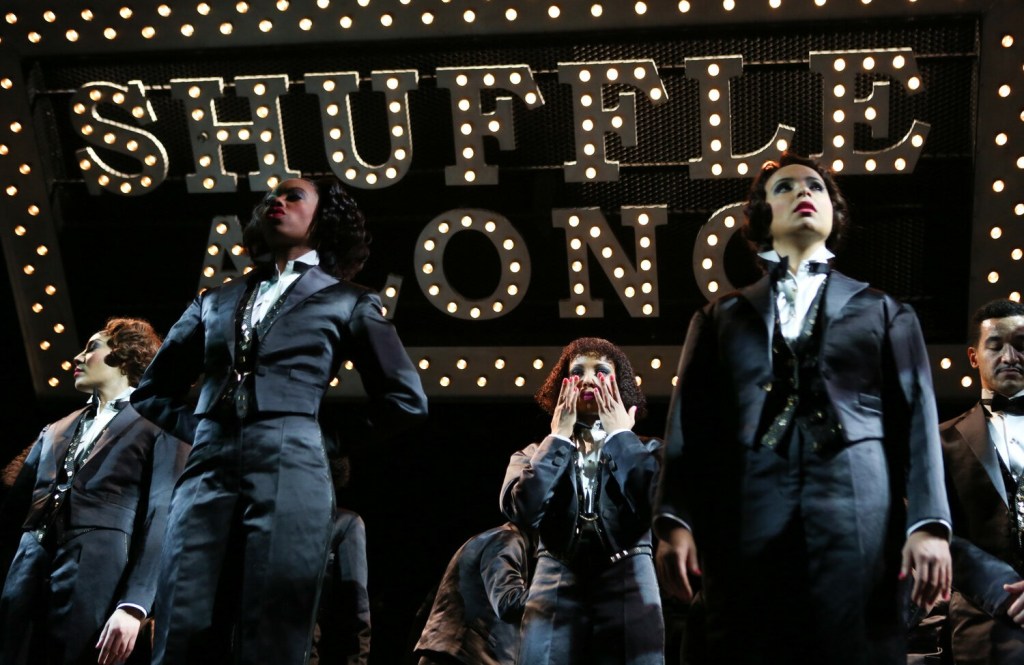
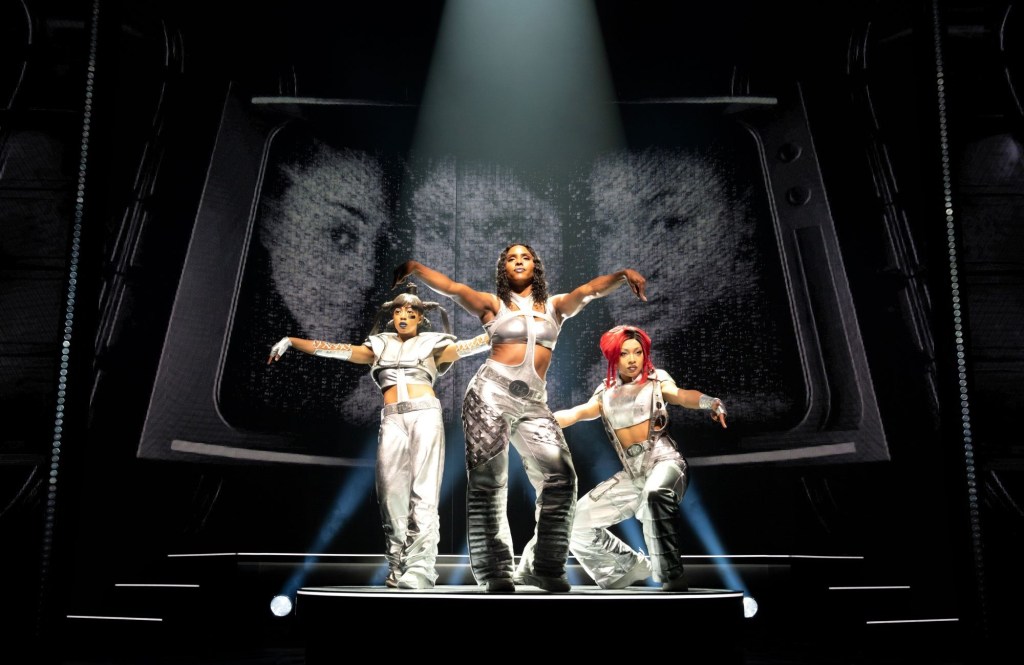
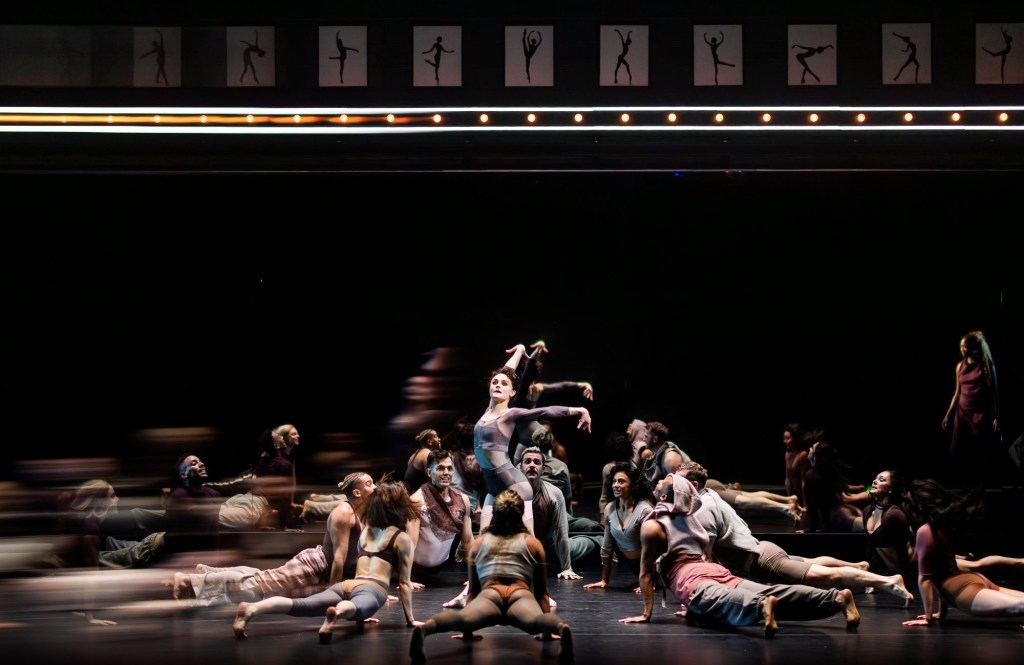
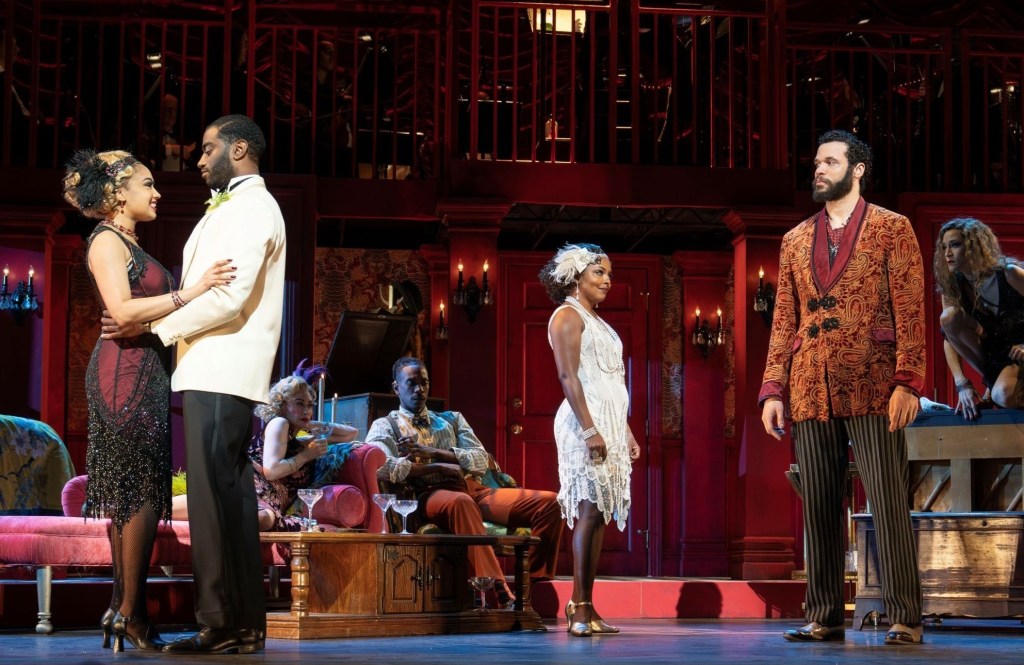
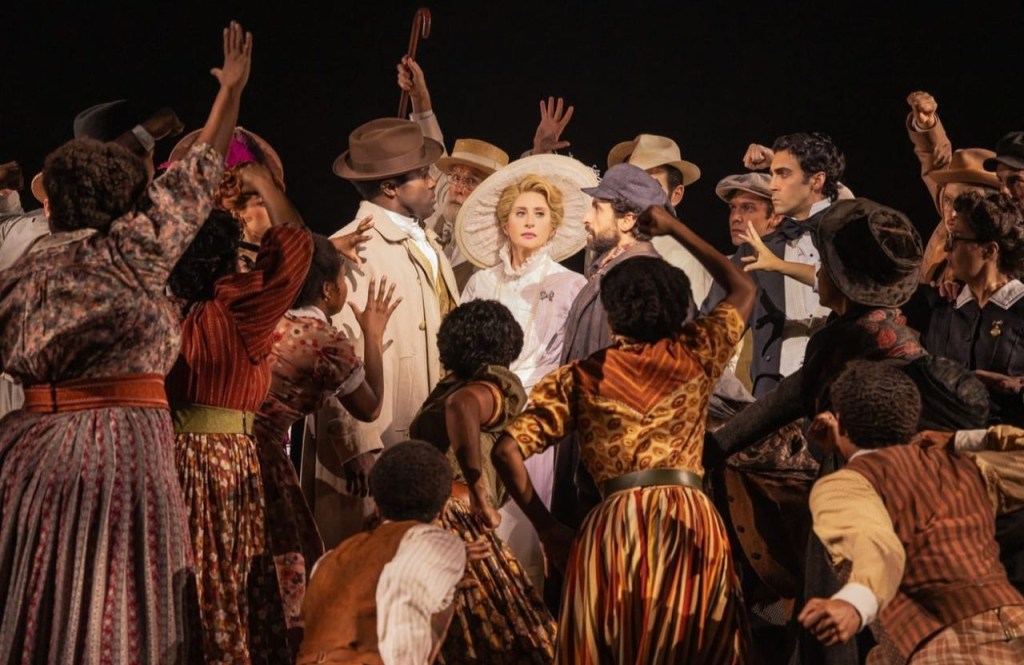
Beaches, a new musical based on the novel, opened on Broadway this week at the Majestic Theatre. It has a book by Iris Rainer Dart and Thom Thomas, lyrics by Dart, music by Mike Stoller, and direction by Matt Cowart and Lonny Price, and it is a gloomy affair.
Letters are a potentially valuable theatrical device, but the letters, in Beaches, have no particular language, no definitive narrative presence. Interludes are a potentially valuable theatrical device, but the interludes, in Beaches, are perfunctory and poorly patterned, specifically those involving the two young girls. The interweaving of time is a potentially valuable theatrical device, but the interweaving of time, in Beaches, is rough. And the use of multiple actors for a single character is a potentially valuable theatrical device, but the use of multiple actors for a single character, in Beaches, is similarly rough.
An unintentional, unproductive imbalance exists between the two central figures, and one of them, Bertie, is poorly introduced (as an adult). The spotting and purposing of songs is not infrequently bizarre. The characters are poorly drawn, with some being complete afterthoughts, and with Bertie falling into the good-girl trap of being bland. Relationships are wildly underdeveloped. Incidents happen out of nowhere. The dialogue is mostly stocky. The lyrics are mostly superficial, sterile, generally failing to excavate situation and character. The irony of “A Day at the Beach” is heavy-handed. And the music is not entirely unpleasant, but it does not really serve situation and character. (A jazz waltz for Bertie’s liberation song? But the song is not effectively or efficiently serving the moment anyway, because the moment, as written, is about Bertie standing up to her mother, resolved to stay put, empowered by her new barefoot, braless existence, and since the lyric does not accomplish that task, we are forced to endure a dialogue addendum, after having already endured the song.)
The staging is generic, occasionally untutored, failing to rise above the material, and the choreography, by Jennifer Rias, is generic, specifically the choreography for the performance pieces. The choreography for the dialogue extenders, like “The Brand New Me,” is terribly schlocky. The orchestrations, by Charlie Rosen, are acceptable, but they might, in some instances, make better room for the lyric. And the cast is unremarkable, though Jessica Vosk, as Cee Cee Bloom, seems to be enjoying her time onstage, and Samantha Schwartz, as Little Cee Cee, is somewhat appealing, with the benefit of having been handed some of the strongest material – which is not saying much.
My mother, for the record, seriously disliked the show, and she absolutely loathed the “Wind Beneath My Wings” finale.
THE LOST BOYS AT THE PALACE THEATRE
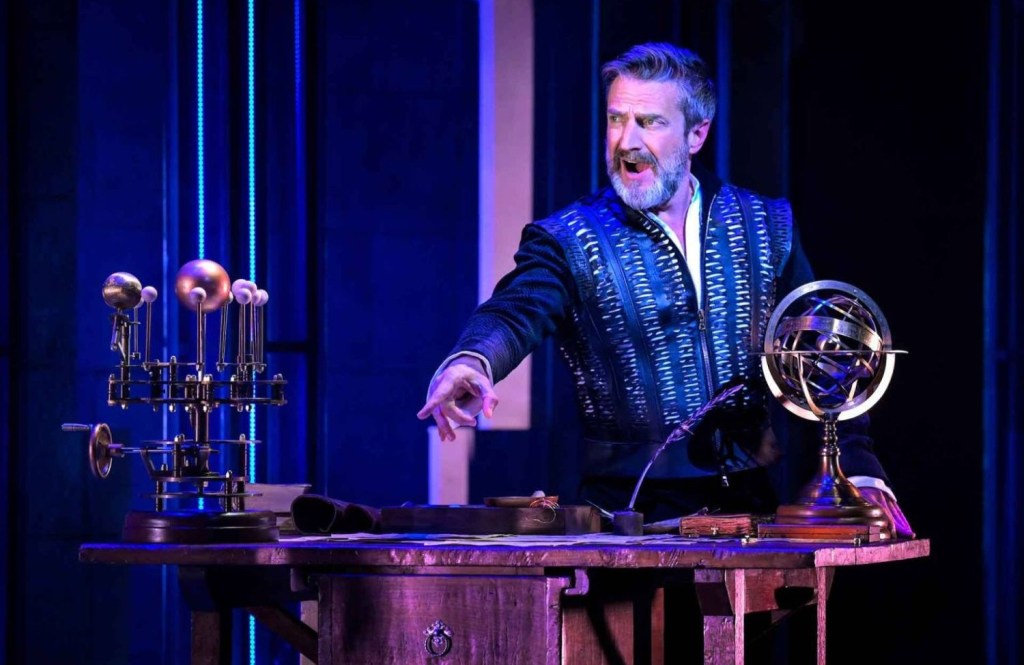
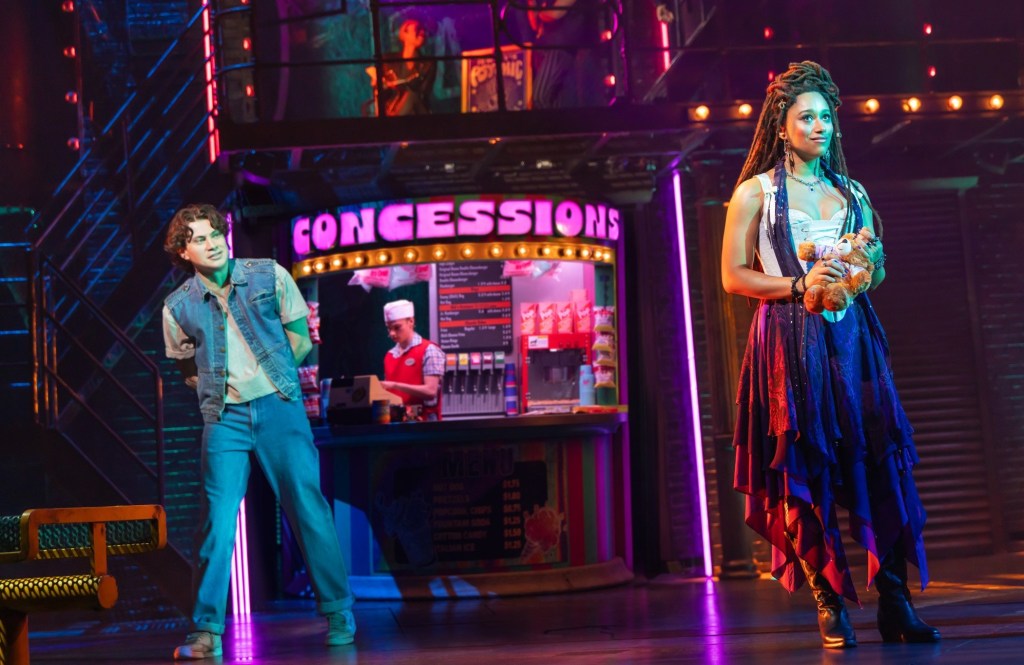
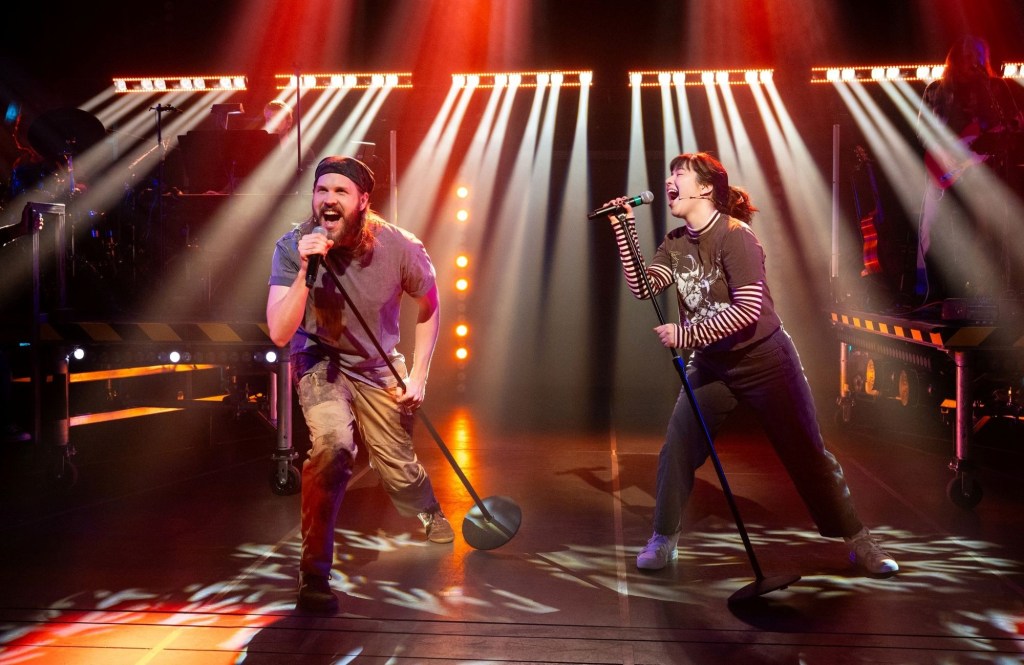
The Lost Boys, a new musical based on the 1987 film, opens on Broadway this evening at the Palace Theatre. It has a book by Chris Hoch and David Hornsby, lyrics and music by Kyler England, Adrianne “AG” Gonzalez, and Gabriel Mann, and direction by Michael Arden, and it is a relentlessly dull atrocity. My review will be published in next Sunday’s Report.
PRESS ANNOUNCEMENTS
Here is a list of select press announcements from the past week. Each headline is clickable for more information.
• Matthew Saldívar to Join The Great Gatsby on Broadway
• Drew Lachey Musical label•less Will Return Off-Broadway This Summer
• World Builders Musicals Initiative Will Partner with Regional Theatres, Universities, Production Companies
• Liza! at 80 Celebration to Feature Kristin Chenoweth, Donna Murphy, Beth Leavel and More
PREVIEWS AND OPENINGS
Here is a list of the new musicals and revivals either opening or beginning previews during the upcoming week, specifically on Broadway and Off-Broadway. It contains, as well, select new musicals beginning performances regionally, and select new musicals and revivals beginning performances in New York City. Each title is clickable for more information.
Monday, April 27
Tuesday, April 28
Wednesday, April 29
• Concert: Bat Out of Hell
Thursday, April 30
• Regional: Millennials Are Killing Musicals
• NYC: Carnival
Friday, May 1
Saturday, May 2
Sunday, May 3
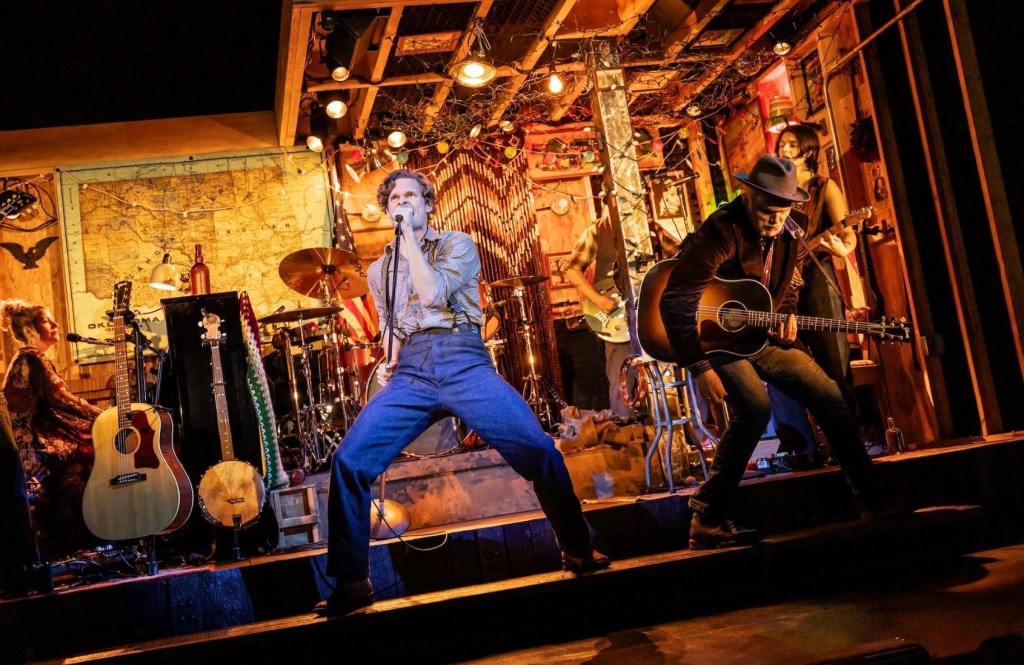
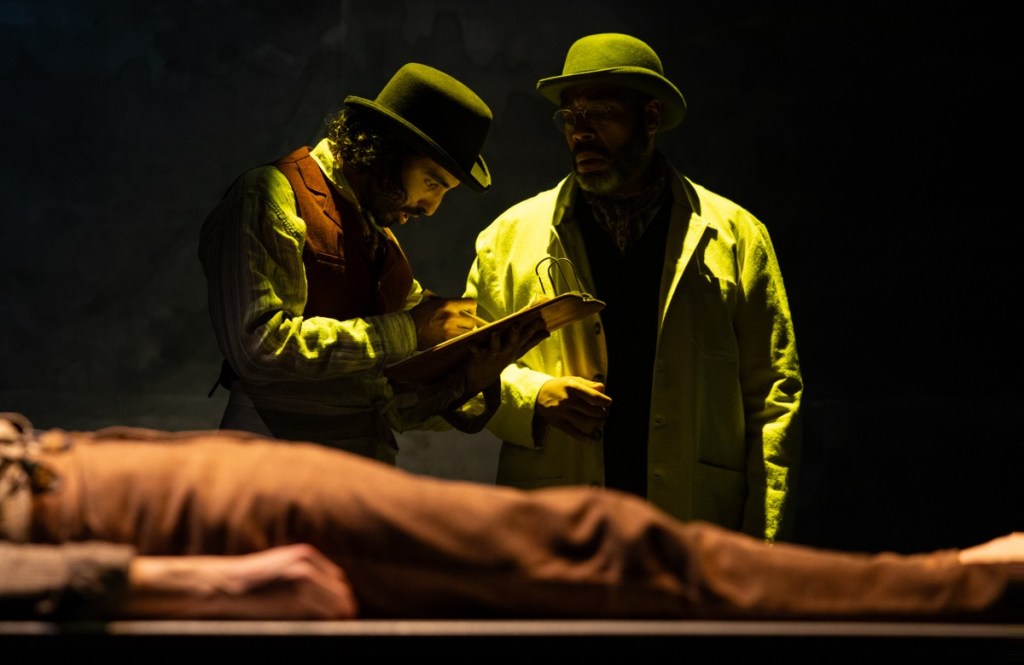
Photo of a scene from The Rocky Horror Show by Joan Marcus.









Leave a comment