A journal for industry and audiences covering the past, present, and future of the musical stage.

Surprise! Today is Sunday, and this is supposed to be a “Summer Break” edition of the Report. But I revisited Maybe Happy Ending last weekend, and I cannot remain silent. Thus, a reappraisal. Plus, a quote of the week, select press announcements from the past week, and the upcoming week’s previews and openings. The Report will return, in full, on September 6 with a brutal take on the fall season.
QUOTE OF THE WEEK
The lyric, by Will Aronson and Hue Park, for “A Sentimental Person,” from Maybe Happy Ending.
I’m not a sentimental person.
That’s what they always told me.
Don’t need someone to hold me;
I’d rather stand apart.
I’m not a sentimental person.
It’s not what I’m designed for,
Can’t say I’ve ever pined for
Someone to break my heart.
So, why does the moon seem brighter,
And my feet much lighter,
And the breeze electrifying?
Waves whisper as they flow by.
It’s as if they know I
Feel like crying.
Do they know? Do you know?
If I’m a sentimental person,
It’s all because you found me.
I change when you’re around me.
So, darling, could it be true
That you’re a sentimental person, too?
A REAPPRAISAL OF MAYBE HAPPY ENDING
Maybe Happy Ending is still running at the Belasco Theatre. It has a book and lyrics by Will Aronson and Hue Park, music by Aronson, and direction by Michael Arden, and, in my initial review, I noted that while it is earnest and well-meaning, it is not well done. Last weekend, I revisited the piece – for the first time since November 9, 2024 – and I remain appalled by the unbridled praise it has received in the interim, for Maybe Happy Ending is a patently middle-grade affair. It could have been tremendous. Here are my notes (from my third overall visit and unrelated to the current cast).
• The concept is inspired, the story is wonderfully potent, with a couple of caveats, and the ideas had by Aronson & Co. in the telling of the story are frequently fine and solidly, appealingly theatrical, from structural elements to characters, incidents to environment, devices to composition. But the execution, across the board, of the seemingly smart, seemingly fresh entertainment is lacking, to different degrees, detail and rigor and finish and skill. One can, for instance, occasionally feel the hand of external forces shifting the characters about, moving them through the story, putting them through their paces, and, in doing so, Aronson & Co. have, carelessly and or lazily, settled, in several instances, for convenience, having evidently no interest in honoring or adhering to the established parameters of the world they themselves created, or to any kind of internal, dramatic motivation. Aronson & Co. have, furthermore, failed to consistently build each moment into the next, toward the realization of a continuous momentum, a continuous dramatic charge, regularly forcing the musical, as a result of this failure, to restart itself amidst successive dips in the narrative. Where is the (quiet) sustained tension, where is the drama, where is the setup and support? Maybe Happy Ending is, to a large extent, processed and precious and posed. Untight and incomplete.
• The structure is adequate and the nature of the narrative design has the potential to be exhilarating, but the final third of the show gets increasingly unsteady, and Gil Brentley, a shrewd narrative device, has not been effectively or definitively woven into the proceedings. He is an afterthought. And this is to say nothing of the aforementioned treatment of each structural element and transition, perhaps better termed dramatic progression.
• Some internal moments in the scenework are beautifully done. Others are unassured. Some thoughts are neatly articulated. Others are immature. Rarely does the scenework snap, crackle, and pop in the way that it might. But the technical movement from dialogue to song is consistently strong, and so is the technical movement from song to dialogue, in such instances when a song ends with a direct segue.
• The lyrics, while happily literate, are a real problem almost throughout the show: roughly half are convoluted, unproductive, dramatically purposeless, while the other half tend to be loose and lightweight; and several, especially in the first category, are saturated with thematic or philosophical statements that the authors have failed to activate, to the detriment of story, situation, and character. (Some statements are nonetheless well turned.) The music, while pleasant enough and marked by a certain degree of elegance, is mostly indistinct, generally, though not always, declining to explode with character or to individualize the respective moment to any significant degree. But the tinkling sonic tapestry makes significant contributions to the musical’s acceptably individual narrative world.
• The union of lyric and music is merely serviceable; it is not a fervent, dynamic, thrillingly theatrical synchronicity. Even valuable devices and motifs, like a repeated phrase in ascending or descending modulation, generate, in Maybe Happy Ending, little or no impact, little or no payoff, perhaps because the authors seem to be unclear about – or unable to articulate – the purpose of the song and the details of the corresponding moment (most of) these devices and motifs are meant to be serving. Even, to an extent, in terms of character. These devices and motifs thus register as mechanical, procedural, stemming from a soggy foundation.
• How do Oliver and Claire so casually leave the Yards when Helperbots are strictly forbidden from doing so? And how do they so casually return? Aronson & Co. have produced, permitted, leveraged not a whiff of danger or concern, not the teeniest sense of lives at stake (to the serious disadvantage of the show, the characters, and the development of their relationship). And Oliver and Claire evidently have no fear that Junseo might report them.
• Why is Claire allowed to have a car if, again, Helperbots are forbidden from leaving the Yards?
• Why do Oliver and Claire suddenly feel the need to create a backstory after starting their journey? Why did they not, before starting their journey, create a backstory, or even have a passing thought about creating one?
• How does Claire know Oliver has been in the Yards for years, if Oliver never answers Claire’s question on the subject?
• Why does Oliver hide his large jar of coins behind a pillow on the couch, rather than putting the jar back into the hidden compartment from which he so easily retrieved it roughly 10 seconds earlier?
• Why does Claire suddenly suggest the pair return to the Yards?
• Why does Junseo suddenly show up at Oliver’s apartment?
• Why does Oliver suddenly, after twelve years, decide to collect money and go visit James?
• “World Within My Room” is stagnant, with no clear dramatic purpose. Why must Oliver sing this song, what compels him to sing this song, and what is he getting from singing this song? Plus, the lyrics and music do not account, either in structure, accompaniment, or text, for the apparent twelve-year timelapse that occurs during the song, as revealed to the audience through projections. In other words, the narrative elements are operating independently, in conflict with each other.
• “When You’re in Love” is stagnant, with no clear dramatic purpose, filled with impersonal lyrics, written partially in the third person. How does it carry Oliver – nay, propel Oliver – into his subsequent confession? Likewise Claire.
• “Never Fly Away” is stagnant, with no clear dramatic purpose. One can understand what the authors want to accomplish with this number, but what do the characters want to accomplish? What necessitates their singing it?
• “The Way That It Has to Be” is stagnant, with a confused, knotty lyric serving no clear dramatic purpose. Plus, the unnecessary projections of other retired robots dilutes the intimate connection we should be forming with Claire (if the lyrics were personal and focused and revealing). But the song is not entirely without interest, especially musically.
• “The Rainy Day We Met” is one of the most active, dramatic, alive, and sparky numbers in the show, accented with snappy, productively playful dialogue interjections, but the umbrella interlude contained therein, as part of the staging, is insubstantial and unessential.
• “Goodbye, My Room” and “Hitting the Road” are similarly alive and sparky, and the combination of the two should make for a delicious juxtaposition sequence, but the authors have inexpertly scripted the transitions, particularly the second transition, from the former into the second part of the latter. The sequence – and, in turn, the show – dies a minor, momentary death as a result.
• “Hitting the Road” and “The Rainy Day We Met” are situated back-to-back in the routine, and they have been given the exact same physical button.
• “Then I Can Let You Go” is a narrative jumble, though the reveal of Gil Brentley is, from a standpoint of staging, an inspired surprise.
• “Jenny” has an insubstantial, nondefinitive ending that severely dampens the potential impact of the number and undercuts the narrative presence of Gil Brentley. And the original mid-century jazz standard is strangely muted. (Some of the material in Maybe Happy Ending has a timidity or a mildness.)
• “A Sentimental Person” is a fabulous instance of dramatic layering, making great use of the Gil Brentley device, and the narrative precision and subtlety of the salty-sweet lyric is something to savor. So are the two-syllable rhymes, and the lyrical progression specifically toward “you” for the final stanza, and the salty-sweet melody, particularly on the title line. “A Sentimental Person” is perhaps the finest intermingling of lyric and music in the show. But the lyric has one bump in the overall progression; the moment, as a whole, is flawed; and the dramaturgical beats between “Never Fly Away” and “Then I Can Let You Go” are blurry.
• “How to Be Not Alone” and “What I Learned from People” are solidly dramatic, without being remarkable.
• Why is the orchestration absent a piano feature when Oliver and James play a piano duet in “Where You Belong?” And I continue to wonder if an opportunity has not been missed, in the material and staging of “Where You Belong,” to better establish the relationship between Oliver and James.
• The orchestrations, by the composer, are thin. But not in their entirety, and certain moments are savory – like the plucked strings in the fireflies sequence.
• Why does a projection introduce Claire after the material has already introduced her? Why does a projection introduce Junseo after the material has already introduced him? Why does a projection introduce James at all? One can understand and appreciate what Arden is intending to do, but what Arden is intending to do is not baked into or supported by the written material. Likewise “Ending.” (The disconnects between material and staging are frequent.)
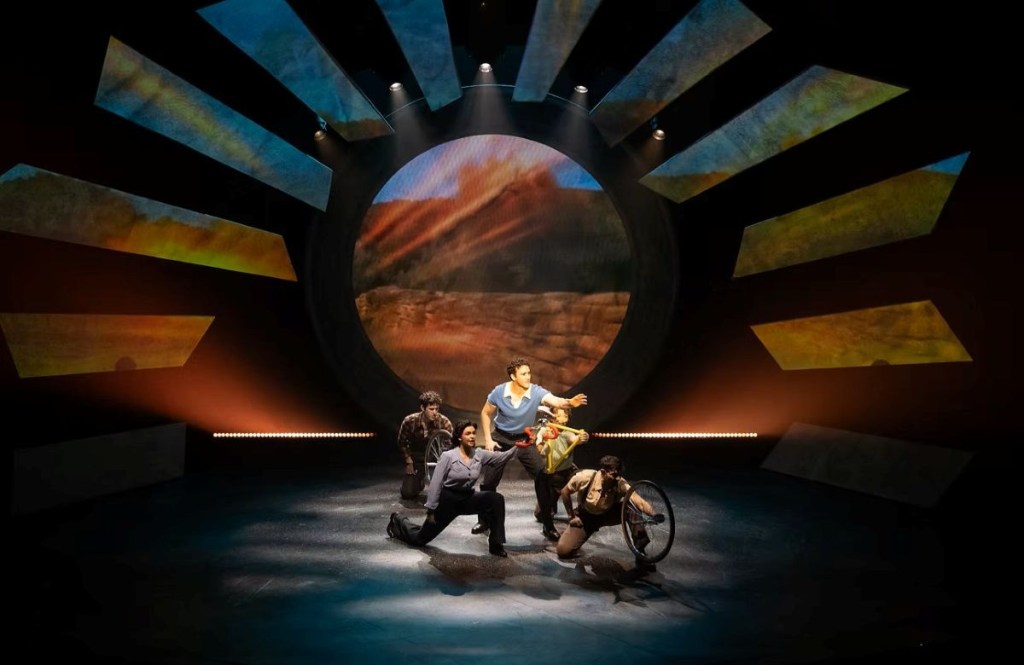
• The scenic design, by Dane Laffrey, is stunning, when taken independently, because the manner in which it is employed occasionally stifles the story. Plus, the scenic gestures, over the course of the show, grow repetitive, and the gestures do not really build or progress toward anything in particular.
• “Charger Exchange Ballet” is labored, clunky, inexpert, deadly.
• The button of “Memory Sequence” through the button of the show is labored, clunky, inexpert, deadly.
• The burlesque of human relationships is cheap and senseless, because Claire and Oliver have already been seen bickering, if only briefly.
• Why does Gil Brentley deliver a drink to Oliver during the drive? How is that cheap comic gesture in keeping with the world of the show?
• Why does Oliver, while in the midst of speaking, casually step through an established wall in his sharply defined cubicle, and onto the deck of the stage? And what motivates his cross?
• The video sequences are sensational, in the service of the story. (What a musical and production Maybe Happy Ending might have been!)
• The use of background vocals is nondefinitive.
• The authors have failed to give the fourth actor a definitive narrative presence, and the moment in which Junseo finds himself engulfed in his father’s memories is unaffecting, because it lacks dramatic foundation.
• The costume design, by Clint Ramos, is dynamite.
• The prop design, by JR Goodman and Ray Wetmore, is dynamite.
• The lighting design, by Ben Stanton, is strong, especially the units that are integrated into the scenic design.
• The sound design, by Peter Hylenski, is unacceptable: concert headgear!
• My husband, for the record, found the show to be long and inoffensive. He did not hate it. But he did not love it – apart from the set.
PRESS ANNOUNCEMENTS
Here is a list of select press announcements from the past week. Each headline is clickable for more information.
• Joaquina Kalukango, Heidi Blickenstaff, and More Cast in The Heart Off-Broadway
• Bradley Jaden to Make His Broadway Debut in Wanted
• Full Casting Revealed for Ms. Blakk for President Off-Broadway
• Anna Camp, Jasmine Cephas Jones and More to Star in 2:22 – A Ghost Story Off-Broadway
• Rarely Seen Cole Porter Musical Out of This World Will Get NYC Concert Via Red Bull Theater
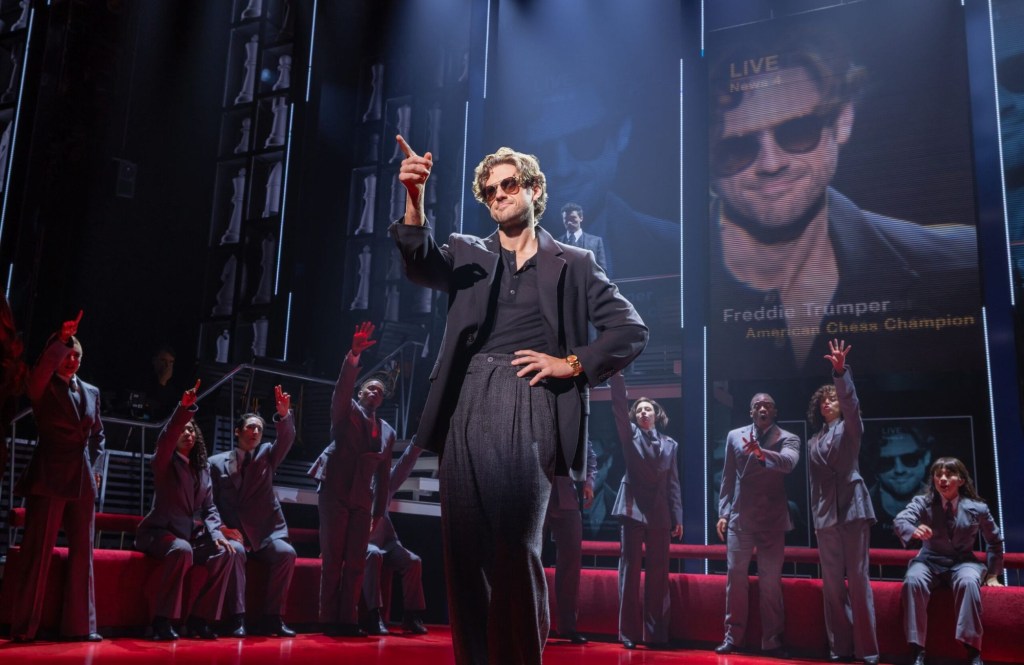
• Lena Dunham, Jessica Huang, Carly Rae Jepsen, Ethan Gruska Musical 10 Things I Hate About You to Open on Broadway in 2027
• Charity Angél Dawson and More to Star in Like Father at the Alliance Theatre
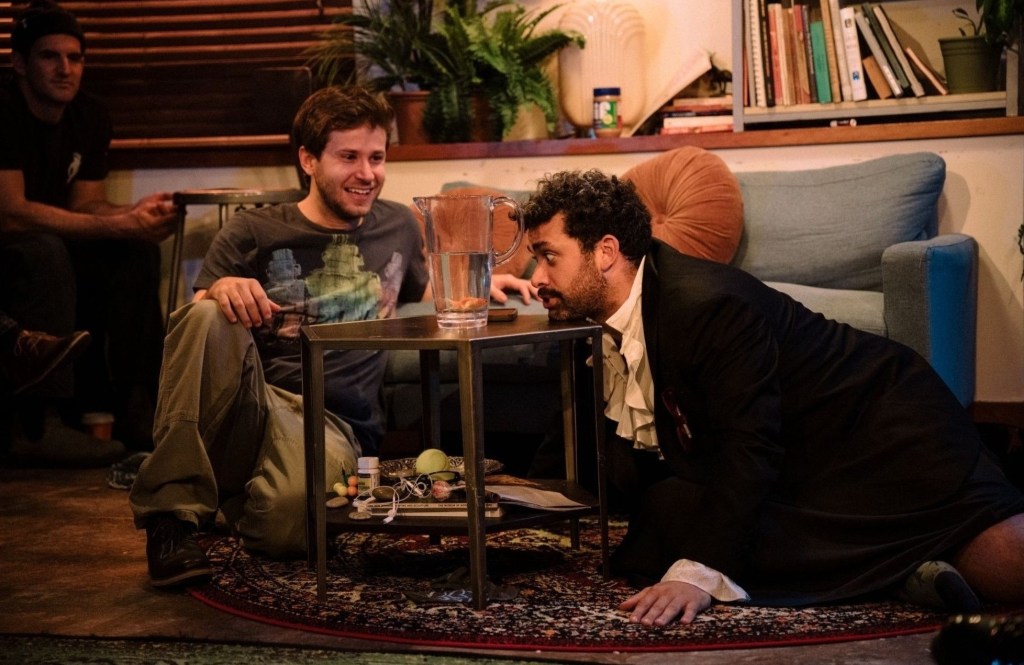
• Jenny Powers and More Join Sophia Anne Caruso in Memoirs of Amorous Gentlemen
• See Who’s Starring in A Beat of Our Own at McCarter Theatre Center
• Troy Iwata Will Join Cast of Heated Rivalry: The Unauthorized Musical Parody
• Judy Kuhn, Nicholas Barasch and More to Star in Rags Benefit Concert
• Ariana Madix Will Return to Broadway in Just in Time
• Full Cast Set for Copperfield The New Musical Off-Broadway
• Irish Musical Parcel From America Sets Off-Broadway Premiere
• for Colored Girls Musical Adaptation Sets Public Reading with Atlantic Theater Company
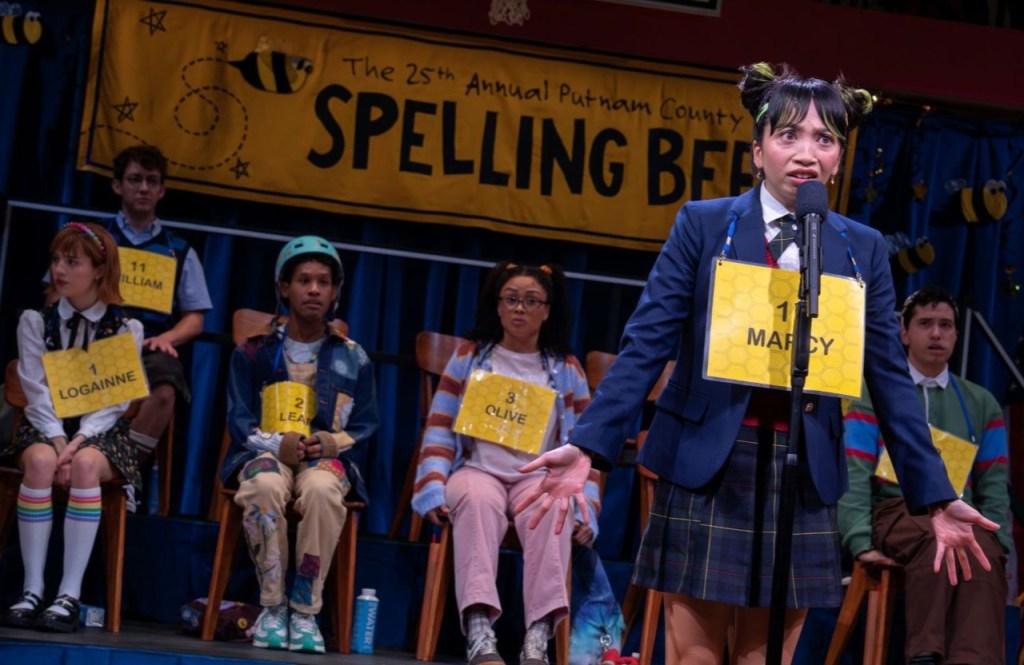
• Ali Stroker and Laurie Hernandez to Join The 25th Annual Putnam County Spelling Bee
• Our Sinatra to Return Off-Broadway for 25th Anniversary Engagement
• Beau: The Musical to Release Two Singles in August & Full Album This Fall
• This Ain’t No Disco Will Get Long-Awaited Cast Recording
PREVIEWS AND OPENINGS
Here is a list of the new musicals and revivals either opening or beginning previews during the upcoming week, specifically on Broadway and Off-Broadway. It contains, as well, select new musicals beginning performances regionally, and select new musicals and revivals beginning performances in New York City. Each title is clickable for more information.
Monday, August 24
Tuesday, August 25
Wednesday, August 26
Thursday, August 27
• NYC: Marina
Friday, August 28
• Regional: The Snow Goose
Saturday, August 29
Sunday, August 30
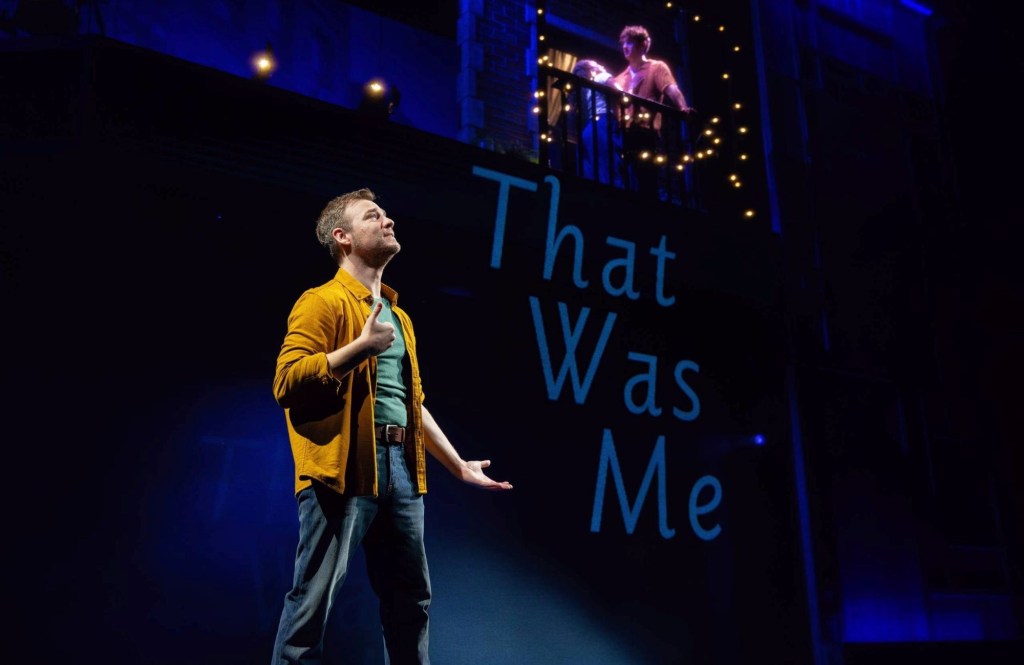
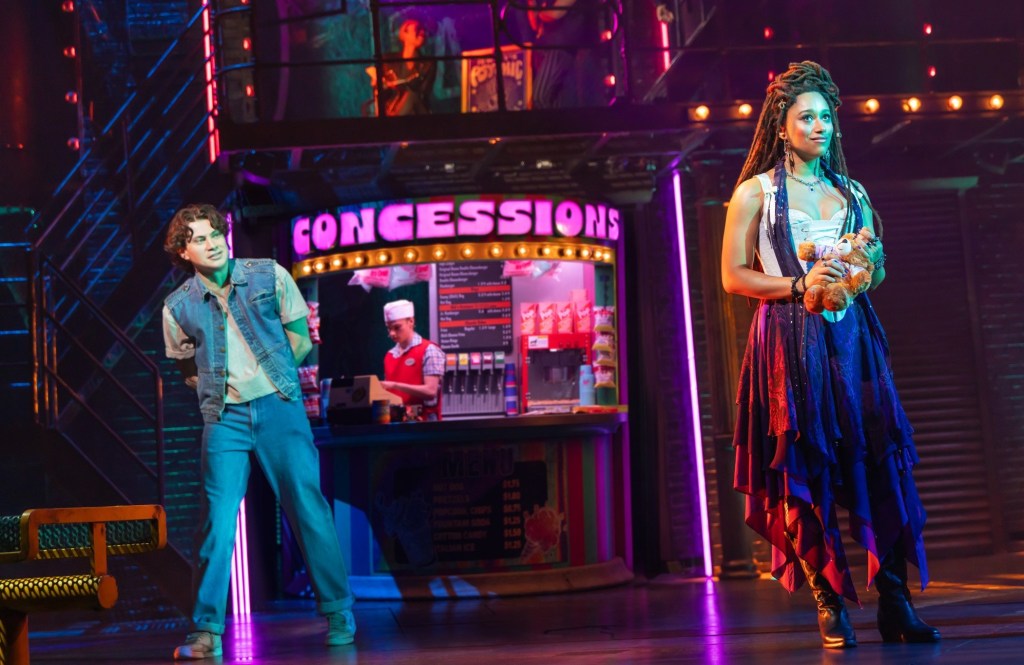
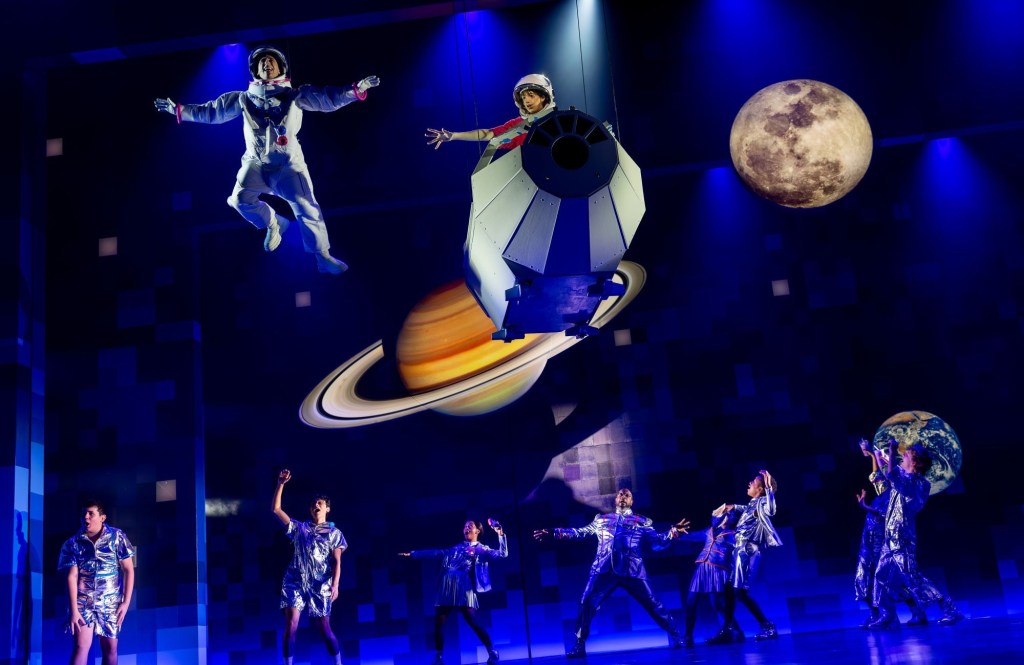
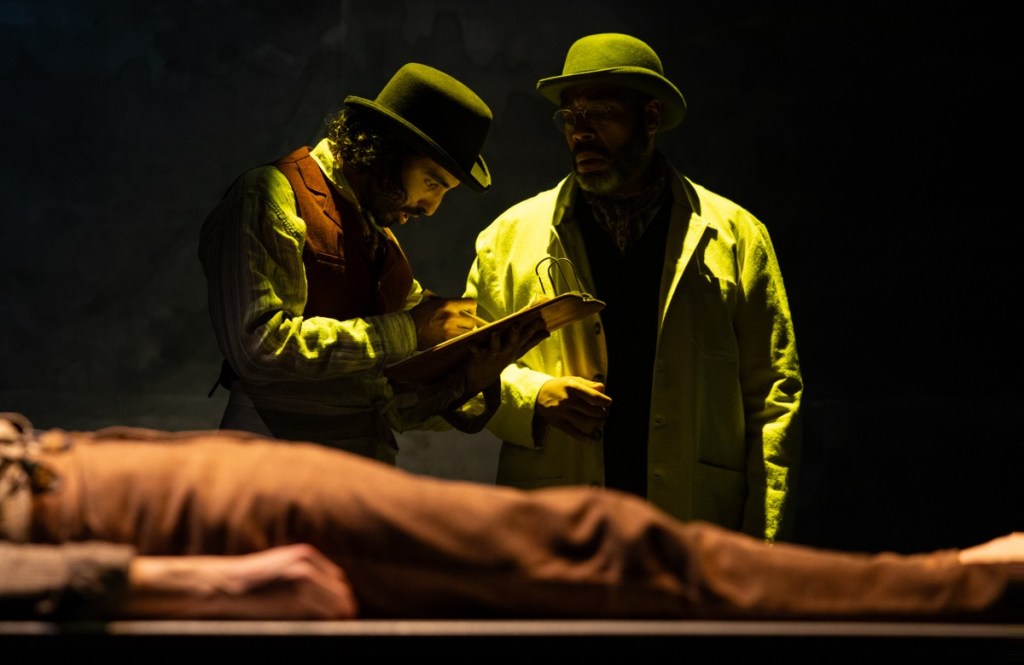
Photo of a scene from Maybe Happy Ending by Evan Zimmerman for MurphyMade.












Leave a comment